

Norwegian State Secretary for Defence at RUSI to Build on Lunna House Agreement

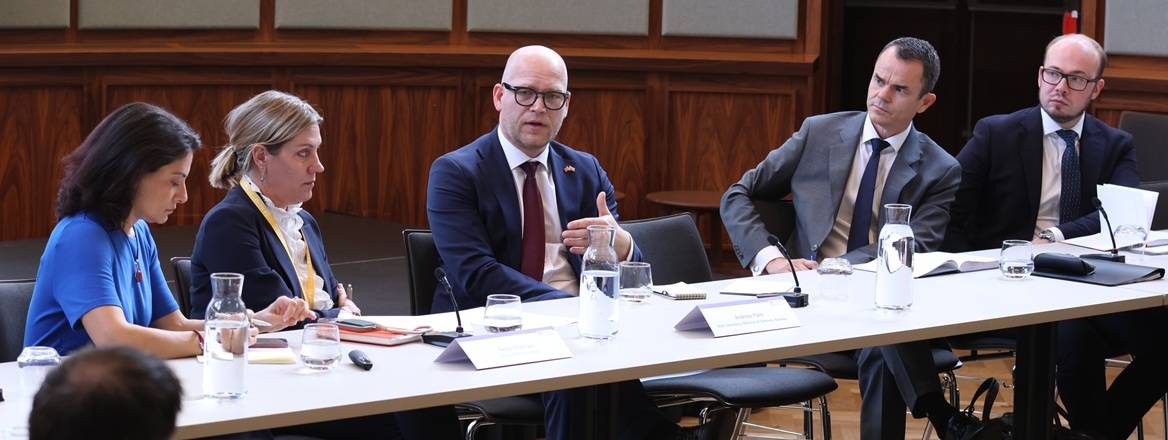
Ministers, officials, industry leaders and RUSI experts gathered to discuss how the UK–Norway defence partnership can deliver on challenges including NATO's northern flank, shared industrial capacity and countering hybrid threats.
The all-day event, titled 'Implementing the Lunna House Agreement', was hosted by RUSI with the Norwegian Center for Security and Resilience (UTSYN) and brought together government, military, industry and research leaders from both countries, including participation from the Norwegian Institute for Defence Studies.
Signed in December 2025, the Lunna House Agreement commits the UK and Norway to deeper defence cooperation, including; a joint fleet of Type 26 anti-submarine frigates, shared maintenance and support, and deeper cooperation on uncrewed systems, munitions and training. The roundtable examined how these commitments can be sustained and made operational.
Opening the first panel, chaired by RUSI Director-General Rachel Ellehuus, Norwegian State Secretary for Defence Andreas Flåm discussed what the agreement adds to NATO, the Joint Expeditionary Force (JEF) and UK-Norwegian cooperation.
He said:
[The Lunna House Agreement] is not just a procurement programme. The ambition is to make our forces interchangeable through common training, maintenance, equipment, personal exchanges and operational procedures. We are already seeing what this can mean in practice, between our two nations.
Andreas Flåm
Norwegian State Secretary for Defence
Welcoming the Minister and reflecting on the challenges, Rachel Ellehuus added:
A year on from the signing of the Lunna House Agreement, it was a pleasure to host a full day of discussions on UK-Norwegian defence and security cooperation.

Rachel Ellehuus
RUSI Director-General
She continued: "For me, there are five ways this partnership is vital. It drives stronger Arctic capabilities within NATO, without needing negotiations between 32 partners. It builds European capabilities. It helps allies respond quickly to challenges such as sabotage. It demonstrates how high trust and interoperability can enable operational integration. And, it provides a model for other European nations also interested in so-called 'minilateral' cooperation."
This event builds on a wide body of RUSI research on European security. This includes:
- A 2026 issue of the RUSI Journal devoted to the region (Vol. 171, Issue 2)
- A long read from May 2026, The UK and the Future of Arctic and High North Security, which examined NATO's changing position in the North and a July 2026 Research Paper, The Royal Marines in the High North, that looked at forward defence around the Bear Island–Norway gap.
- We also published shorter pieces which have covered Jan Mayen and cooperation among the Arctic NATO allies.
RUSI's work on UK–Norway ties includes commentary on Norway's purchase of Type 26 frigates and an Occasional Paper on the Joint Expeditionary Force's contribution to European security
On industry, Winning the Industrial War: Comparing Russia, Europe and Ukraine, 2022–24 (2025) examined how Europe organises defence production, alongside commentary on the EU's SAFE instrument and on incentives for European defence industry cooperation
Focusing on hybrid threats, RUSI has looked in detail at suspected Russian incidents across Europe. Recent work covers the threat to European energy, sabotage of civilian infrastructure and logistics that NATO relies on for reinforcement, as well as the financing of sabotage operations.
In September, the Institute published a 'Beyond ‘Cyber’ in Deterrence' framework, demonstrating how NATO, EU member states and partners can more effectively counter hybrid threats by integrating cyber and non-cyber tools in a coordinated, whole-of-government approach.
- Jim McLeanMedia Relations Manager+44 (0)7917 373 069JimMc@rusi.org