

Evaluating Russian Support for North Korea’s Nuclear Weapons

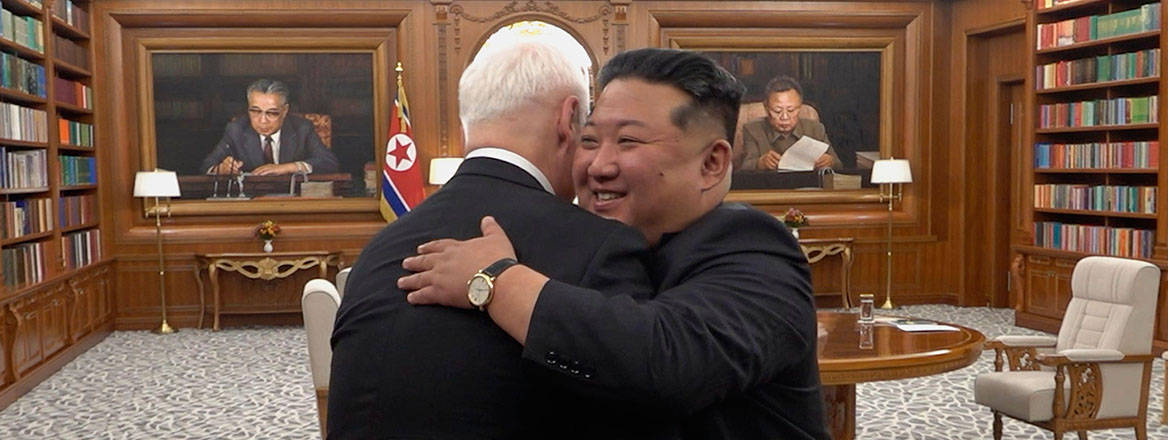
Russia’s partnership with North Korea could advance Pyongyang’s nuclear weapons programme through technical aid and proliferation financing, particularly in the absence of global controls.
Overview
Russia’s deepening defence partnership with North Korea is reshaping the global security landscape, with potentially significant implications for nuclear non-proliferation efforts. This paper analyses how Russian technical and financial support might be advancing North Korea’s nuclear weapons programme and how the international community might seek to respond.
Key findings highlight how Russia’s assistance (ranging from missile technology and satellite capabilities to proliferation financing) could enable North Korea to further develop its nuclear arsenal and circumvent international sanctions and monitoring efforts. The dissolution of the UN Security Council’s Panel of Experts has further complicated the international community’s ability to disrupt this collaboration, demanding innovative responses from partners across international agencies, governments, and the public and private sectors alike.
Key Recommendations
- Continue monitoring and reporting of Russia–North Korea exchanges, especially concerning dual-use goods and services, to maintain international pressure and awareness.
- Extend and enforce sanctions and export controls targeting Russian goods and financial channels that could support North Korea’s nuclear ambitions.
- Encourage the private sector to strengthen due diligence and compliance, recognising Russia’s central role in North Korean proliferation.
- Leverage diplomatic channels with China to highlight the regional risks of a stronger North Korean nuclear arsenal and encourage restraint.
- Support non-governmental organisations and industry-led initiatives to sustain research, funding and advocacy against North Korean nuclear proliferation.
This paper ultimately contributes to a greater understanding of the evolving Russia–North Korea nexus of nuclear proliferation.
Register or log in to continue reading
Account creation is quick, free and gives access to all RUSI research and more
- FREE account
- One-time set-up
- Easy to manage
Introduction
North Korean nuclear ambitions have long benefited from Russian support, particularly through transfers of technology and knowledge. Since the 1960s, such transfers have aided fissile material production and delivery systems. Six decades later, in 2025, the Nuclear Information Project estimated that North Korea’s nuclear stockpile potentially included about 50 missiles, with enough fissile material for up to 90 missiles.
In June 2024, the North Korea–Russia Treaty on Comprehensive Strategic Partnership further solidified the two countries’ defence cooperation., which renewed when North Korea first started supplying Russia with ammunition in October 2023 to sustain the invasion of Ukraine. Beyond the Treaty’s mutual defence clause, it features other indications of closer and more integrated cooperation. These include the pursuit of ‘joint measures with the aim of strengthening the defence capabilities’ and 'cooperation in the fields of science and technology ... and proactively facilitat[ing] joint research’. The announcement in late April 2026 of a forthcoming additional military cooperation agreement through 2031 signals that Russia and North Korea seem willing to further institutionalise their security partnership.
North Korea sees its nuclear arsenal as critical for its survival. It is therefore unsurprising that, on 30 October 2024, then South Korean Minister of National Defense Kim Yong Hyun offered a more specific assessment of just how far collaboration between Moscow and Pyongyang might reach: ‘North Korea is very likely to ask for technology transfers in diverse areas, including the technologies relating to tactical nuclear weapons technologies related to their advancement of ICBM [intercontinental ballistic missiles], also those regarding reconnaissance satellite and those regarding SSBNs [submarine-launched ballistic missiles] as well’. This covers – in an expanded form – the topics for discussion identified by the US and its allies one year prior, before the signing of the Comprehensive Strategic Partnership Treaty.
There are evident proliferation concerns that stem from the Russia–North Korea security partnership given the two countries’ historical ties and current drivers for collaboration on nuclear issues. North Korea would clearly gain from Russian support for its defence industry and nuclear programme, and Russia has historically demonstrated its willingness to offer such support (even as it continued its engagement with the UN Security Council 1718 Panel of Experts – that targeted the prevention of North Korea’s nuclearisation – until Moscow voted to dissolve the Panel). However, even if the two countries choose not to pursue technical cooperation, Russia’s growing involvement in illicit North Korean proliferation financing tactics will still indirectly advance Pyongyang’s nuclear ambitions. As the security partnership continues to deepen, it is worth asking whether there are limits to Russia’s willingness to support the North Korean cause – and if anything can be done to stop Moscow.
This paper first analyses why Russia and North Korea might be interested in jointly advancing the capabilities of the latter’s nuclear weapons programme, as well as what might curb those interests. It then examines the likeliest avenues for collaboration. It does so by considering two strands: technical assistance, and proliferation financing. Finally, the paper explores the potential to tackle North Korea’s continued nuclearisation through established methods and multilateral forums, such as the now-dissolved UN Panel of Experts, in today’s international security environment.
Geopolitical and economic considerations, among other factors, are poised to favour Russia’s continued technical and financial support for various components of North Korea’s nuclear weapons programme. Without the Panel of Experts, international partners will need creative solutions – and moderated expectations – for disrupting this collaboration.
Acknowledgements
The Korea Foundation kindly supported the research presented in this paper. The authors thank the paper’s peer reviewers, the expert roundtable participants who further informed the paper’s analysis (including Olaf Andrieu, Aaron Arnold, Jonathan Brewer, Treston Chandler, Grant Christopher, Joseph Dempsey, Eliana Johns, Jamie Kwong, Alastair Morgan, Philip Shetler-Jones, Juliana Suess and Joshua Tjeransen, among others), the survey respondents, and Daniel Salisbury and Ramon Pacheco Pardo, as the project’s advisers. The authors are also grateful to Côme Allard de Grandmaison and Tadaweb, who provided open source analysis for this paper. This project would not have been possible without additional support from Chandana Seshadri, Rosalind Roberts, Mar Casas Cachinero, and RUSI’s Editorial and Publications teams.
Why Cooperate, and Why Stop?
Russia has a long history of support for North Korea’s nuclear programme. From 1961 to 1965, the Soviet Union aided the construction of North Korea’s IRT-2000 nuclear reactor in Yongbyon and supplied fuel rods for the reactor until 1973. Since the end of the Cold War, assistance from Russia has flowed more readily through illicit channels, rather than Russian state-sanctioned means. In the immediate aftermath of the Soviet Union’s collapse, North Korea frequently attempted to recruit – with moderate success – former Soviet nuclear scientists to develop its nuclear weapons programme.
More recently, in 2016, the US Treasury sanctioned a Russian businessman for having sold goods since 2011 to a North Korean company that was aiding the country’s nuclear weapons programme. Between 2016 and 2020, an official within North Korea’s embassy in Moscow named O Yong Ho facilitated the export of dual-use technologies for North Korea’s ballistic missile programme and received handwritten information from a scientist in Russia. This information included instructions for the production of solid rocket fuel and a CAD (computer-aided design) drawing of a Soviet nuclear-capable cruise missile (the latter also from a different, and allegedly deceased, Russian scientist). The official also sought manufacturing tools for re-entry vehicles and rocket motors.
These examples are indicative of a steady flow of assistance, although they only illustrate intentional exchanges with Russian experts and companies. A 2023 Microsoft report on North Korea’s hacking of different national defence industries further revealed that 14% of the recorded attacks were against entities in Russia – making it the country most frequently targeted by North Korea. This raises the question of why renewed formal collaboration is now especially enticing, and how it might be constrained.
To better understand why Russia and North Korea cooperate, this section examines the state-level drivers of cooperation within both countries, wider geopolitical considerations that further incentivise collaboration, and the constraints that limit the partnership.
State-Level Drivers of Cooperation
The transactional nature of the Russia–North Korea relationship is pivotal to understanding how and why they might cooperate on developing the latter’s nuclear weapons programme.
Russian President Vladimir Putin’s primary foreign policy goal in recent years has been distilled into the single, existential goal of victory in Russia’s war of aggression against Ukraine and its partners. Moscow is subsequently likely to prioritise short-term military advantages on the battlefield over any reputational costs of closer affiliation with North Korea, which might further explain the rationale for the announced 2027–2031 military cooperation agreement, and could signal Russia’s willingness to partner with North Korea even after the timeline it might envision for the conclusion of the Russo-Ukrainian War. This basis for Russia’s embrace of North Korean military support suggests why Russia might subsequently want to offer nuclear assistance in return.
North Korea’s provision of hundreds of ballistic missiles and launch systems, 16,000 soldiers and 15 million artillery shells to Russia has certainly contributed to alleviating some of the need for battlefield support. North Korean supplies reportedly accounted for 50% of Russian artillery shells in 2025. Considering the Russo-Ukrainian War and given the longstanding rift between North Korea and the US and its allies, Russia may also want to leverage the partnership as a deliberate geopolitical statement. Doing so signals defiance against a global balance of power that favours the US and its partners. It draws on alternative partnerships with shared interests, ranging from unity against the West to strategies for sanctions evasion.
The conclusion of the Russo-Ukrainian War, and the terms on which it is resolved, might introduce different considerations for Russia’s continued interest in sustaining the partnership. For example, if Moscow feels the need to bolster its ammunition and missile stockpiles but is unable to do so solely through domestic production, Pyongyang could remain an appealing business partner for arms and materiel. If there is no need for external sources of arms and related materiel, however, and Russia seeks rapprochement with Western countries and their allies, it would be easy for Moscow to once again take a more aggressive counterproliferation stance against North Korea.
From North Korea’s perspective, a security partnership with a great power that has the world’s largest nuclear arsenal offers clear benefits for a pariah state whose existence is internally credited to the continuity of its own nuclear programme. Already, its export of old ammunition stockpiles to Russia has probably allowed it to rebuild stockpiles with newer, more modernised (and potentially nuclear-capable) missiles. In terms of recent nuclear ambitions, Kim Jong Un made them clear in the 2021 Five-Year Plan during the Eighth Congress of the Workers' Party of Korea. Initial assessments of Kim’s nuclear-related remarks from the 2026 Ninth Congress proceedings also indicate similar ambitions for the next five years, as shown below, even though this Congress’s proceedings have been more ambiguous than previous iterations.
Table 1: Comparing Nuclear Priorities in North Korea’s 2021 and 2026 Five-Year Plans
WRITTEN BY
Jack Crawford
Former Research Fellow


Gonzalo Saiz Erausquin
Research Fellow
Centre for Finance and Security

Wojciech Pawlus
Head of Countering Proliferation Financing Programme
Centre for Finance and Security

- Jim McLeanMedia Relations Manager+44 (0)7917 373 069JimMc@rusi.org