

Four Alternative End States in Iran – the Only Good One Becomes Unlikely

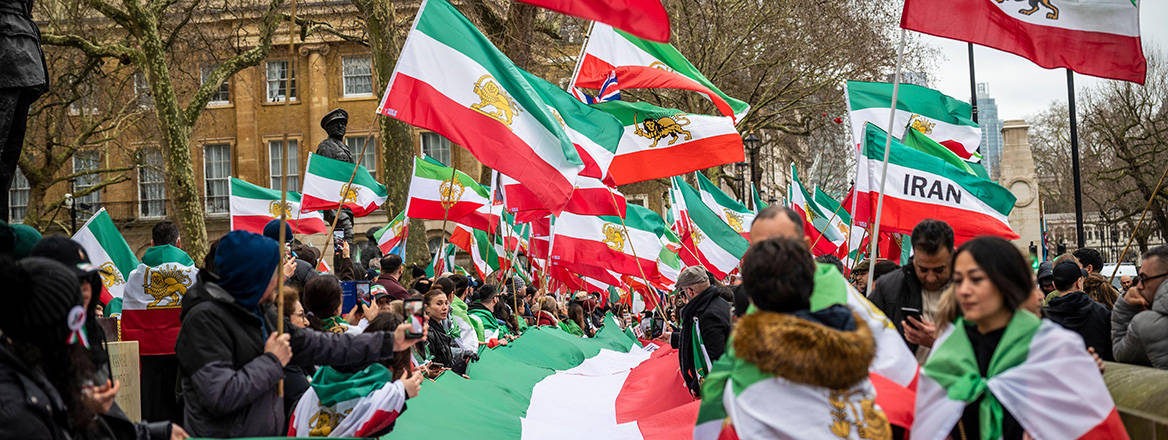
US-Israeli strikes suggest preferred political end-states. Each make assumptions of resilience, anti-regime sentiment and air power effects. Do these assumptions still hold?
Operations ‘Epic Fury’ and ‘Roaring Lion’ seek regime change in the Iranian Islamic Republic, understood as an end to Iran’s missile (launcher and production site) and nuclear programmes. Success would be International Atomic Energy Agency (IAEA) inspections of Tehran’s nuclear sites and a surrender of its stockpile of weapons-grade fissile material to the US. Iran would pose no imminent threat to Israel or to US in the longer term. Two other unstated but reasonable-to-expect outcomes would follow. First, the US consolidates its position as the primary security provider and stabilizer in the region. Second, the Iranian energy sector – as with Venezuela following Maduro’s ousting – opens to US investment and influence over strategic sales to preferred partners, and control of global supply and the Strait of Hormuz.
From the moment daylight strikes began on 28 February, at least four Iranian alternative end-state scenarios appeared possible, each resting on assumptions that can be made explicit.
#1 ‘Trump Gets Lucky: 1979 in Reverse’
Targeted airstrikes achieve leadership ‘decapitation’ on day 1 of ‘major combat operations’. This unifies society in popular rebellion against a hollow kleptocratic theocratic regime. Such precise kinetic destruction and dislocation break the will and ability of the Islamic Revolutionary Guards Corps (IRGC) to resist, and the regular army remains non-aligned (as it did in 1979).
Iran has a highly professional administration, an educated, urbanized and organized society and is rich in both energy (globally it holds the second largest gas and third-largest oil reserves) and agricultural natural resources. This potential can be unleashed to build a new Iran.
This scenario has withered on the vine, though may lay the foundation for future successful uprising and transformation.
#2 ‘Islamic Republic Consolidates Around an IRGC-Centric Military Dictatorship’
This managed but more militarised and opaque continuity pathway best captures regime evolution.
Prior assumptions around Iran’s lack of political and military resilience, the ability of society to protest under external bombardment and of airpower triggering collapse have, so far, proved misplaced. The regime is not personalised but deeply embedded in a network of interlocking institutions – religious, military, political and economic – with power distributed across the armed forces, the clerical establishment and security agencies. The IRGC’s Mosaic Defence Doctrine has proved durable: IRGC units function like a ‘mission-command-mosaic’ made of many small pieces: if some pieces are destroyed, the rest keep fighting independently. Survival and endurance can defeat stronger powers and maritime insurgency disruption is more powerful than destruction.
However, ‘boots on the ground’ seizures could also end up echoing the sieges of Dien Bien Phu (1954) and Khe San (1968), the only difference being Western troops isolated by water not jungle
However, even in this ‘worst case’ scenario, US bottom-line assumptions may still be:
- ‘Anyone is better than Khamanei’ (not expecting hereditary succession).
- Iran’s missile and nuclear programmes will be non-functional, for now.
- Although the Iranian energy sector would not be externally managed, the Strait would be US controlled.
- And, a weaker Islamic Republic regime, even if radicalized further, will have to accept US terms.
In other words, diplomacy and deterrence can manage the Iranian nuclear proliferation threat in future, with periodic Israeli ‘mow the lawn’ strikes as a backstop. The IRGC does not need a functioning navy to disrupt transit, and it can use low-cost sea mines and drones to force the US ‘to choose between Israel’s security interests and the stability of global markets.’ Iran can exercise in-kind regional escalation, maintaining escalation control, should its civilian infrastructure be targeted, while preserving a deterrent effect.
#3 Pragmatic ‘Reformist’ Centrists Undertake a ‘Negotiated Transition’ – Venezuela Scenario
This scenario looks to recognize a Delcy Rodriguez Iranian equivalent as a ‘good enough’ US off-ramp, considering continued economic pressure, with military degradation forcing Iran to promote ‘moderates’ over ‘hard-liners’ to ensure regime survival.
A senior insider to the regime would halt the missile and nuclear programme, allow US investment in Iran’s energy sector (de facto control), and moderate internal repression (though in practice ‘hard-liners’ and ‘moderates’ prove equally repressive). Institutional continuity keeps the state functioning.
The assumptions here:
- If the Islamic Republic proved more resilient than supposed, its hardline leadership would nonetheless be delegitimized.
- There would not be a ‘rally around the hardliner flag’ effect.
- Iran's powerful elite can reach consensus on a more moderate and reformist direction: pragmatists such as Hassan Khomenei, Hassan Rouhani, Mohammad Javid Zarif or even the late Ali Ardeshir Larijani, would take leadership positions, would be more open to negotiation and over time the system gradually reform.

However, the election of Mojtaba Khamenei on 8 March to Supreme Leader showed consolidation became the only viable option for regime survival. The lack of an immediate popular uprising suggests the majority favoured flawed current order over future possible chaos. Mojtaba has the support of hard-line Principalists, IRGC commanders, Basij leaders, and top security officials. IRGC unparalleled access to the Assembly of Experts, who were reliant on the IRGC for personal protection, proved decisive. The Trump administration would preference the ‘Venezuela’ option over ‘IRGC military dictatorship’. The targeted killing of Larijani on 17 March may suggest Israel’s determination to take ‘Venezuela’ off the table. In Israel, ‘question marks are growing’ over continued US support and possible ‘gaps in interests’ between Israel and the US.
#4 Chaos and Civil War – the Libya, Syria, Post-Iraq 2003 Scenario
This ‘worst case’ pathway, now more clearly a default scenario, and a product of failed alternative end-states, externally supported internally destabilizing ethno-nationalists’ agendas and regional escalation.
The IRGC’s Mosaic Defence Doctrine trades survivability for control, and provincial commanders following general protocols (fight asymmetrically, on multiple fronts, imposes costs on the adversary) through disruption keep Hormuz closed, and threaten the Red Sea (through ‘Axis of Resistance’ Houthi and Muslim Brotherhood proxies in Yemen and Sudan respectively).
The assumption here is time has an equalizing factor:
- Regime actors cannot maintain order, anti-regime elements cannot seize power nationally.
- External actors are unable to stabilize growing dysfunctionality from the air, even with close air support.
The US off-ramp narrative would note:
- The Iranian people failed to overthrow their regime, though the US created enabling conditions.
- A divided Iran cannot advance a missile or nuclear programme.
- The US is energy independent.
- Trump ‘declares victory and leaves‘ (and pivots to Cuba).
However, the US could not then prevent Iran from continuing to target US assets in the Gulf and controlling the Strait, exacerbating critical commodities’ price spikes, and possibly global recession.
Assessment
So far, US-Israeli joint military force has experienced a tactical and operational catastrophic success but that translates into desired end-state strategic failure. That is, the IRGC military dictatorship scenario is the ascendant. The US ‘cannot force surrender on a government that refuses it‘. A consolidated IRGC has every incentive to increase military-intelligence-reconnaissance links with Russia and China. And Russia and China each need the war to be prolonged, to see US munitions and attention expended and its strategic credibility shredded.

A US military seizure of Kharg Island (Iran’s main oil export terminal) might be assumed to provide a golden off-ramp if it triggers popular anti-regime protests leading to ‘1979 in reverse’ or ‘Venezuela’ scenarios. However, ‘boots on the ground’ seizures could also end up echoing the sieges of Dien Bien Phu (1954) and Khe San (1968), the only difference being Western troops isolated by water not jungle. Iran can shut down pipelines supplying oil terminals to make seizure irrelevant before troops arrive and then target them with drones and missiles. If the objective is to destroy Iran’s oil export capability – a Parthian-blow type off ramp – this can be achieved by air strikes alone.
Rather than ‘1979’ or ‘Venezuela’, such a seizure further risks consolidating the IRGC and it also increases rather than mitigates the gravitational pull of a ‘chaos and civil war’ scenario, placing global pressure on the US to end the conflict on Iranian terms to restore economic stability. The second and third order effects of a supply chain disruption at choke points, causing delays that ripple through the global economy. Cascading collateral shortages and rising prices hit poorest countries hardest, with 100 million at risk of food insecurity, humanitarian catastrophe and political instability.
What of US bilateral security links in the Gulf? Do exclusive US-Gulf Arab security-umbrella-bases make US-allies and partners into targets, more-so than they provide security when Iran ‘retaliates’? Will Gulf states diversify, with Saudi Arabia falling under a Pakistani nuclear umbrella, alongside talk of a ‘Muslim NATO’ being created?
The implications for European security are also profound. President Trump’s Truth Social media posts set European NATO up as the ‘fall guy’ when the ‘who is to blame’ debate begins. Out-of-area crisis-response and collective security operations are in fact precisely what European NATO members were explicitly told by the Trump administration fall outside the parameters of ‘NATO 3.0‘.
© Graeme Herd, 2026, published by RUSI with permission of the author.
The views expressed in this Commentary are the author's, and do not represent those of RUSI or any other institution.
For terms of use, see Website Terms and Conditions of Use.
Have an idea for a Commentary you'd like to write for us? Send a short pitch to commentaries@rusi.org and we'll get back to you if it fits into our research interests. View full guidelines for contributors.
WRITTEN BY
Dr Graeme Herd
Guest Contributor


- Jim McLeanMedia Relations Manager+44 (0)7917 373 069JimMc@rusi.org