

The DPRK’s Chemical Facilities: Sunchon Area: Site Profile 7
This report on Sunchon chemical facilities, co-published by RUSI, VERTIC and 38 North, is the seventh Project Anthracite site profile exploring different chemical production facilities throughout North Korea.
Executive Summary
The Sunchon area has historically been associated with a dual-use capacity to contribute to such a programme, but it has seen significant reconstruction over the past decade, including of the Sunchon Phosphatic Fertiliser Plant and the Sunchon C1 Chemical Facility. Both sites replaced portions of the old Sunchon Vinalon Complex, a site which from review of open sources seems to have produced many of the same materials using similar processes to those at the 8th February Vinalon Complex.
In addition, this report analyses the Sunchon Pharmaceutical Factory and the Sunchon Chemical Complex. The features and areas of the Sunchon Phosphatic Fertiliser Plant are consistent with the large-scale production of phosphatic fertilisers using both a wet and dry process. This yields lower purity phosphorus, of use primarily for agricultural fertiliser, and higher purity white phosphorus, of use for consumables but also of dual-use relevance for organophosphorus chemistry in relation to nerve agent production.
The features and areas of the Sunchon C1 Chemical Facility are consistent with the use of coal gasification to generate a wide range of hydrocarbons, including large quantities of methanol for conversion to gasoline. Yet, large areas of the site remain under construction as of February 2026.
The Sunchon Chemical Complex, as referred to in North Korean sources, appears to encompass both the Songyong Paints Factory and a Nutrient Solution Factory. The two facilities are located on different sites. The Nutrient Solution Factory is co-located with the Sunchon Pharmaceutical Plant, and its processes appear consistent with the possible provision of growth medium for antibiotic production at the Pharmaceutical Plant. The Songyong Paints Factory has features inconsistent with its reported purpose, including a higher level of security than the other chemical sites analysed in this report, and a probable helipad. It is reported to produce acrylic acid via oxidation of propylene, but a small change to this process could yield significant amounts of hydrogen cyanide (HCN).
No evidence of production related to chemical warfare agents was identified. Yet, the Sunchon area remains relevant for dual-use chemistry, including large-scale synthesis of discrete organic chemicals (DOCs) and phosphorous chemistry, despite the transition from the former Vinalon Complex to the current industry. The materials available from the Sunchon area could be of relevance to the production of nerve agents, given the close proximity of facilities producing phosphorus and DOCs, although chlorine was not identified as a product of any of the sites analysed. Additionally, the presence of methanol and ammonia at the C1 Plant and Sunchon Phosphatic Fertiliser Complex, respectively, could support the production of HCN and nitrogen mustards.
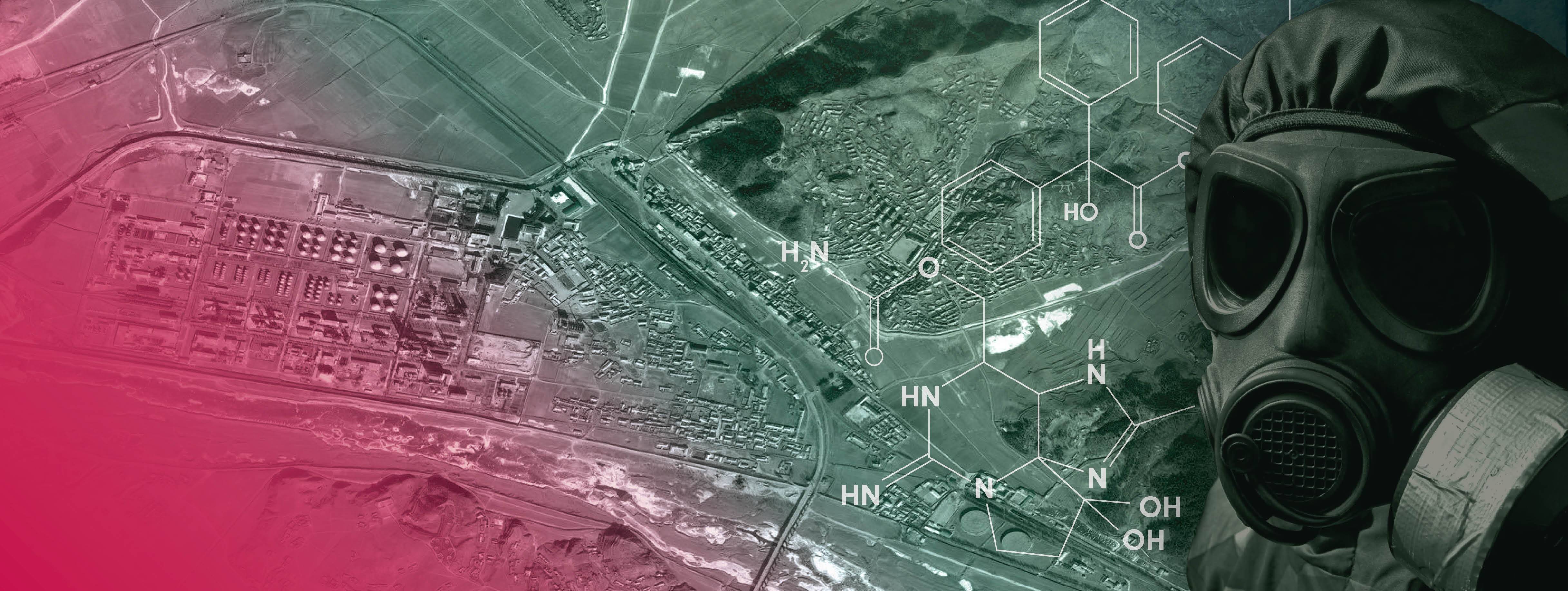
Image credit: Google Earth (Airbus & Maxar), 2026
WRITTEN BY
Hailey Wingo
RUSI Associate Fellow, Proliferation and Nuclear Policy


Air Vice-Marshal Sean Corbett CB MBE
Guest Contributor

Professor David Crouch
RUSI Senior Associate Fellow, Proliferation and Nuclear Policy

Lennie Phillips OBE
Former Senior Research Fellow, Chemical Weapons

Grant Christopher
Co-Programme Director of VERTIC’s Verification and Monitoring Programme