

The Evolution of Russian and Chinese Air Power Threats

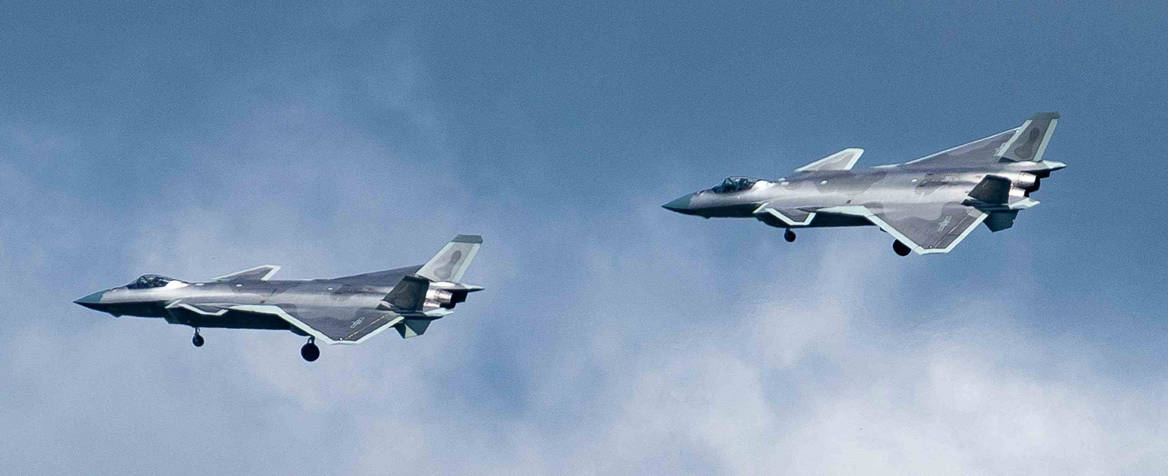
Russian and, particularly, Chinese capabilities now pose greater threats to Western air power than in 2020.
Introduction – Baseline 2020
In 2020, RUSI published papers on the potential threats posed to Western forces by Russian and Chinese combat air capabilities and ground-based air defence (GBAD) systems. Since these studies were published, both Russian and Chinese air power capabilities have evolved significantly.
The aim of this Insights Paper is not to present a comprehensive analysis of the various types, weapons systems and tactics operated by the Russian Aerospace Forces (VKS) and People’s Liberation Army Air Force (PLAAF). Instead, it provides a succinct outline of the ways in which the threat posed to Western air power capabilities by Russian and Chinese forces respectively has changed over the five years since 2020. As a starting point, readers are invited to read the two RUSI papers from 2020, mentioned in the paragraph above, for an overview of the primary aircraft types and GBAD systems operated by each nation.
This Insights Paper demonstrates that in 2025, Chinese air power in particular poses a fundamentally different level of threat to traditional US dominance in the air domain than it did in 2020. Russian air power has evolved in a different way and to a lesser extent – its evolution is driven largely by the pressures of Russia’s long war against Ukraine. However, Russian air power still represents a greater threat to Western air power capabilities in Europe than it did prior to the invasion of Ukraine in 2022.
Methodology
As part of this study, the author conducted interviews during 2024 and 2025 at Fighter Weapons Schools in the UK, US and Australia, and conducted research visits to relevant air force units and ministries in numerous European countries, as well as in Japan and elsewhere in the Indo-Pacific.
The author also drew from data from the Armed Forces of Ukraine. However, due to the sensitivity of information and, in some cases, the classification levels involved, these interviews have been used for background research and quality control rather than as direct sources in this paper. For cited sources, the author filtered and selected open source information to present the most accurate picture possible for a public, unclassified document.
Russian Air Power: Evolving from Failures
The failure of the VKS to establish air superiority over Ukraine during the full-scale invasion of Ukraine from February 2022, and the significant attrition in terms of aircraft, weapons and GBAD systems that it has suffered in the conflict so far, has led many policymakers and military observers to significantly downgrade the VKS as a potential threat to European NATO member states. However, in many respects, the VKS of 2025 is a significantly more capable potential threat for Western air forces than it was in 2022.
First, the impact of the attrition that the VKS has suffered during operations in Ukraine has been lower than would be suggested by the numbers of lost and damaged aircraft. In fact, the VKS’ fleet has expanded in that time. Around 130 fixed wing aircraft have been either shot down or badly damaged, and losses in tactical aircraft have been heavily concentrated in the Sukhoi Su-25SM(3) Frogfoot and Su-34(M) Fullback fleets – accounting for around 40 of each type. The Su-25s shot down would have had little practical utility in any direct conflict between Russian and NATO forces, and the loss of around ten Su-24M/MR Fencer strike/maritime reconnaissance aircraft similarly does not constitute a meaningful reduction in threats for NATO forces.
As for the loss of almost 40 Su-34s, this would – in theory, at least – have a much more noticeable effect on the air-to-surface firepower that the VKS might bring to bear against NATO forces. The Su-34 Fullback fleet is Russia’s primary tactical strike aircraft and the fleet comprised only around 130 frontline aircraft at the start of the full-scale invasion in 2022. However, the United Aircraft Corporation delivered eight new Su-34s in 2022, 11 in 2023, and between 12 and 14 in 2024. At time of writing, nine aircraft had been delivered in 2025, with a final batch of two expected before the end of the year. In other words, new production of the Su-34 for the VKS has exceeded Su-34 losses during the four years of the war so far. This also applies to the Su-35S and Su-30SM(2) fleets, of which a combined total of only around 20 airframes have been lost or damaged beyond economical repair since February 2022. In addition, Su-57 deliveries have continued at a modest pace. In short, the numbers of modern VKS fighter and strike fighter aircraft, specifically the Su-35S, Su-30SM(2), Su-34(M) and Su-57, have marginally increased since the start of the full-scale war, despite the attrition inflicted by Ukrainian forces and by accidents (see Table 1).
Table 1: Losses and New Deliveries for Russian Fighters and Bombers, 2020 and 2025
Source: Author's own best estimate, compiled from a range of sources.
Second, the VKS aircrew cadre has also grown significantly more capable during the war. For a start, pilot attrition has been significantly lower than airframe attrition. Russian pilots who survived being shot down over Ukrainian-held territory in the first month or so of the war have been largely returned to Russia, as part of prisoner exchanges. Those who successfully ejected from subsequent shootdowns almost exclusively did so over Russian-held territory, since the VKS has not conducted penetrating operations with crewed aircraft at any serious scale since March 2022. Furthermore, a significant proportion of Russian aircraft losses during the war have occurred on the ground during Ukrainian drone and Army Tactical Missile System (ATACMS) strikes on airbases. In such cases, aircrew casualties were probably minimal. Where experienced crews have been lost, the impact on the overall capability of the VKS to pose a threat in a direct conflict with NATO nations has been more than offset by the huge growth in flying hours and combat experience across the VKS aircrew cadre.
One of the features of the VKS fighter fleets pre-2022 was that flying hours were relatively low compared to NATO standards, and that a significant proportion of those flying hours went to a few senior aircrew in each regiment or brigade. Operations over Syria helped raise experience levels via regular rotations of aircrew through the theatre, but although the airspace was complex and weapon deliveries were regular, there was little direct threat against Russian air operations. By 2025, however, Russian aircrew have built up four years of regular combat flying against a significant integrated air defence system (IADS) and the Ukrainian Air Force, involving regular live weapon employment against air and ground targets. They have also gained hugely valuable experience in cooperating closely with VKS and Russian Ground Forces' GBAD systems, and Ukrainian sources routinely report noticeably improved fighter–GBAD integration, especially since early 2024. Furthermore, within the constraints of their still-rigid command and control system and doctrine, Russian fighter pilots have improved their effectiveness in air-to-air engagements during the war, both in intercepting UAVs and in conducting long-range engagements against Ukrainian aircraft.
In any war against NATO forces, the VKS of early 2022 would have struggled to employ effective battlefield firepower on a large scale due to inadequate weapon options, a lack of targeting pods, and poor close air support training. This is no longer the case.
Third, the conversion of the Su-35S, and increasingly the Su-30SM2 fleets, to rely primarily on the long-range R-37M (NATO codename: RS-AA-13) air-to-air missile – instead of the relatively limited medium-range R-77-1 (RS-AA-12b) – has significantly contributed to increasing the threat that they can theoretically pose to NATO air operations. Equally, the Su-34 fleet has been essentially re-rolled since early 2024 to focus on the delivery of massed glide bombs using UPMK and UPMB (Unified Gliding and Correction Module and Universal Planning Module for Bombs) wing and guidance kits to extend the range and add precision guidance to FAB-500, FAB-1500 and FAB-3000 heavy demolition bombs. These weapons can be delivered from at least 60 km, with stand-off ranges of up to 130 km possible in some conditions. Hundreds of these weapons are employed every week against Ukrainian forces across the frontlines, and due to their heavy explosive payloads, adequate accuracy and sheer quantities, they are highly effective at demolishing strongpoints, trench lines and command centres.
In any war against NATO forces, the VKS of early 2022 would have struggled to employ effective battlefield firepower on a large scale due to inadequate weapon options, a lack of targeting pods, and poor close air support training. This is no longer the case. In any future war, NATO forces on the frontlines could be intensively bombarded with glide bombs without Russian Su-34s having to venture beyond their dense GBAD cover. This would place urgent and taxing demands on NATO air forces for rapid and aggressive offensive counter-air cover in the early stages of any conflict. This would be challenging to achieve alongside the required large-scale suppression and destruction of enemy air defences campaign (SEAD/DEAD) that would need to take place as a prerequisite to establishing any form of localised air superiority for NATO forces.
Fourth, Russia’s ground-based IADS remains a highly potent threat to NATO air capabilities in a European context, despite having suffered more significant attrition during the war against Ukraine than the VKS combat aircraft fleets. Ukrainian forces have successfully achieved a steady drumbeat of UAV, loitering munition, artillery and ATACMS strikes on Russian short-range systems like the SA-22 Pantsir and SA-15 Tor; against the medium-range SA-17/27 Buk M1/2 and even on long-range SA-21 (S-400) batteries. However, several hundred batteries of assorted Russian surface-to-air missile (SAM) systems remain in service, and the primary threat systems are also still all in production in their latest variants. Russian SAMs have also become significantly more effective at shooting down Ukrainian aircraft, UAVs and guided munitions such as the AGM-88 HARM (High-Speed Anti-Radiation Missile) and the GMLRS rocket artillery rounds, as a result of extensive combat experience and lessons learned since the full-scale invasion of Ukraine in February 2022. These improvements include software updates to boost radar performance against different target sets; improved electronic warfare resistance; evolving tactics, techniques and procedures (TTPs); and, in some cases, the introduction into regular service of new hardware like the SA-28 (S-350 Vityaz). Consequently, Russian SAM systems not only remain numerous, but are also likely to perform better against NATO aircraft and munitions in a hypothetical direct conflict than they would have before 2022.
Fifth, in any direct conflict with NATO forces in Europe, the threats to NATO aircraft posed by the Russian VKS and ground-based IADS would be far better coordinated today than they were prior to 2022. Ukrainian sources consistently report that since mid-2023, Russian long-range SAM systems have been observed, increasingly frequently, coordinating engagements with both A-50U airborne early warning and control (AEW&C) aircraft, and more recently, with Russian fighter aircraft on combat air patrols near the frontlines. This has sometimes enabled SA-21 systems to fire 48N6 missiles with active seeker heads at Ukrainian aircraft at low altitudes, at ranges beyond what the main SA-21 battery fire control radar can directly observe. Presumably, this is done by using track data passed by datalink from an A-50U, or a fighter with modern datalinks like the Su-35S.
In a conflict with NATO forces, Russian GBAD systems could use similar tactics to engage Western aircraft flying at low altitudes at longer ranges. The probability of kill from such shots almost certainly remains low in Ukraine, since they would rely on the missile seeker acquiring the correct target during its descent from a high-altitude apex post-launch, without mid-course guidance information from the launch battery. However, these tactics are an indicator of how much more proficient VKS aircrew and GBAD crews have become in executing cooperative engagements, compared to the basic and often flawed deconfliction observed in 2022.
Just as with VKS fighter aircrew, Russian SAM operators are significantly more combat experienced and more capable overall than they were prior to the start of the full-scale invasion. Alongside hardware and software upgrades, this increase in operator experience at least partially offsets the impact of the significant attrition that Russian SAM systems have suffered during the war against Ukraine on Russia’s GBAD capability. On the other hand, thanks to close cooperation with Ukrainian forces, NATO air forces also have access to significantly more detailed and accurate data on the strengths, weaknesses, tactics and technical characteristics of Russian SAM systems than they had before 2022. Russian GBAD is now a better understood threat and one for which suitable SEAD/DEAD weapons, tactics and doctrine exist – albeit not in sufficient numbers in Europe yet. However, on balance, Russia’s GBAD still represents a far more significant threat to NATO’s air power capabilities in any direct conflict scenario than the fighters of the VKS.
Finally, Russia’s Long-Range Aviation (LRA) forces have also become significantly more capable as a potential threat to Western forces in any direct conflict, thanks to experience gained during extensive operations against Ukraine. At the start of the war, Russia launched several hundred Kh-101 and Kh-555 cruise missiles from the Tu-160(M) Blackjacks and Tu-95MS(M) Bears, and also launched Kh-22s from Tu-22M3 Backfires. The Kh-101 and Kh-555 cruise missiles were employed to service targets generated through a relatively slow, highly centralised AKATSIA system. They were fired alongside naval Kalibr, ground-launched 9M727 and 9M728 cruise missiles, and 9M720 and 9M723 ballistic missiles from Iskander-M/Iskander-K systems, but not in a closely coordinated fashion.
In 2025, the same Kh-101 cruise missiles are used in concentrated salvos alongside not only land-based Iskander systems, but also air-launched Kh-47M2 Kinzhal aero-ballistic missiles fired from MiG-31Ks, and hundreds of small, one-way attack (OWA) Geran-2/3 drones and Gerbera decoy drones. This makes them far more difficult for Ukrainian air defences to intercept. Continued improvements in Russian air defence reconnaissance and in last-minute route planning capabilities for missile and drone salvos also increase the challenge they pose for defences. Furthermore, Russian missiles have increasingly been equipped with improved electronic and physical countermeasures to degrade the effectiveness of air defence radars, and programmed for more effective terminal manoeuvring to further improve penetration against Patriot PAC-3 and other advanced air defences.
In any direct conflict with NATO forces, therefore, the Russian LRA force (and wider Russian long-range strike capabilities) can threaten far more effective mixed salvos, with improved route planning, coordination with different ballistic, cruise and OWA strike systems, and improved terminal penetration capabilities than it could before 2022. This is despite the loss of at least four Tu-95MS and three Tu-22M3 bombers during the audacious Operation Spiderweb attacks on Russian bases, using infiltrated massed UAVs in June 2024, and the shootdown of a Tu-22M3 in April 2024.
Chinese Air Power Capabilities: Astonishing Growth
There has been a dramatic increase in China’s capacity to challenge Western airpower during the past five years. Hundreds of modern and highly capable fourth- and fifth-generation fighters have been produced, alongside myriad enabler aircraft such as AEW&C and electronic attack (EA) platforms. Production of world-class air-to-air missiles and SAM systems and sensors has been undertaken on a large scale, alongside continued, rapid development of even more advanced systems. In addition, standards of pilot training and operational exercise complexity appear to have continued to quickly improve. This chapter will cover these key Chinese capability growth areas within the PLAAF and the People’s Liberation Army Navy Air Force (PLANAF), along with some of the long-range anti-air systems now being tested by the People’s Liberation Army Rocket Force.
As a starting point, growth figures for modern, indigenously produced fighter aircraft types can help underscore the qualitative and quantitative increases that have occurred since 2020. In 2020, when RUSI’s last paper on Chinese combat air capabilities was published, the PLAAF operated around 50 J-20 fifth-generation fighters (which were, in technological terms, relatively immature), and 90–100 of the advanced fourth-generation J-16 Flanker-Ns. Around 20 of the J-20s were produced annually from the Chengdu assembly lines in Sichuan province, and 40 of the J-16s from the Shenyang factory in Liaoning province. In contrast, in late 2025, production rates for the upgraded and technologically mature J-20A (and two-seat J-20S) have reportedly reached around 120 aircraft per year. Open source, in-service estimates for mid-2025 assess that around 300 J-20 fighters have entered service across at least 13 PLAAF regiments, and the total produced are likely to be higher, since a significant number of newly produced fighters will still be awaiting delivery to units. In addition, around 450 J-16s will probably have been delivered to the PLAAF by the end of 2025, based on public estimates of 350 J-16s in service in 2024 and a production rate of around 100 new fighters per year (see Table 2).
Table 2: Annual Production and In-Service Numbers of Chinese Fighters, 2020 and 2025
Source: Author’s own best estimate, compiled from a range of sources.
What these figures indicate, in practice, is that the proportion of fifth-generation and advanced fourth-generation fighters operated by the PLAAF has greatly increased since 2020 and will continue to do so. The trend suggests that around 1000 J-20/A/Ss and 900 J-16s will be in service with the PLAAF by 2030. There is also a noticeable trend towards heavy fighters in general, with J-16s and J-20s being used to re-equip units that previously were operating not only J-11 and Su-27/30 Flanker heavy fighters, but also some J-7 light and J-8 medium fighters. The PLAAF’s primary modern medium-weight fighter, the J-10C, is itself a noticeably capable machine, with modern AESA (active electronically scanned array) radar, datalinks, satellite communications capabilities and access to a wide variety of potent air-to-air and air-to-surface munitions, including the long-range PL-15 (NATO codename: CH-AA-10). In addition to the heavy fighters listed above, over 300 of the J-10C variant are likely to be in PLAAF service as of 2025, with around 250 older J-10A/B variants also remaining in the inventory.
Second, production is now well established at Shenyang for the PLAAF land-based J-16D and PLANAF naval J-15DT/DH airborne electronic warfare aircraft. Both Flanker-derivative aircraft types are equipped with specialised internal sensors, wiring and missionised cockpit, as well as two to four external pods per aircraft. They are an almost direct analogue to the US Navy’s EA-18G Growler aircraft, and are an indicator of the degree to which the likely sophistication of PLAAF and PLANAF force packaging and airborne tactics has increased over the past five years. It is worth stressing that this is a rare and very potent enabling capability. As of 2025, beyond the US Navy, only the Royal Australian Air Force operates the EA-18G, and no other Western air forces field a comparable tactical-fighter derived airborne EA platform.
Nevertheless, this extraordinarily rapid growth in China’s advanced fourth- and fifth-generation fighter force is seemingly not enough for PLAAF and PLANAF leaders. In addition to the roughly 120 J-20A/S stealth fighters being produced per year, the smaller J-35/A is now being acquired for the PLAAF for ground-based use, in addition to its planned naval role for the PLANAF. In late 2025, the J-35/A is almost certainly still in low-rate initial production, but if previous programmes are any indication of likely direction of travel, production can be expected to increase rapidly in the coming years. The aircraft will also probably incorporate development experience and technology from more mature types, in particular the J-20A/S, for its avionics and weapons systems.
Third, China has also made a point of flying at least two demonstrators for advanced next-generation crewed combat aircraft in 2025. These include a very large, tri-engine Chengdu triangular tailless design that Western analysts have christened the J-36, and the roughly F-22-sized Shenyang design referred to alternatively as the J-XDS or J-50. Both are clearly designed to incorporate advanced broadband stealth characteristics and optimised for air-to-air missions at high altitudes and speeds. The J-36 in particular will probably have an extremely impressive range on internal fuel and a huge internal weapons bay that would be able to hold not only significant numbers of PL-15 and PL-16 long-range air-to-air missiles, but also probably the larger PL-17 missile which is currently only carried externally by the J-16 Flanker. These advanced aircraft are almost certainly still only developmental prototypes rather than frontline assets, but as in other areas, Chinese production and operational capability timelines are likely to be faster than their Western equivalents. The same holds for several types of Chinese uncrewed combat aerial vehicles (UCAVs) and collaborative combat aircraft (CCA) type prototypes shown off at the CCP Victory Day parade in September 2025, and the GJ-11 attack UCAVs which were recently observed in satellite images conducting testing at the Malan Air Base.
Fourth, alongside rapidly growing their aircraft numbers and capability, the PLAAF and PLANAF have also considerably raised the quality of their aircrew and exercise programme since 2020. Aircrew from multiple Indo-Pacific air forces interviewed during base visits in 2025 consistently stressed that the observed sophistication and realism of PLAAF and PLANAF regular training has increased, especially in the J-16 and J-20 fleets. Prior to 2020, both services generally operated according to very rigid procedures and tactics, relying heavily on pre-planned prescriptive manoeuvres and on ground-based or airborne controllers for direction. However, this has changed significantly, partly via experience gained through more dynamic air combat competitions such as the Golden Helmet series, and partly thanks to significant numbers of experienced Western former aircrew providing training to PLAAF and PLANAF pilots. In 2025, PLAAF and PLANAF aircrew routinely fly complex training and demonstration of force sorties involving fighters, bombers, tankers and AEW&C aircraft, in coordination with each other and with PLAN surface action groups. This is especially noteworthy around Taiwan and in the Sea of Japan.
The fifth, and perhaps most striking, area where Chinese air power capabilities have increased in recent years is in air-to-air and SAM technology. Indeed, the PLAAF fields at least two air-to-air missiles in frontline service that significantly out-range not just Russian but also American and European equivalents. These missiles are the PL-15 and PL-17 (NATO codename: CH-AA-12). The PLAAF has probably undertaken regular software and hardware upgrades for the PL-15 since it entered service around 2015, and will probably field the PL-16 (NATO codename: CH-AA-X-13) on the frontline soon – in fact, it may have already begun to do so. The PL-16 offers a similar performance to the PL-15, but in a slightly smaller missile body with folding fins to enable six missiles to be carried internally by the J-20. Moreover, the PL-15, PL-16 and PL-17 are all known to feature AESA type active radar seeker heads, and probably also feature dual-mode capabilities such as home-on-jam or passive-homing modes. These missiles not only provide an absolute range advantage over Western fighters armed with the AIM-120C/D AMRAAM (advanced medium-range series of air-to-air missiles), but also an advantage in time-to-target across any given range due to their very high peak speeds. This means that if a Chinese and a Western fighter fire at one another simultaneously, the Chinese missile will probably reach its target first (in the absence of other factors), which is a significant potential tactical advantage.
The engagements between the Pakistani Air Force and the Indian Air Force during Operation Sindoor in May 2025 provided useful, albeit incomplete, insight into the capabilities of PLAAF missiles and aircraft compared to their Western and Russian counterparts. During a series of long range engagements, at least one Indian Rafale was shot down, along with a Su-30MKI, and potentially two to three other Indian fighters. Pakistani officials claimed that the PL-15E (E standing for ‘Export’ version) missile that hit the Rafale was fired from 200 km away. Regardless of the exact figures, several relatively advanced Indian Air Force fighters were hit by PL-15E missiles fired by J-10CE fighters in their first ever combat engagement at unprecedented distances.
The contrast between China and Russia’s long-range air-to-air missile performance during Operation Sindoor and the war in Ukraine respectively is striking. Despite regularly firing R-37M missiles at often obsolescent Ukrainian aircraft with very limited defensive sensor capabilities, Russian Su-35s, Su-30s and MiG-31s have achieved only a handful of air-to-air kills over four years of conflict. It is also worth stressing that the PL-15Es used by Pakistani J-10CEs during the clashes with the Indian Air Force in May 2025 were probably significantly less capable than the state-of-the-art missiles currently in frontline PLAAF and PLANAF service. After all, the baseline PL-15 that probably formed the basis for the PL-15E export variant has been in PLAAF service since approximately 2015 or 2016. If the development of the rest of China’s military capabilities is any indicator, then the PL-15 family of missiles has probably received several software and hardware upgrades for the PLAAF and PLANAF during the intervening decade.
China’s development of SAM systems is more opaque than the development of their combat aircraft. However, it is clear that the PLA continues to assign a high level of priority to the development of indigenous medium- and long-range SAM systems, in addition to having acquired two regiments of SA-21 systems from Russia. These include the long range HQ-9B/C and HQ-22 systems, the anti-ballistic missile HQ-19 and follow-on HQ-26, and the medium-range HQ-16 family of SAMs. Broadly speaking, these SAM systems have significantly more sophisticated and widely networked sensor arrays and guidance/seeker systems than their Russian equivalents, because China has a far more capable and better funded electronics and software industrial base. However, Chinese SAM systems may be less technically mature due to their lacking the depth of data from real-world engagements that their Russian (and American) equivalents have acquired.
There are also indications that the PLA is actively funding the development and testing of ultra long-range SAM systems with ranges of 2000 km or even more, which operate according to fundamentally different principles to traditional SAMs. These systems appear to combine a boost stage of a ballistic missile with a payload section, that can launch air-to-air missiles or a manoeuvrable kill vehicle that would intercept aircraft in their terminal phase of flight. This is probably what the US Department of the Air Force’s report to Congress in 2024 was referencing when it mentioned future ‘counterair weapons with ranges out to over 1,000 miles and supported by space-based sensors [that] will place aircraft, such as tankers, that have traditionally operated with impunity, at risk.’ At such great ranges, launch and mid-course guidance would probably depend – at least partly – on real-time surveillance from orbit, or on very low-latency orbital relay capabilities to pass target track data to the missile from long-range penetrating crewed or uncrewed aircraft. China is also actively working to develop and refine these capabilities.
Finally, the PLAAF has prioritised a revolutionary growth in its airborne sensor capabilities over the past decade. These efforts are probably driven, at least in part, by the complex kill chain demands of its very long-range air-to-air missiles, like the PL-17 and exotic SAMs. Sensor capability improvements can be observed in China’s wholesale switch over the past decade to AESA radars as the primary sensors of all the fighter types still in production – namely, the J-10C, J-16, J-20 and now the J-35. This growth can also be seen in the rapid expansion of the PLAAF’s AEW&C fleet. By mid-2023, leading open source estimates had already placed the Chinese Shaanxi KJ-500 AEW&C fleet at roughly 40 aircraft. Since production has continued and indeed increased since then, the total in late 2025 is likely closer to 50 KJ-500s in service. In addition, China operates four large KJ-2000 and eleven KJ-200 AEW&C aircraft, and the new, large KJ-3000 and carrier-based KJ-600 are at least in active testing, if not in initial service. All these AEW&C types feature modern, large and thus high-capacity and jamming-resistant AESA radars as their primary sensors, and undoubtedly also carry numerous datalink and satellite communications links to act as nodes for other aircraft and joint assets.
Moreover, Chinese orbital ISR and communication capabilities have seen similarly explosive growth in numbers and sophistication since 2020. While the overall picture is complex, the result is clear: the PLAAF and PLANAF collectively field a vastly greater number and higher quality of long-range sensors in 2025 than they did in 2020. This will directly translate into greatly improved situational awareness and more robust long-range kill chains for air-to-air and surface-to-air engagements in any clash with US, Taiwanese or any other forces.
Conclusion
Western nations are generally more heavily dependent on the ability to achieve air superiority for their national security than they were before the Russian invasion of Ukraine in 2022. Western land forces’ inventories have been significantly depleted by donations of both old stock and new production materiel to the Armed Forces of Ukraine, while the Russian Army and Russian military production have expanded significantly, raising the threat Russia might pose to wider European security. Meanwhile, Chinese military capabilities have continued to grow, not least in the naval sphere, leading the US joint force and its Indo-Pacific allies to increasingly rely on being able to gain and leverage temporary air superiority at key points in any clash with the PLA.
European NATO states face the threat of direct aggression from Russia in the coming years, without being able to rely on large-scale military support from a geopolitically changed and militarily overstretched US. In Europe, the primary threat to NATO air power remains Russia’s extensive ground-based SAM coverage, which forms the core of its IADS. This IADS has suffered considerable attrition from Ukrainian forces, but Russia’s production is continuing, and the numbers of SAM systems and sensors that it deploys remain a major challenge for NATO.
As explained in the first section of this paper, Russian air defence capabilities have been boosted by combat lessons over almost four years of operations against Ukraine’s Western-supplied munitions and long-range UAV campaign. The VKS fighters and long-range missile-launching LRA bombers are also considerably more capable than they were at the start of the war, and in any clash, would represent a greater threat than before to NATO forces. At the same time, NATO states have learned a great deal about Russia’s capabilities through the assistance they offer to their Ukrainian partners.
With the correct munitions purchasing strategy and focused cooperative training, European NATO nations should still be able to counter the threat posed by Russian forces to their air power.
The situation in the Indo-Pacific is fundamentally different. The growth in Chinese air power and ground-based and maritime IADS capabilities has already had a transformative effect on US military freedom of action in and around the first island chain during any potential conflict, compared to 2020.
The PLA now fields a range of capabilities that can threaten US Air Force aerial refuelling tankers, US Navy carrier groups and forward air bases at 1000 km or more. These include thousands of long-range ground-based, air-launched and maritime ballistic and cruise missiles, as well as long-range ground-based SAMs and long-range air-to-air weapons carried by hundreds of advanced fifth-generation fighters. The force that China has built is supported by extensive airborne long-range sensor and communications nodes in the shape of AEW&C aircraft like the KJ-500, impressive and rapidly expanding orbital ISR capabilities, and EA aircraft like the J-16D, J-15DT and Y-9LG. These will improve the efficiency with which it can marshal forces to challenge any US or regional adversary air power operations and greatly increase the lethality and robustness of the kill chains on which its impressive long-range missiles like the PL-17 rely.
In Europe, Western airpower faces significant challenges from incremental, but broad, Russian capability improvements made in the past five years. In the Indo-Pacific, Western airpower faces a potentially revolutionary challenge.
As a result, where US or other Allied aircraft can penetrate airspace contested by Chinese forces during a major clash, these aircraft will probably be operating at the end of long and contested tanker, basing and electromagnetic enablement chains. This means that the numbers of F-22s, F-35s, B-2s and other penetrating assets that US forces can push forward effectively at any given time will be more limited than their (already relatively small) fleet sizes would suggest, on paper. This will further increase the challenge that those assets will face when trying to deal with the significant (and rapidly increasing) numbers of Chinese fourth- and fifth-generation fighters, modern SAMs and, potentially, UCAVs and CCAs. By 2030, these Chinese capabilities will almost certainly have been complemented by initial numbers of next-generation platforms, too.
In Europe, Western airpower faces significant challenges from incremental, but broad, Russian capability improvements made in the past five years. In the Indo-Pacific, Western airpower faces a potentially revolutionary challenge.
US-led Western forces may still be able to win localised and temporary windows of air superiority in a potential conflict by leveraging greater operational experience; careful use of fifth-generation F-22s and F-35s alongside legacy assets; high-end training and exercise programmes such as Red Flag and Bamboo Eagle; new weapons and platforms like the AIM-260, B-21, and F-47; and rapid development and fielding of suitable CCAs. However, current Chinese capability growth is sufficiently impressive and rapid that the traditional Western airpower edge is no longer guaranteed in the Indo-Pacific.
For terms of use, see Website Terms and Conditions of Use.

Senior air force leaders, policymakers, and industry experts discussed strategies for enhancing deterrence credibility and operational effectiveness at this year's Combat Air Power Conference.

WRITTEN BY
Justin Bronk
Senior Research Fellow, Airpower & Technology
Military Sciences


.jpg)
- Jim McLeanMedia Relations Manager+44 (0)7917 373 069JimMc@rusi.org