


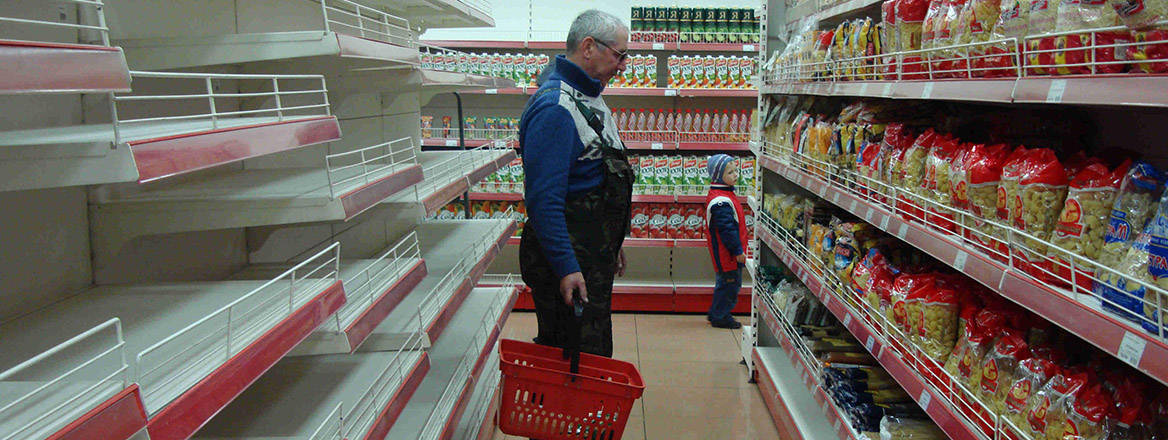
For Russia, wartime brought on a change of values.
One of the enduring beliefs of liberal internationalism is that economic pressure can substitute for military force. Sanctions, trade restrictions and financial isolation are supposed to raise the costs of aggression to such an extent that governments eventually revise their aims. This faith has been widely applied to Russia’s war against Ukraine. As Russia’s economy shows signs of strain – slowing growth, persistent inflation, high interest rates and deteriorating investment prospects – hopes periodically re-emerge that economic pain will compel Moscow to change course.
History, however, offers limited comfort for this view. Wars are rarely abandoned because they become expensive. They are more often terminated when states are defeated militarily, when ruling coalitions fracture, or when regimes themselves collapse. Economic pressure, where it matters, tends to operate through these channels rather than through persuasion alone. The experience of Russia today fits this broader pattern. Its economy is under strain, but that strain is unlikely to prove decisive.
The Limits of Economic Coercion
The appeal of economic coercion is obvious. It promises influence without bloodshed. Yet the historical record suggests that, once large-scale wars begin, economic instruments have only a modest capacity to shape outcomes directly.
Consider the two most frequently cited successes. Imperial Japan in the early 1940s was confronted with an oil embargo that deprived it of the fuel on which its armed forces depended. But this did not induce restraint. It triggered escalation. Japan chose war precisely because it believed that economic strangulation would otherwise render it strategically defenceless. The eventual collapse of Japan’s war effort came not from economic pressure in isolation but from the combination of blockade, strategic bombing and battlefield defeat.
Germany in 1918 provides a similar lesson. The Allied naval blockade inflicted immense hardship on the civilian population and degraded industrial capacity. Yet Germany did not sue for peace simply because the war had become economically intolerable. It did so when military defeat on the Western Front coincided with social unrest, mutiny and the collapse of the imperial regime.
A rather different case is late-apartheid South Africa. Here, international sanctions did not lead to military defeat or regime collapse. Instead, they contributed to a realignment within the ruling elite. Business leaders and political insiders concluded that continued isolation was incompatible with long-term prosperity and security. Negotiation became preferable to confrontation. This is perhaps the cleanest example of economic pressure operating through elite incentives rather than through force or revolution.
Leaders often value power more highly than prosperity. For regimes that equate survival with strategic success, economic contraction may be an acceptable price for political security
These cases point to a general pattern. Economic pressure tends to matter in war only when it triggers one of three outcomes: the collapse of a state’s capacity to fight, the fragmentation of the ruling coalition, or the destabilisation of the regime itself. Where none of these occurs, wars often persist despite extraordinary economic costs.
Why Wars are Economically ‘Sticky’
There are structural reasons for this resilience. War generates what economists would call ‘sunk costs’. As casualties mount and resources are expended, leaders and societies become invested in avoiding defeat. Objectives are reframed as existential. Compromise appears not as prudence but as capitulation.
Political institutions matter, too. Democracies are not immune to this logic, but authoritarian systems are particularly insulated from the transmission of economic pain into policy change. Leaders who face limited electoral accountability and control the media can shift the burden of adjustment onto the broader population while shielding core supporters.
Moreover, wartime economies adapt. Trade is rerouted, domestic substitutes are found, and resources are reallocated from consumption and investment to armaments and logistics. Efficiency falls, but the capacity to fight is often preserved.
Finally, leaders often value power more highly than prosperity. For regimes that equate survival with strategic success, economic contraction may be an acceptable price for political security.
These dynamics help explain why sanctions and economic isolation, while damaging, have historically struggled to bring about decisive changes in the conduct of major wars.
Russia’s Economy Under Pressure
Russia today is not immune to economic strain. The war and the sanctions regime imposed in response have reshaped its economic landscape. Growth has slowed, almost to a halt. Inflation, although far from hyperinflationary, remains persistent. Interest rates are high. Labour shortages are acute, driven by mobilisation, emigration and the demands of the defence sector. Investment and output in civilian industries has weakened, and long-term prospects for productivity and technological upgrading have deteriorated.
These developments are significant. They imply a poorer, less dynamic economy over time. But the crucial question is whether they undermine Russia’s capacity or willingness to continue the war. On that point, the evidence is more ambiguous.
Military Capacity: Resilience Over Efficiency
Economic pressure ends wars when it deprives states of the means to fight. That threshold has not been reached in Russia’s case.

The Russian state has effectively ring-fenced the military sector. Defence spending has risen sharply as a share of the budget. Industrial capacity has been redirected towards munitions, repair and refurbishment rather than advanced civilian production. Labour has been pulled into defence plants with wage premiums and legal exemptions. Supply chains, although constrained in high-end components, have been reoriented towards alternative suppliers and domestic substitutes.
The nature of the war matters here. The conflict has evolved into a largely attritional struggle in which volume of fire, manpower and logistical endurance are more important than technological sophistication. This favours a system capable of mobilising resources, even inefficiently, over one that relies on complex global supply chains.
From this perspective, conventional macroeconomic indicators tell only part of the story. A country can experience low growth, high inflation and weak investment while still sustaining a war effort, provided it can continue to pay soldiers, produce ammunition and maintain equipment. Russia meets these conditions, at least for now.
Elites and Incentives
If economic pressure is to change policy, it often does so by changing elite incentives. In Russia, however, sanctions appear to have reinforced rather than weakened the cohesion of the ruling coalition.
Over the past two decades, the Kremlin has systematically reduced the autonomy of economic elites. The oligarchs of the 1990s have long ceased to exert significant influence over the political leadership, especially in matters of security policy. Political pluralism, weak to begin with, has narrowed. As a result, there is no independent economic class capable of exerting collective pressure for a change in strategy.
Sanctions have accelerated this process. Those elites most integrated into the global economy have lost assets, access and influence. Those embedded in the domestic, state-dependent economy – particularly in defence, energy and security – have gained. The war economy redistributes rents towards those whose fortunes are tied most closely to the regime.
This creates a perverse stability. For many insiders, the continuation of the war is not merely tolerable but materially advantageous. Defence contracts, subsidies and political favour compensate for broader economic deterioration. Exit options are limited. Loyalty becomes a rational strategy.
The state has selectively protected key constituencies – soldiers, their families, and defence workers – while framing hardship as patriotic sacrifice imposed by hostile external forces
In this respect, Russia’s experience is the inverse of South Africa’s in the late 1980s. There, sanctions empowered reformist elites. In Russia, they have entrenched war-dependent ones.
Society and Regime Stability
The final channel through which economic pressure can matter is regime stability. Severe economic shocks can, in some circumstances, overwhelm a state’s capacity for repression and narrative control. But this typically requires abrupt and dramatic deterioration: hyperinflation, food shortages, or fiscal collapse.
Russia’s economic stress, by contrast, has been gradual. Living standards have been eroded unevenly, not catastrophically. The state has selectively protected key constituencies – soldiers, their families, and defence workers – while framing hardship as patriotic sacrifice imposed by hostile external forces.
The country’s internal security apparatus remains strong. Media control limits the spread of alternative narratives. Political opposition is fragmented and weak. Unsurprisingly, dissatisfaction has expressed itself more in emigration than in mass mobilisation.
None of this implies immunity to future shocks. But it does suggest that current economic conditions fall well short of those historically associated with regime-threatening instability.
The Problem of Strategic Metrics
Much commentary on Russia’s economic condition relies on indicators such as GDP growth, inflation and interest rates. These are relevant for assessing welfare and long-term development. They are less useful for judging war sustainability.
A more pertinent set of questions would include: Is ammunition production sufficient? Are soldiers paid and supplied? Can damaged equipment be repaired or replaced? Is the internal security apparatus funded and loyal?
On these measures, Russia has, so far, proved more resilient than many expected. The economy is less efficient and less dynamic than it might otherwise be. But it remains capable of supporting the war effort.
Existential Stakes
Perhaps the most important factor insulating Russia from economic pressure is the way the conflict has been framed by the regime. The war is presented not as a discretionary policy but as a struggle over national survival, sovereignty and historical destiny.
This framing has powerful political consequences. Progress towards victory in Ukraine is tied to the leadership’s legitimacy at home. Defeat would carry not only geopolitical costs but domestic ones: loss of authority, elite vulnerability and heightened risk of internal challenge.
The history of war offers few examples of conflicts ended by economic pain alone
In such circumstances, economic considerations recede. Leaders prioritise avoiding defeat over restoring growth. Negotiated retreat under pressure would signal weakness, potentially undermining both external deterrence and internal control.
This dynamic is not unique to Russia. It is characteristic of conflicts that become closely bound to regime identity. Once that happens, economic pain alone rarely proves decisive.
What Would Make Economics Matter?
None of this is to suggest that economic pressure is irrelevant. It is to specify the conditions under which it might become decisive.
One possibility would be a sustained deterioration in Russia’s military performance so severe that it overwhelms the state’s capacity to mobilise resources and manpower. Another would be a disruption of elite rents so profound that key insiders conclude their interests are better served by compromise than by continuation. A third would be a sudden mass-welfare shock – such as a food or energy crisis – capable of overwhelming repression and narrative control.
At present, none of these conditions appears to hold. The economy is under strain, but the political and military system has adapted to manage that strain.
A Sobering Conclusion
The history of war offers few examples of conflicts ended by economic pain alone. Where economic pressure has mattered, it has done so indirectly, by reshaping military capacity, elite incentives or regime stability.
Russia today exhibits none of these vulnerabilities in a decisive form. Its economy is poorer, less efficient and less promising than it might otherwise have been. But it remains capable of sustaining the war. Its elites are more dependent on the regime, not less. Its political system is insulated from the transmission of economic discontent into pressure for regime change.
For policymakers in Ukraine’s allies, this suggests a more sober assessment of what economic instruments can realistically achieve. Sanctions and restrictions may weaken Russia over time, limit its technological development and constrain its future options. However, they are unlikely, on their own, to bring about a near-term change in the course of the war.
Economic pressure is a powerful tool. But in wars framed as existential, it is rarely a decisive one.
© RUSI, 2026.
The views expressed in this Commentary are the author's, and do not represent those of RUSI or any other institution.
For terms of use, see Website Terms and Conditions of Use.
Have an idea for a Commentary you'd like to write for us? Send a short pitch to commentaries@rusi.org and we'll get back to you if it fits into our research interests. View full guidelines for contributors.
WRITTEN BY
Dr Richard Connolly
RUSI Senior Associate Fellow, International Security


- Jim McLeanMedia Relations Manager+44 (0)7917 373 069JimMc@rusi.org