


Ukraine’s battlefield prospects are improving while Russian forces deteriorate, but damage is accumulating in the rear and funding for its resistance is far from assured.
The unsurprising failure of US diplomatic efforts to negotiate a termination to Russia’s full-scale invasion of Ukraine will see the conflict protract into its sixth year. The dynamics of the conflict in 2027 will be characterised by the diverging trends between the front, where Ukraine is gaining the advantage, and the rear, where Russia retains hopes of success. Shifting Putin’s intransigence requires that Ukraine and its partners deny him a viable path to military victory and set out a clear plan to resource Ukrainian success beyond the winter.
The Fortress Holds
In Donbas, Russian forces are conducting a high intensity of attacks at the northern and southern ends of Ukraine’s fortress belt to set conditions to seize Slovyansk and Kramatorsk in 2027. Despite a massive commitment of manpower and fires, they are failing, with unprecedented casualty rates of more than 35,000 a month. While the Russians may make some progress as the weather decreases the efficiency of Ukrainian UAV operations in late November, Russia is now losing more personnel than it is recruiting, such that its forces are on track to shrink in size for the first year since 2022.
Russian forces are not only declining quantitatively but are qualitatively degrading under the pressure of attrition. As a result, Ukraine has been able to conduct small but successful counterattacks along the front, demonstrating a growing capacity for combined arms manoeuvre in some formations. As winter sets in and the density of cover declines, attacks on Russian logistics and advancing troops are destined to see casualties remain high. This should leave Russian forces vulnerable in the spring.
As Russian forces now threaten to contest the hills at the centre of Ukraine’s ‘fortress belt’, Kyiv can no longer trade space for time and must counterattack. Its capacity to do so at greater scale will be determined by the extent to which it can build up reserves and coordinate its forces. Progress has been made in consolidating Ukraine’s new Army Corps, but increasing the scale of Ukrainian gains will depend upon better coordination of close fighting and strikes on Russian logistics and command and control, closing the gap between Ukraine’s ground and unmanned systems forces.
A Race to the Middle
For much of 2026, Ukraine has waged an aggressive ‘middle strike’ campaign on Russian forces. US interference with the performance of Starshield terminals, used to control UAVs beyond the radar horizon, will reduce the efficiency of these operations. Increasing Russian tactical air defence and interceptors along with specialised jamming will also contest Ukraine’s ability to attack the Russian rear.
Conversely, while Russia – lacking Starlink – has struggled to dynamically control UAVs to attack moving targets in the Ukrainian rear, experimentation with mesh networks is beginning to enable interdiction of Ukrainian vehicles significantly beyond the frontlines. If this trend continues, Russia may begin to be able to isolate parts of the front from support and replicate Ukraine’s successes, though Ukraine remains much better coordinated and tactically proficient in these operations.

In the context of middle strike, therefore, there is a race to improve air defence, networks and coordination that will determine who can maintain momentum in the spring. It is an area of current Ukrainian advantage, but Kyiv must improve its resilience to US coercion if it is to keep the edge. Alternatives to Starshield – and the provision of middle-strike munitions – should be a key priority for Ukraine’s remaining partners as governments approach a period where underspend in departmental budgets will open opportunities for accelerated support to Kyiv.
Blows in the Deep
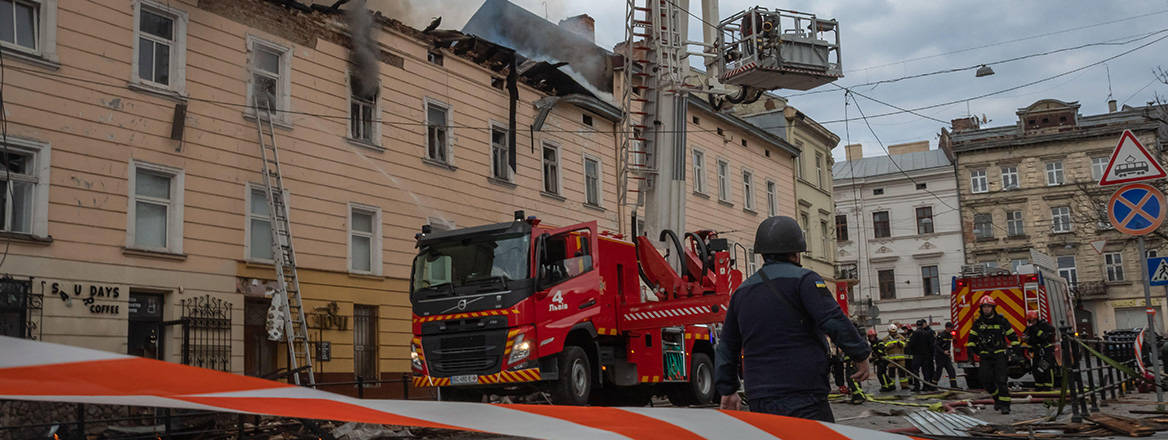
If Ukraine has the advantage in middle strike, the balance is reversed in Kyiv and Moscow’s respective deep-strike campaigns. With less resilience, a shortage of spares and fewer interceptors, Ukraine’s critical national infrastructure is in a more vulnerable position than last year. Russia, meanwhile, has diversified and expanded its arsenal of strike systems, including jet-powered flying bombs that cruise too high for Ukraine’s cheap interceptors to catch. Ukrainians can expect to be without power or other utilities for extended periods through the winter, displacing people from their cities and devastating the economy.
If Russia is making gains in middle strike, Ukraine is significantly expanding its deep-strike capabilities. Ukraine is now better coordinated in its campaign to disrupt the Kremlin’s revenue generation through attacks on fuel refineries, oil export infrastructure and social targets like warehousing and data centres. As Ukraine begins to receive more cruise missiles, it is also able to increase the intensity of strikes against Russian defence industry. As more targets become viable, Russian air defences become more stretched. Russia therefore faces the prospect of compounding damage to its infrastructure as targets are hit repeatedly. Many Russian officials fear that this damage will make the ongoing conflict unsustainable, and so continuing to resource Ukraine’s deep strikes is critical to bringing Russia to negotiations, rather than the Potemkin talks currently being orchestrated by Washington.

The picture for both Ukraine and Russia therefore is greater vulnerability and striking power in the deep. The strategic impact on both sides is on revenues. For Russia, the expanding costs of the war are placing ever greater strain on the country’s finances. Ukraine hopes this will hit a critical point where the Kremlin fears losing control. In Ukraine, population displacement means diminished industrial output, reduced capacity to export goods and less tax revenue. With a dwindling number of international partners, financing the war effort is a major vulnerability.
The Bottom Line
Ukraine’s resistance is now overwhelmingly paid for by eight countries: Germany, Denmark, Norway, Sweden and France, with crucial military support from the UK, the Netherlands and Canada. Poland, meanwhile, enables the logistics that keeps Ukraine in the fight. 2027 will see elections in Germany, France, Poland and Italy, all of which have openly anti-Ukrainian parties in prominent positions. Securing funding is now a political issue, and as the Ukrainian economy accumulates damage, the bill rises. There is little prospect of Russia’s immobilised central bank assets being seized.

In this context, the Russian Special Services are briefing that they expect to be able to disrupt the EU from agreeing sufficient funding packages. Subversion in targeted countries – especially Germany and Poland – is intended to fracture support for Ukraine. The prospect of defeat in depth and the potential fragmentation of European unity that this would bring about is behind the Kremlin’s expanding demands in negotiations for Ukrainian surrender and the rolling back of NATO.
Bringing about an end to the conflict sooner rather than later therefore requires Ukraine and its partners to build a strategy that brings the fronts back into alignment. In Donbas, Ukraine must focus on strengthening its Army Corps and building a reserve to exploit Russian weakness. The race to win the middle-strike battle is one that demands technological innovation and countermeasures in anticipation of Russian progress. The deep-strike campaign is where Ukraine is most acutely vulnerable but is also a potentially decisive path for Kyiv’s theory of victory. Ukraine’s partners must be clear in their financial commitments to deny the Kremlin its theory of victory if they want a negotiated outcome.
© RUSI, 2026.
The views expressed in this Commentary are the authors', and do not represent those of RUSI or any other institution.
For terms of use, see Website Terms and Conditions of Use.
Have an idea for a Commentary you'd like to write for us? Send a short pitch to commentaries@rusi.org and we'll get back to you if it fits into our research interests. View full guidelines for contributors.
WRITTEN BY
Dr Jack Watling
Senior Research Fellow for Applied Military Sciences
Military Sciences


- Jim McLeanMedia Relations Manager+44 (0)7917 373 069JimMc@rusi.org