

Somali Piracy in 2026 is Not Just a Resurgence of a Past Problem

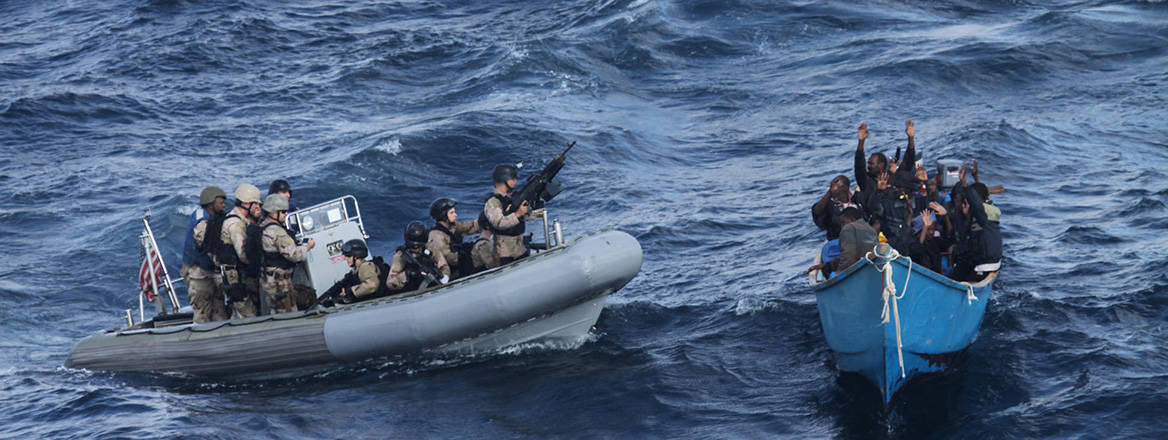
Piracy off Somalia has surged in 2026. More than a ‘resurgence’ of a past problem, this reflects a rapidly evolving maritime security environment.
The Problem
Over almost 14 years between the collapse of Somali piracy in the first half of 2012 and the beginning of 2026, only three commercial vessels were hijacked off the Horn of Africa. Now, since late April 2026, six have been seized. At the time of writing, four remain in pirate hands, along with more than 60 seafarers of various nationalities. Data from the UK Maritime Trade Operations and the International Maritime Bureau indicates there have also been numerous ‘suspicious approaches’, attacks (incidents in which firearms are discharged at vessels) and attempted boardings off Somalia this year. Many incidents targeting fishing vessels and dhows go unreported, but it is understood that at least four such craft have been hijacked since the start of 2026. The recent spike has been remarkable.
Two distinct areas of operation have emerged. Three of the commercial vessels were hijacked off Puntland’s east coast between Garacad and Durdura, a stretch of land associated with notorious pirate networks during their heyday. The other three were taken on the Yemeni side of the Gulf of Aden. All the vessels were subsequently held in different locations off Puntland’s coast, suggesting the potential involvement of multiple pirate action groups (PAGs).
These recent incidents have been widely reported as the ‘resurgence’ of a problem that cost the global economy almost $7 billion in 2011 alone. Between 2005 and 2011, over 1,000 vessels were attacked off Somalia, with more than 200 successfully hijacked. The ‘pirates’, mainly from the semi-autonomous Puntland region, initially targeted foreign dhows and fishing vessels they accused of illegally plundering Somali waters, undermining their livelihoods. These groups effectively served as a local coastguard in the absence of any state support. However, groups became more organised when they realised they could earn much larger sums by targeting commercial vessels. By 2012, the crisis was effectively quashed through a combination of multilateral naval missions, armed private security guards on board vessels and adherence to ‘best management practices’ including increasing speed and transiting further from the shore.
Unconfirmed reports have emerged that the Houthis have provided training, equipment and even financing to Somali pirate groups
Since that time, pirates have launched occasional missions and a handful of hijacks were reported, particularly between late 2023 and 2024. However, only the seizure of the MV Abdullah in 2024 resulted in the payment of a ransom. The risk-to-return ratio was against the pirates and, for most, it was no longer worth putting to sea.
Is This Just Opportunism...
That has changed. Reporting has widely cited the reduction in the presence of international warships since 2021 as a key factor in the recent spike in incidents. In 2026, there has been a further redeployment from the Somali Coast to the crisis in the Strait of Hormuz and to the Strait of Bab el Mandeb to deter Houthi activity. Moreover, a rise in commercial traffic off Somalia’s coast due to ships rerouting in response to the US–Israel war on Iran has increased the number of potential targets for pirates. Others have noted that global rises in the price of oil have made hijackings more attractive. Indeed, four of the six commercial vessels taken this year have been tankers. Analysts also observe that ‘unusually calm sea conditions’ have made things easier for the pirates in 2026.
In addition, it is highly likely that complacency has played its part. Years of relative quiet led to the lifting of the Indian Ocean High Risk Area from January 2023 and the shipping industry has increasingly sought to save costs on the tactics proven to protect them from pirate attacks. It is notable that none of the vessels hijacked this year had armed security on board.
The conditions on land within Somalia which enabled piracy 15 years ago have not changed. Despite the billions spent by the international community, Al-Shabaab is present in – and governs – large swathes of the country, Islamic State remains active in Puntland and the government in Mogadishu controls only a few urban settlements and the main supply routes between them. Service delivery to communities living on Puntland’s coast remains limited, and recent cuts to international aid are likely to have entrenched feelings of abandonment. Meanwhile food and fuel prices are rising and the illegal, unreported and unregulated (IUU) fishing continues, with coastal communities growing angry about the declining stocks in their waters.

In this context, it should be noted that the organised networks supporting piracy never disappeared. The pirate ‘kingpins’, the foot soldiers and the financiers active in the late 2000s–early 2010s simply diversified, engaging in smuggling networks or other means of earning a living. Some of these actors are understood to remain connected to the Puntland or federal government security apparatus. Now, with limited options on land and little deterrence offshore, the potential revenue generated from piracy is enticing once again.
...or Something Different
However, to frame what has been seen in the last few months as nothing more than a resurgence of a past Somali problem perpetrated by opportunist pirate groups fails to acknowledge the rapidly changing nature of the maritime threat environment in the wider Indian Ocean amid the war against Iran.
The crisis in the Strait of Hormuz has disrupted the status quo. As part of Iran’s ‘Axis of Resistance’, Houthi targeting of shipping in the Red Sea and the Strait of Bab el Mandeb has drawn warships away from the Somali coast. But Houthi involvement in piracy may well be more direct. Unconfirmed reports have emerged that the Houthis have provided training, equipment and even financing to Somali pirate groups. Three of the six commercial vessels hijacked this year were either at anchor or transiting very close to the Yemeni coast on the northern side of the Gulf of Aden. While all were subsequently taken into Somali waters, there are indications that PAGs have launched from Yemeni settlements and that these operations have included Yemeni nationals. Puntland officials have alleged that Houthi-linked individuals may have been involved in the May hijacking of the Eureka at anchor just off Yemen. More recently, it was reported that the Houthis played a role in the seizure of the Asana in July, and closed source reporting suggests that the group financed the hijacking of the Sward, seized off the Puntland coast in April and subsequently used as a mothership to conduct further attacks. While the evidence directly linking Houthis with pirates remains circumstantial, a Houthi collaboration with Somali pirates would provide the group with an opportunity to disrupt international shipping without drawing the same level of international military response as do their projectile attacks against ships in the Bab el Mandeb.

Houthi interest in developments on the Somalia side of the Gulf of Aden is growing. Their ties to Al-Shabaab have been well documented in recent years, and Israel’s formal recognition of Somaliland’s independence led the group to threaten any ‘Israeli presence’ in the breakaway region. For centuries, traders have moved food, khat, livestock, weapons and contraband across the Gulf of Aden between Somalia and Yemen. These established maritime links now appear to be supporting a convergence of the operations of the Houthis, Al-Shabaab and pirate networks. There are also indications that elements of Al-Qaeda in the Arabian Peninsula (AQAP) are connected to these groups through the Gulf of Aden trade. The same financiers and captains are likely involved in supporting the operations of all these groups. These are incongruous relationships: the Houthis are Shia; the Al-Qaeda groups are Sunni; the pirates are motivated purely by commercial gain. Collaboration is pragmatic, built on shared interests in maritime disruption.
This trafficking–piracy–extremism ecology threatens a critical chokepoint – with the Bab el Mandeb accounting for ‘14% of global maritime trade’ – and a region that has become increasingly militarised in recent years as the Horn becomes drawn into Gulf politics. With the Houthis expanding their territorial control over Yemen’s Red Sea coast, pirates operating across the Gulf of Aden and Somali Basin, and Iran continuing their blockade of the Strait of Hormuz, western warships are spread thin.
Looking Forward
Some perspective is needed. The frequency of pirate activity remains substantially below that during the heyday 15 years ago. Moreover, unique circumstances relating to several of the vessels taken thus far are worth noting. Local reporting suggests the Palau-flagged Honour 25 is owned by a Puntland businessman; the Tanzanian-flagged Asana appears to have been carrying a false cargo and its ownership has been disputed; the Eritrean-flagged Sibu 1 is said to have been part of the Iranian shadow fleet and the Cameroonian-flagged Lutuf is widely reported to have been transporting Turkish weapons en route to Mogadishu. These ships do not represent the average commercial traffic navigating international shipping lanes.

That said, whether the current piracy ‘resurgence’ intensifies will depend on how the hijacked vessels are liberated. Purported ransoms paid for vessels this year set a dangerous precedent: over $1 million for a Chinese fishing vessel in January, $2.5 million for the Lutuf in August, and as much as $2.7 million for the Sward earlier in September. But the alternative is military force. Puntland authorities allege that Turkey conducted a series of airstrikes in efforts to liberate the Lutuf, actions which led to at least 14 deaths. The operations have contributed to a significant row between the Turkish-backed federal government in Mogadishu and the Puntland authorities, who claim civilian fishermen were killed and that the Lutuf was only released after a ransom was paid.
Warships cannot patrol the Somali Basin and Gulf of Aden indefinitely. Moreover, amid fierce middle-power rivalries involving the UAE, Saudi Arabia, Türkiye and Israel, a coherent coalition response is unlikely. Ultimately, sustainable solutions to Somali piracy have to begin on land. Service delivery to coastal communities and meaningful income-generating opportunities are essential. Somali fisheries must also be better protected. But Somalia’s political space remains more divided than ever. The current federal government’s centralising tendencies have contributed to the deepening of political divisions with the federal member states. Rather than being able to focus on combatting Al-Shabaab, the Islamic State or the pirate groups, the Puntland authorities have increasingly turned their attentions to the threat they perceive to be emanating from Mogadishu. Indeed, Garowe and Mogadishu have traded accusations over the facilitation of the recent piracy. Moreover, with the future of the African Union mission in Somalia uncertain following the withdrawal of US support, Somalia is on the brink.
With the Horn being drawn ever further into Gulf geostrategic proxy conflict, growing pressure on maritime chokepoints, and Houthi territorial expansion, the recent pirate activity must be understood as part of a regional network of conflict actors. Piracy serves as another revenue stream in the broader Iran–Yemen–Somalia smuggling ecosystem. This makes it a more intractable problem to solve and potentially a far more dangerous one.
© RUSI, 2026.
The views expressed in this Commentary are the author's, and do not represent those of RUSI or any other institution.
For terms of use, see Website Terms and Conditions of Use.
Have an idea for a Commentary you'd like to write for us? Send a short pitch to commentaries@rusi.org and we'll get back to you if it fits into our research interests. View full guidelines for contributors.
WRITTEN BY
Christopher Hockey
Senior Research Fellow
RUSI Nairobi


- Jim McLeanMedia Relations Manager+44 (0)7917 373 069JimMc@rusi.org