

Russia Has Not Avoided Mobilisation: It Has Normalised It

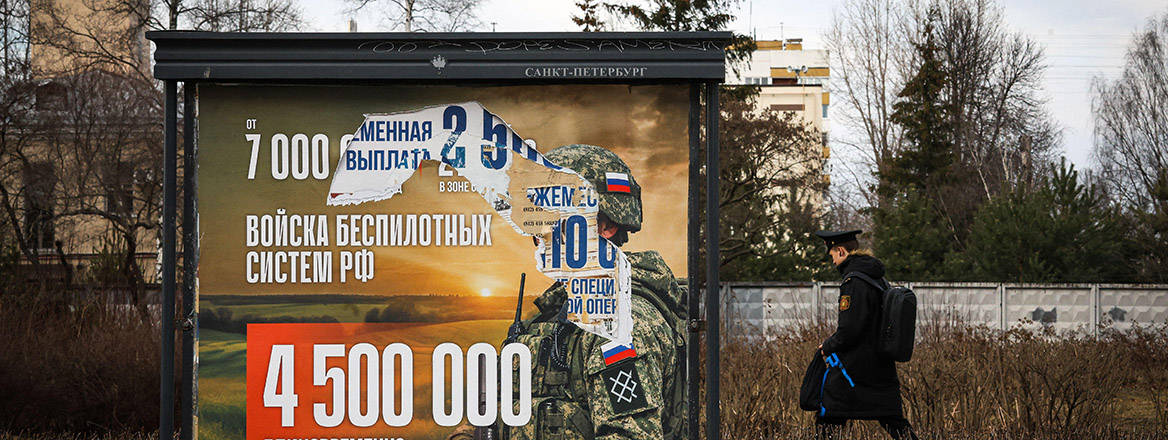
Vladimir Putin never formally ended his 2022 partial mobilisation. The question is not whether he orders another, but how long its quieter replacement can hold.
In 2022, the Kremlin called up around 300,000 reservists, triggering the largest flight of Russian men since the Soviet collapse. The decree has never been formally rescinded. Officials announced that the call-up was complete that October, but no demobilisation decree followed, with the Kremlin maintaining that none is legally required. Yet for months before this year’s election, another nationwide mobilisation remained a persistent concern. Reports of men considering whether to leave the country before polling day suggested that fears of another mobilisation had gained traction. Dmitry Medvedev, deputy chairman of the Security Council, dismissed the speculation as ‘nonsense’, and emphatic official denials showed that the prospect remained politically sensitive.
Yet, framing the issue as whether mobilisation will be re-announced misses what has happened since 2022. The Kremlin did not solve its recruitment problem. Instead, mobilisation was converted from a single visible political event into a permanent process, pushed down to regional governments and directed at Russians least able to refuse. The question is therefore whether this system has made another nationwide call-up unnecessary, or whether it is now beginning to strain.
Mobilisation Never Ended
Putin’s decree of 21 September 2022 declaring partial mobilisation has never been formally rescinded. Analysts within the UK government note the consequence: men mobilised in 2022 cannot be discharged until the mobilisation is formally terminated, except on limited grounds such as serious health problems or imprisonment.
From 1 January 2026, conscription became a year-round administrative process, with a target of 261,000 conscripts for the year, while dispatch to military units remains in two designated periods. Conscripts cannot legally be sent to Ukraine, but the system keeps the state in regular contact with eligible men and creates a steady pool of soldiers who can be pressured to sign contracts. In December 2025, Putin also signed a decree calling reservists up for training with the armed forces, National Guard and security agencies. Such measures establish the basis for rolling call-ups without a new mobilisation announcement.
Individually, each change reads as an administrative update. Together they describe a state that has made permanent what it once presented as exceptional. Ukrainian intelligence described a ‘covert mobilisation campaign’ as early as 2022. What has changed is its scale and its methods.
The Rising Price of Volunteers
So far, the engine of this system has been money rather than compulsion. Well-paid contract service, with bonuses that dwarf median wages in poorer regions, has filled the ranks without touching the reserve.
A formal mobilisation would therefore not simply mean that the army needs more men. It would suggest that the existing system has run out of people it can recruit quietly, or of regions able to finance it, without spreading the burden to groups with greater capacity to resist
This model is becoming expensive. Federal budget data indicates around 71,000 contract soldiers in the first quarter of 2026, the lowest first-quarter figure in three years and roughly 20% down year on year, even as the average enlistment payment reached a record 1.47 million roubles in March. Against Russia’s 2026 recruitment target of roughly 409,000, that is about 70% of the pace required. Medvedev has claimed some 200,000 contracts in the first half of the year, which would imply a sharp increase in recruitment during the second quarter. The figures are difficult to reconcile, but they demonstrate the cost of recruitment is rising.
That price is not paid centrally. Several regions have sharply raised their one-off payments, even as regional budgets saw record deficits in 2025. This is the detail most accounts of coercive mobilisation miss. Russia’s binding constraint is not a shortage of available men but the rising cost of persuading them. Coercion substitutes for cash at the margin, which is why it concentrates in regions where budgets are thinnest.
The reported methods follow this logic. Forced detentions and pressure to sign Defence Ministry contracts have been documented in at least 17 regions, a pattern that surged over the summer. Men have been threatened with fabricated charges or beaten until contracts were signed. In Penza, activists describe police raiding workplaces and detaining men in the street, with comparable sweeps in Ulyanovsk and Rostov.
The administrative mechanism is not new. It was seen first in 2022, when the Defence Ministry handed mobilisation quotas to regional governors. What has changed is the pressure inside it. Public sector employees and private recruiters are expected to find 20 to 30 men a month, rewarded for exceeding targets and penalised for missing them. They concentrate on men vulnerable through debt, criminal cases or addiction, whose circumstances become leverage. The pool of eligible convicts has been widened by law, while hundreds of universities now host recruitment campaigns, sometimes using expulsion as pressure to sign contracts.
The common feature is deniability. Every one of these men signs a contract, and on paper the Russian army’s recruitment remains voluntary.
Outsourcing the Political Cost
Similar logic extends beyond Russia’s borders, although not at a scale that has a significant impact on recruitment figures. Investigators have verified more than 1,400 African citizens in Russian service, while Kenyan intelligence has reported over 1,000 Kenyans recruited to fight in Ukraine, some allegedly lured by promises of civilian work. The networks appear largely to involve brokers and commercial intermediaries rather than clearly documented state-directed recruitment, and the extent of direct Russian state involvement remains contested.

A second example is North Korea’s deployment of its own forces, roughly 11,000 of whom were in Kursk oblast at the start of 2026. This is not foreign recruitment but an interstate transaction with its own strategic logic and its own price for Moscow. Neither source is numerically significant relative to Russia’s 2026 recruitment target of around 409,000. This is not implying that foreign recruits or North Korean troops can solve Russia’s manpower problem. It is that they demonstrate the Kremlin’s ability to supplement domestic recruitment through channels that do not require a nationwide call-up.
The connection between these cases and Russia’s domestic recruitment system is therefore political rather than numerical. They are different mechanisms, involving different actors and different degrees of Russian state control, but each allows Moscow to obtain additional manpower without concentrating the costs of recruitment on the Russian population. A coerced man in Penza, a deceived recruit from Nairobi and a North Korean soldier in Kursk have little in common militarily. Politically, however, none belongs to the constituency whose mobilisation would impose the greatest domestic cost on the Kremlin.
External recruitment therefore forms part of a broader pattern in which the human cost of sustaining the war is distributed across populations with very different capacities to resist, organise or impose political pressure on the Russian state.
A Durable System
It is tempting to read this as an imminent crisis, but that is not yet the case. Putin’s revealed preference over four years has been to pay rather than compel. Medvedev has claimed 200,000 contracts in the first half of 2026, and the Kremlin may still have fiscal room to keep using financial incentives while shifting much of the burden onto regional budgets. Desertion has also risen sharply, with at least 28,000 convictions and leaked documents suggesting it may be twice that, yet the system continues to replace a significant proportion of those leaving the force.
More uncomfortably, the fact that coercion falls on the socially marginal is part of why it remains politically cheap. Men with criminal records, debts or addictions have fewer avenues to convert grievance into organised pressure, while the state has closed many of the channels through which they might. Yabloko, Russia’s only registered antiwar party, was excluded from the election. The absence of protest is therefore weak evidence of consent; it may instead reflect the state’s success in preventing disparate grievances from becoming organised political pressure.

Nor does the casualty count support the strongest sustainability claims. Western estimates put Russian losses at more than 30,000 killed and wounded a month against recruitment of roughly 27,000; but killed and wounded are not equivalent, and many of the wounded return to duty. The force is therefore being replenished under considerable pressure rather than generating a large surplus of manpower for sustained expansion. The system is durable enough to avoid a new nationwide call-up, but its durability depends on keeping the costs of recruitment dispersed.
The Threshold of Mass Mobilisation
The post-election period matters even if no new call-up is announced immediately. The Kremlin is likely to continue the system already in place: reserve call-ups for training, expanded contract eligibility, and higher regional quotas. And the indicators are straightforward. Whether signing bonuses keep rising, whether coercion spreads beyond poorer and remote regions, and whether reservists move from training into sustained deployment.
A formal mobilisation would therefore not simply mean that the army needs more men. It would suggest that the existing system has run out of people it can recruit quietly, or of regions able to finance it, without spreading the burden to groups with greater capacity to resist. The question after the election is not simply whether Putin mobilises again, but how far the existing system can stretch before the human cost becomes politically visible.
That matters beyond Russia. As planning turns to how the war might end, assumptions about Russian exhaustion, including the expectation that manpower shortages will eventually influence Moscow’s decision-making, remain relevant. The system described here has so far deferred that possibility. For Ukraine and its partners, the key implication is that Russia’s manpower constraint is as political as it is demographic. Battlefield attrition alone may not force a change in course, but the constraint is not unlimited. As the costs of sustaining the war become harder to disperse, the political consequences of doing so may become increasingly difficult to contain.
© RUSI, 2026.
The views expressed in this Commentary are the author's, and do not represent those of RUSI or any other institution.
For terms of use, see Website Terms and Conditions of Use.
Have an idea for a Commentary you'd like to write for us? Send a short pitch to commentaries@rusi.org and we'll get back to you if it fits into our research interests. View full guidelines for contributors.
WRITTEN BY
Zoe Neiman
Course Assistant
RUSI International


- Jim McLeanMedia Relations Manager+44 (0)7917 373 069JimMc@rusi.org