

Putin’s Predictable Victory, Russia’s Uncertain Future

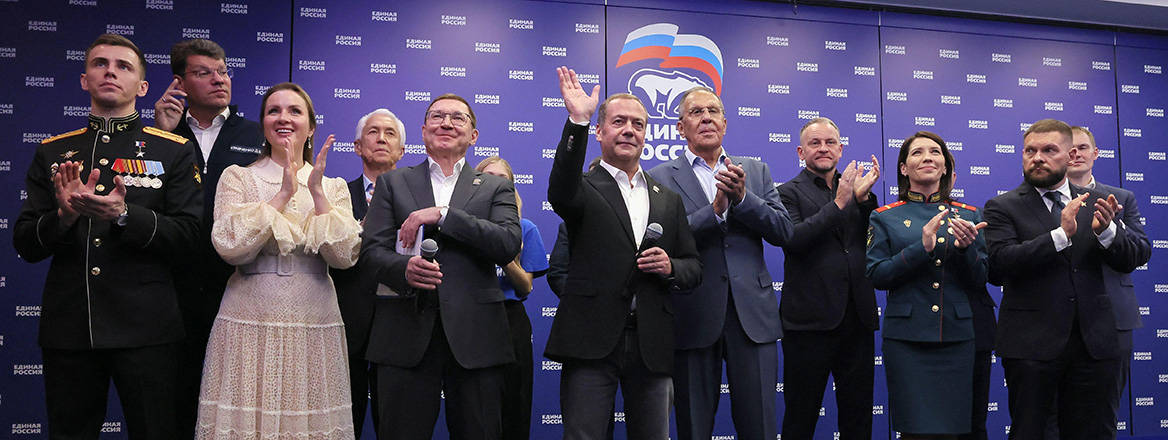
Russia’s elections were a staged affair, designed to legitimise Putin’s war on Ukraine. But elections have never decided Russia’s future. The latest ballots are no exception
Hardly anything in Putin’s Russia is more predictable than election results. During September’s three days of voting, Russians headed to the polls to elect deputies to the State Duma and regional officials. Yet, unlike in previous years, these elections took place at a time when Russians are feeling growing economic pressure and an increased sense of insecurity, driven by the success of Ukraine’s long-range drone strikes. These attacks have not only raised the costs of the war for Moscow but have also significantly strained a key Kremlin narrative, that after four and a half years of war, the regime is still able to insulate ordinary Russians from the direct impact of the conflict.
Possibly the biggest proof of this was Ukraine’s large-scale drone attack on Moscow on Sunday, 20 September, the final day of voting, bringing the war visibly into the capital. Rather than changing an already well-known election result, Ukraine exposed the widening gap between the Kremlin’s promise of security and the reality of a conflict that is increasingly reaching ordinary citizens at home.
Why Elections Still Matter?
Against this backdrop, the elections serve as an important instrument for showcasing legitimacy by demonstrating that Russians once again vote for United Russia, the party of government, thereby expressing trust in Putin and, by default, unquestioning support for his war effort in Ukraine.
To meet these goals, high voter turnout remains essential, but it must be carefully calibrated and tightly managed to avoid appearing excessive. Putin certainly has the tools to completely abandon elections, yet he prefers to present himself not as a dictator pursuing his own imperial ambitions, but as a strong, popular leader whose decisions reflect the will of the people.
Despite the predictability of the Duma elections, Russia faces an increasingly uncertain future
In a widely anticipated outcome, Russia’s ruling United Russia party secured a decisive victory in the country’s first wartime parliamentary election, winning approximately 58% of the party-list vote for half of the 450 State Duma seats, according to preliminary results released by the Central Election Commission. The party’s candidates also led in 208 of the 225 single-mandate constituencies, putting United Russia on track to retain its constitutional supermajority. This comfortable victory would allow Putin to claim that there is no internal pressure for the discontinuation of the war.
Campaign Messages
Throughout the campaign, two key themes dominated: national unity and the victory in the war in Ukraine, which go hand in hand, as well as social and economic reassurance. The messaging ahead of the vote demonstrated the central importance Putin attaches to the war. In an address on 16 September, he stressed every citizen’s responsibility to vote and to demonstrate unity around ‘common values, historical memory and love for the motherland.’ He presented electoral participation as a demonstration that millions of Russians stand behind those fighting in Ukraine.
Victory in Ukraine and the rejection of compromise in any eventual negotiations were central to United Russia’s campaign rhetoric. Moreover, for the first time since 2007, the ruling party openly rebranded itself as Putin’s party. This is a shift from previous campaigns, because Putin is neither a formal member of United Russia nor a candidate on its list, and has generally tried to preserve some distance from official affiliation, even though it is widely understood to be his political tool. The return to personalised messaging, including the slogan ‘Being for Putin is the bare minimum,’ was intended to turn a vote for United Russia into a direct expression of support for Putin, his leadership and, most importantly, his conduct of the war.

At the same time, given the mounting economic grievances, regional campaigning mainly focused on familiar promises of improved public services, healthcare, wages and living conditions, while avoiding discussion of the war’s human and economic costs. This division of the debate allowed the Kremlin to frame the election as a patriotic rallying around the flag while also offering voters, particularly in the regions, more traditional social and economic assurances.
Removing Symbolic Dissent
The dominance of the war as an electoral theme was also evident in the removal of even marginal sources of political opposition. By cancelling the registration of Russia’s only registered anti-war party, Yabloko, after it had initially been granted a right to run in elections, the regime demonstrated that there is no appetite to take even a very marginal risk. Yabloko had consistently polled in the low single digits, and even the call from Yulia Navalnaya, the widow of Russian opposition leader Alexei Navalny, for anti-war voters to support the party was unlikely to have translated into a meaningful electoral challenge. The decision was therefore less about preventing Yabloko from winning seats than about closing the last formal political outlet for anti-war sentiment and maintaining complete control over the public narrative about the war in Ukraine.
Instead, the Kremlin elevated war veterans on United Russia’s candidate lists, presenting participation in the invasion as a route to political advancement and public recognition. This demonstrates that contribution to the war effort is rewarded, while also signalling to established elites that a new wartime political class is being based on demonstrated loyalty and service to Putin’s central political project.
Post-Election Uncertainty
Despite the predictability of the Duma elections, Russia faces an increasingly uncertain future. Putin may project satisfaction at United Russia’s landslide, but the vote does not resolve the problems he is currently facing. Ukraine is demonstrating growing confidence in its long-range strike campaign, increasingly targeting Russian cities and critical infrastructure. The Kremlin can manage public messaging, but it cannot blindfold citizens to the tangible consequences of the war when air-raid alerts, flight disruptions, fuel shortages and drone attacks become part of daily life.


Meanwhile, negotiations remain effectively stalled. Although Moscow may initially have judged the process to be moving in its favour, there is no indication that Ukraine or its partners are prepared to accept Russia’s maximalist demands, especially under the current status quo. Nor is Russia close to imposing those demands militarily. Its forces continue to make incremental territorial gains, but only at a slow pace and at a very high human and material cost. The prospect of capturing the entire Donbas region through battlefield advances or using limited gains to force Ukraine into accepting Moscow’s terms remains unfeasible.
Putin therefore faces a narrowing set of options, and one prospect that is causing growing concern among Russians is another wave of mobilisation. With the Duma elections now behind him, he may seek to present United Russia’s landslide as evidence of public backing for a more demanding phase of the war.
Several indicators suggest that the Kremlin may be preparing for this scenario. The National Guard has reportedly conducted mobilisation-related training and evacuation preparations, while its chief has issued a decree assigning the force responsibilities during a mobilisation period, under martial law and in wartime.
Although any new call-up would most likely be partial, it would still carry substantial political risks. The September 2022 mobilisation triggered a large outflow of Russians into neighbouring countries and generated considerable anxiety at home. A further and potentially more coercive wave could deepen war fatigue and undermine the Kremlin’s claim that it has successfully insulated ordinary Russians from the direct costs of the conflict.
It is unlikely that mobilisation alone would trigger regime change or mass nationwide protests. But, combined with Ukraine’s strikes inside Russia, deteriorating economic conditions and the cumulative exhaustion of a prolonged war, it could seriously erode the Kremlin’s ability to maintain the appearance of normality.
© RUSI, 2026.
The views expressed in this Commentary are the author's, and do not represent those of RUSI or any other institution.
For terms of use, see Website Terms and Conditions of Use.
Have an idea for a Commentary you'd like to write for us? Send a short pitch to commentaries@rusi.org and we'll get back to you if it fits into our research interests. View full guidelines for contributors.
WRITTEN BY
Natia Seskuria
Senior Research Fellow, Russia, Eurasia, and Black Sea Security
International Security

- Jim McLeanMedia Relations Manager+44 (0)7917 373 069JimMc@rusi.org