

Leipzig Sabotage: Why Transport Underpins NATO and Russia’s Defences

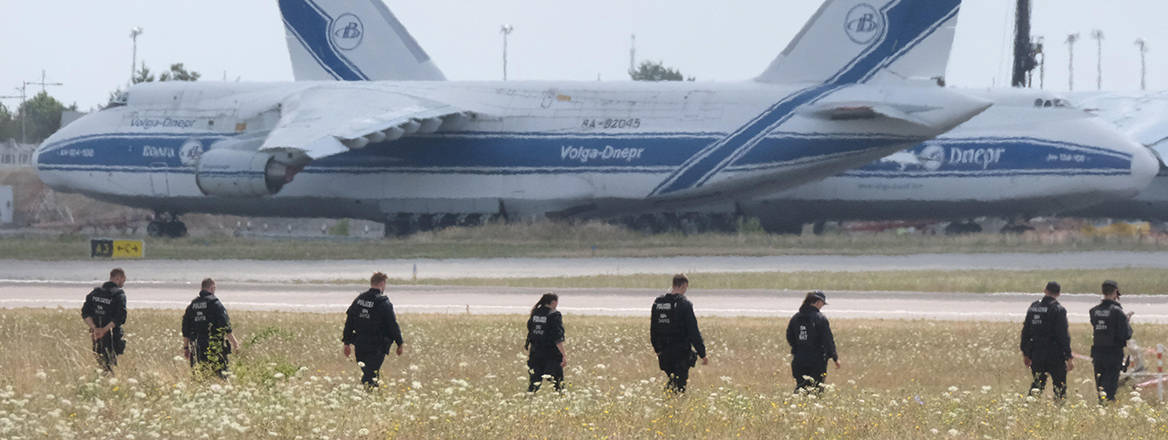
Germany’s attribution of the Leipzig drone attack to Russia shows why transport networks now sit at the centre of both NATO’s and Russia’s defence.
The Leipzig airport drone attack, which the German authorities have now formally attributed to Russia, was significant in several ways.
First, while it was technically one in a series of Russian sabotage attacks of NATO infrastructure in Europe – and it essentially failed – the complexity of the approach demonstrated Russia’s increasing investment in undermining NATO, irrespective of the outcome.
Second, it showed that Moscow – and likely NATO itself – remains unclear on the current red lines that would prompt a military response.
And third, it demonstrated why transport infrastructure is so critical in underpinning defence, and the many vulnerabilities that it contains at multiple points along the supply chain. This is just as true for Russia as it is for NATO.
Unpacking Leipzig
In and of itself, the attack is not new. It is not even the first time Leipzig airport, an important NATO hub used for airlifting arms and equipment into Ukraine, has been targeted. Indeed, earlier this year, your author wrote about some of the discernible patterns in Russia’s targeting of NATO infrastructure in this manner, particularly the increased risks to international transport networks and logistics hubs, as Russia continues to test NATO’s red lines.
But as that report suggests, for now Russia’s attacks of NATO infrastructure lack the coordination and coherence to disable transport infrastructure for long periods and cause significant disruption. That said, Russia continues to capitalise on the inconsistencies and poor coordination between European countries transporting aid to Ukraine, particularly vulnerabilities at different stages in supply chains such as loading and unloading at multiple points while vehicles are in transit or idling, providing greater opportunity for sabotage. In this latest incident, available information about the target of attack and the means to attack it fit with previous patterns of Russian intelligence behaviour.
If an ancillary goal of this sabotage is to probe what NATO might do in response, then that line has not yet been clearly delineated
The human factor persists – the suspects have been preliminarily identified as a man of Russian origin but with a Latvian passport, and another with a Belarusian passport, entering Germany on an Italian tourist visa. Russia’s use of third-party proxies – which carries its own risks – has been increasingly common not only due to the strategic distance from the intelligence services that this creates, but also because it is somewhat of a necessary evil, as the GRU has sought to rebuild its deconstructed intelligence operations in Europe after 2022.
Here, the sabotage appears to have been much more carefully coordinated than the various arson attacks that have been attributed to the GRU previously, with multiple nationalities at play, alternative transport routes taken, and an apparent professional degree of understanding of logistics. This is different to the run-of-the-mill Russia-sponsored arson attacks in the UK, which, while damaging, have been mostly a step up from vandalism.
Crucially – this attempt still failed.
But that might matter less to Moscow, as one of the various aims of these sabotage campaigns is amplifying a sense of discord, and the suggestion that Russia is capable of being behind any disruption to transport or cargo services in Europe.
Here, amorphous goals work to Russia’s advantage. If the aim is to intimidate E3 countries like Germany into scaling down support for Ukraine, the opposite has been proven, as Berlin announced soon afterward its intention to increase intelligence sharing and military assistance to Ukraine.
But perhaps for Moscow, no matter. If an ancillary goal of this sabotage is to probe what NATO might do in response, then that line has not yet been clearly delineated. Partly this is because NATO itself does not know what those lines are, and, in the absence of confirmation, Russia is expanding its activities to fill the vacuum left by this uncertainty.
Russia’s Logistical Adjustments
What Leipzig does raise is the importance of defending transport infrastructure, the difficulties in doing so, and some of the longer-term readjustments that may be necessary.

In response to the incident, Germany pledged to boost its air defences using anti-drone shields capable of defusing drone bombs and other IEDs. But the problem is wider than defending a single airport, and requires a shift in how transport networks ought to be considered as a fundament of national security.
It is therefore worth considering how, under pressure from Ukraine’s targeting of Russia’s supply chains, Russia is shifting its own infrastructure focus, in a country where transport is considered a vital military organ.
Russia is still regrouping from Ukraine’s comprehensive 40-day campaign against its logistical infrastructure in recent months, and the Kremlin has been forced to confront the long-term security and reliability of its supply chains. Although that campaign did not bring the war to a desired political conclusion, Ukraine’s long-range drone campaign nevertheless poked holes in Moscow’s assumption that its land and maritime supply chains located deep in Russian territory (the tyl, or rear) were immune to attack.
Russia is still battling issues around securing supply chains to the frontline via its southern route, but refocusing its efforts on the High North and the Far East is part of the Kremlin’s intent to both circumvent sanctions and tie up its national security with its infrastructure. Two recent developments demonstrate this well.
First, a new road bridge in the Far East between Russia and North Korea, which was formally announced last year, is now complete – a swift construction turnaround considering the usual issues of corruption or political disagreements that tend to plague infrastructure projects in Russia. The road bridge across the Tyumen River is important – Russia receives ammunitions, troops and missiles from the DPRK via this route, which is geographically difficult for drone systems to target and disable. This bridge will be the main artery for further deliveries of military supplies to Russia in the coming months and is physically challenging to disrupt, ensuring a steady flow of supplies through the winter.

Second, Putin a few days ago launched the Vostok Oil Arctic project – an infrastructure project linking up oilfields in the Krasnoyarsk region with the new Sever Bay port on the Yenisei River, designed to ship oil to consumers in Asia and Europe and take the pressure off some of Russia’s other overloaded ports. This is part of an overarching project connecting sea terminals to rail and Russia’s inland waterways.
These developments are significant because they expand Russia’s network of High North ports that are more difficult to target – Ukraine’s attacks on Russia’s Black Sea ports in recent months obstructed shipping via the south, forcing Russia to seek alternative export routes.
This is also a move to connect and secure Russia’s internal waterway systems, which have been long neglected and are a serious vulnerability that Ukraine’s drone attacks laid bare – Russia’s shadow fleet operating along the Don Canal and via the Kerch Strait were essentially sitting ducks. Using alternative waterways in the North comes with its own issues, as many are seasonally operational, underfunded and require expansion to allow an increase in loading capacity. But Russia is clearly shifting and adapting its critical national infrastructure to account for weaknesses in the tyl that the war has pried open.
While this is more challenging for NATO given its geographical expanse and the need for multistate input, Leipzig should remind us that land, sea and air transport networks across the Alliance – and some of the people that operate them – are uniquely vulnerable to exploitation, and require a coordinated effort to harden them against Russia.
© RUSI, 2026.
The views expressed in this Commentary are the author's, and do not represent those of RUSI or any other institution.
For terms of use, see Website Terms and Conditions of Use.
Have an idea for a Commentary you'd like to write for us? Send a short pitch to commentaries@rusi.org and we'll get back to you if it fits into our research interests. View full guidelines for contributors.
WRITTEN BY
Emily Ferris
RUSI Senior Associate Fellow, International Security


- Jim McLeanMedia Relations Manager+44 (0)7917 373 069JimMc@rusi.org