

Development Aid as Security Policy?

Recent cuts to foreign aid have raised serious humanitarian concerns. They also offer vital insights into the relationship between development and security going forward.
As aid budgets come under mounting pressure, there has been a revival of ‘transactional’ arguments that development aid can help bolster security. The problem is that this reasoning relies on a chain of elements, some of which have not received much scrutiny in empirical work. First is the question of whether development aid actually curbs armed conflict.
A Double-Edged Sword
Conceptually, the answer is ambiguous, as development aid is typically a double-edged sword. On the one hand, we know from an impressive body of evidence that poverty and desperation are powerful breeding grounds for armed conflict. In this context, aid programmes may create jobs and attenuate poverty, making fewer people willing to enrol in paid engagements on the battlefield, such as joining a warlord. In the literature, this is often called the ‘opportunity cost effect’.
On the other hand, inflows of aid may increase the availability of valuable, appropriable commodities, stoking rent-seeking behaviour and armed conflict. This second, countervailing force is the ‘rapacity effect’.
Given these two opposing forces, it is unsurprising that empirical studies have found a whole range of contradictory results. For instance, a series of articles have highlighted that aid and cash transfer programmes can exacerbate armed conflict, while others suggest they may contribute to a drop in fighting. One challenge with all these statistical findings is that they focus on particular randomised controlled trials (RCTs) or ‘natural experiments’, where a treatment group in one country or in a subcountry region is compared with a control group in the same local setting. This makes it difficult to rule out displacement or spillover effects. Conflict may decrease in ‘Country A’ but surge in neighbouring ‘Country B’, as armed groups move elsewhere. This is what economists call a ‘partial equilibrium’ analysis, which does not account for ‘general equilibrium’ effects.
Different forms of international engagement – whether developmental or security-related – may affect the trajectory of armed conflict, with consequences that need not remain confined within national borders
One way to tackle these methodological constraints is to study huge, continent-level impacts. However, this comes with its own difficulties, whether practical – finding RCTs or natural experiments of sufficient scale – or conceptual, drawing on different contexts that risk ‘comparing apples with oranges’.
What the USAID Shutdown Reveals
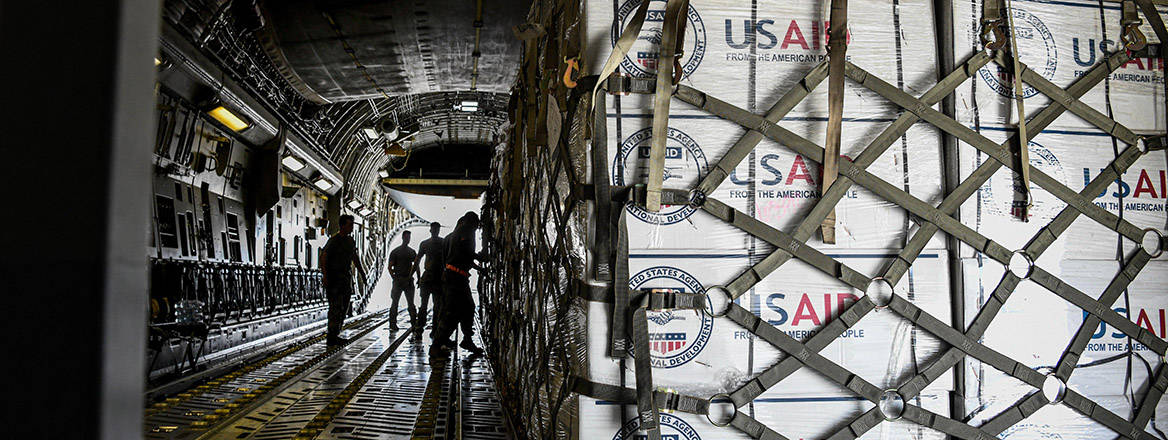
One exception to this is a recent unanticipated policy U-turn of unprecedented scope. Within days of taking office in January 2025, the second Trump administration abruptly shut down the US Agency for International Development (USAID) – one of the world’s largest aid agencies, active in over 100 countries – triggering immediate concerns about stability in fragile regions that had depended heavily on its programming. To investigate this, we used geocoded aid disbursement data, merged with violent event records across African subnational regions, to compare conflict outcomes in the 10 months before and after the shutdown between areas with high and low historical exposure to USAID funding.
Your authors found that after the shutdown, regions receiving more aid per capita experienced relatively more conflict. For regions being among the top US aid recipients (in other words, at the 75th percentile of exposure to US aid), the withdrawal of support was associated with an approximately 6.5% greater probability of any conflict event, compared to those regions that received no aid from the US. The number of conflict events increased by 10.6%, battle counts rose by 6.9%, and battle-related fatalities went up by 9.3%.
We also ran a so-called ‘event-study’ analysis, which is a statistical technique tracking the magnitude of effects over a given time period. It found no evidence for pre-existing differences in conflict trends between high- and low-exposure regions before the shutdown. For this alternative statistical approach, the effects remain of similar size, with a 12.3% relative increase in the number of conflict events. The effects also persist over the sample period.
Protests started almost immediately, while fighting intensified progressively over subsequent months. Countries with stronger and more inclusive political institutions absorbed the shock better, suggesting that governance quality may buffer the destabilising effect of aid withdrawal. The study concludes that the underlying mechanism may be asymmetric adjustment: when aid disappears suddenly, the economic incentives that discourage violence (opportunity cost channel) may weaken faster than the rents that armed groups compete over (rapacity channel).
Implications for Donors
It is of course too early to tell what medium- and long-run effects the US aid cuts will have on armed conflict or other socioeconomic outcomes. It would similarly be speculative to draw conclusions on the effects of other donor cuts to foreign aid.
However, it is worth considering what these patterns mean for policy trade-offs if decreases in development aid across donors, continents and times may lead to a long-run surge in insecurity. In such an environment, donor nations may end up substituting development assistance with security assistance. The broader lesson is that different forms of international engagement – whether developmental or security-related – may affect the trajectory of armed conflict, with consequences that need not remain confined within national borders. Underlining the parallel between these policy levers, evidence from Afghanistan suggests that disengagement from international security assistance can also boost violence.

Help your search results show more from RUSI. Adding RUSI as a preferred source on Google means our analysis appears more prominently.

Beyond the countries directly affected, armed conflict often generates spillovers that cross national borders. Violence can trigger refugee movements, disrupt trade and investment, and create opportunities for armed groups to operate across frontiers. As a result, even conflicts that originate in relatively localised settings may have wider regional consequences. To the extent that development assistance contributes to stability, its effects may therefore extend beyond the immediate recipients of aid.
The Peace Multiplier
The scenario in which a collapse of global aid drives conflict recalls the vicious cycles and war traps that have already been highlighted in the existing academic literature. Wars destroy physical, social and human capital, which in turn make future fighting more likely. In contrast, public policies that invest in productivity, trust, education and health will reduce the scope for armed fighting, and boost the economy. These policies may not only alleviate human suffering but may also end up paying for themselves.
Well-designed development assistance could generate similar peace multipliers. To the extent that aid programmes increase productivity without raising the potential for appropriation, they can unambiguously curb conflict incentives. In this way, they can at the same time foster development, reduce armed conflict and boost regional security with positive spillovers globally. Human capital is a key ingredient of productivity and at the same time human capital cannot be appropriated – contrary to physical capital. Hence, the types of policies that allow us to reap the benefits of this ‘peace multiplier’ are to invest in ‘people’: in school construction, better health treatments and labour-market access. These investments entail the ‘double dividend’ of fostering both development and global security.
© Oliver Vanden Eynde, Dominic Rohner, Uwe Sunde, Austin L. Wright and Jing-Rong Zeng, 2026, published by RUSI with permission of the authors.
The views expressed in this Commentary are the authors', and do not represent those of RUSI or any other institution.
For terms of use, see Website Terms and Conditions of Use.
Have an idea for a Commentary you'd like to write for us? Send a short pitch to commentaries@rusi.org and we'll get back to you if it fits into our research interests. View full guidelines for contributors.
WRITTEN BY
Oliver Vanden Eynde
Guest Contributor


Dominic Rohner
Guest Contributor

Uwe Sunde
Guest Contributor

Austin L. Wright
Guest Contributor

Jing-Rong Zeng
Guest Contributor

- Jim McLeanMedia Relations Manager+44 (0)7917 373 069JimMc@rusi.org