

The Battle for Bab Al-Mandeb is Becoming a Contest for Regional Power

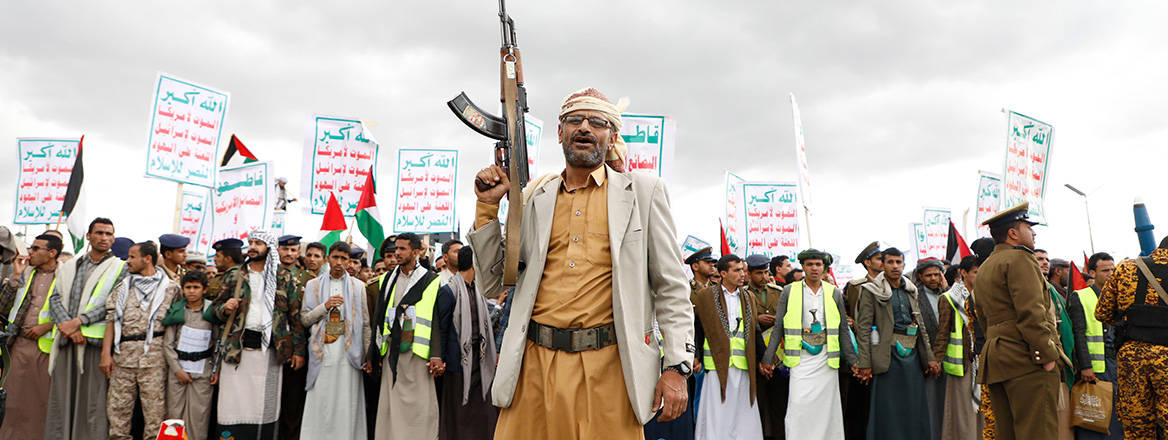
Houthi gains around Bab Al-Mandeb have exposed rival visions of Gulf security, as Saudi Arabia, Israel, Turkey, Pakistan and the US weigh competing responses.
Over the course of a few fateful days, Yemen’s Ansar Allah movement – the Houthis, an Iran-aligned group designated by the US as a foreign terrorist organisation – crossed several regional red lines. Its fighters made lightning gains along Yemen’s Red Sea coast, seizing Mocha, Dhubab and strategically important islands around Bab Al-Mandeb. On 8 September, the group also launched attacks against Saudi Arabia that injured more than 70 civilians. Riyadh subsequently said it had intercepted a Houthi drone heading towards Mecca, Islam’s holiest city, an allegation the Houthis deny.
At the same time, a separate drone attack, reportedly launched by an Iran-aligned armed group operating from southern Iraq, struck Saudi Arabia’s East–West Pipeline. Running from the oil-processing centre of Abqaiq in the Eastern Province to the Red Sea port of Yanbu, the pipeline has become an economic lifeline for the Kingdom as disruption around the Strait of Hormuz continues to constrain Gulf energy exports.
On Saturday 19 September, the Houthis claimed responsibility for strikes against Riyadh, as well as an Aramco facility at Yanbu. Further consolidation of Houthi control around the Bab Al-Mandeb is compounded by the stubbornly unresolved crisis over the Strait of Hormuz. For now, the Houthis claim that only Saudi-linked vessels are prohibited from safe passage, but this declaration of selective targeting offers little reassurance to mariners and markets as they brace for the fallout of two interlinked maritime crises at two of the world’s most important chokepoints, and the prospect of a deeper global energy shock.
For close watchers, there have been indications of Houthi mobilisation for some time. Despite substantial investment in improving the military capabilities and training of the Saudi-supported Yemen government armed forces, internal fragmentation in the counter-Houthi camp has been a nagging and corrosive issue. The lack of resolve across Gulf governments on the best course of action, amplified by tensions between Saudi Arabia and the UAE, and the failure of Western allies to fully lean into the problem have meant that over time the Houthis have not only been able to hold their influence, but also to implement a more ambitious political and military strategy.
Emboldened by their advances, the Houthis have, for now, little incentive to de-escalate. Their forces are pressing towards Marib and Taiz. As Riyadh weighs its options, it is unlikely to publicly admit a willingness to offer a revised containment arrangement. More likely is that Riyadh believes that the surge in Houthi attacks on sensitive Saudi infrastructure, combined with a growing threat to maritime traffic and energy supplies, will eventually leave Trump with little choice but to resume strikes against Houthi positions along the Red Sea coast. Just what action Trump may eventually approve remains deeply unclear but a security alert was issued by the US State Department to all US citizens in the Middle East, and Iran claimed that it had intelligence that the US was preparing to resume major bombing operations.
Tehran appears to favour sustained escalation below the threshold of another major US response, yet the Houthis have their own interests and may not be easily reined in
A hurried counter-offensive by Yemeni government forces could backfire, possibly resulting in further territorial losses and reinforcing the Houthis’ narrative of triumph. Instead, a more prudent Saudi response may be to wait and see what its regional allies are willing to commit, while focusing resources on defending existing lines in vulnerable and contested territory inside Yemen, strengthening coordination among the fragmented anti-Houthi forces, and preserving space for diplomacy.
The bigger military and diplomatic dilemma for the US, UK and regional allies is whether this is a Saudi problem requiring Saudi retaliation, or one that requires a multilateral response. The Houthi advance exposes two intertwined challenges, neither of which has a ready solution. The counter-Houthi forces inside Yemen have demonstrated structural vulnerabilities including fragmented command and control and contested decision-making. Outside Yemen, the scale of the current threat level is not matched by allies’ willingness to absorb the cost of confronting it directly, especially if doing so may trigger Houthi retaliation against their own territory, infrastructure or interests.
The international response has not, so far, taken the form of a large-scale or decisive military operation. There are several, mostly valid, reasons for this restraint. The Houthis maintain that navigation through Bab Al-Mandeb remains open to international shipping, while ready to enforce their declared ban on Saudi vessels. The operational picture also remains fluid and highly contested. Houthi forces face a fragmented counter-campaign led by the Saudi-backed Yemeni government, while external powers have yet to agree on either the objective or the limits of a broader response. In this vacuum, the nascent regional reaction is beginning to expose fault lines between competing visions of regional security (fault lines already widened by the US–Iran war).
Among the top contenders as authors of a new regional order are the signatories of the Mecca Joint Defence Agreement, a trilateral Saudi–Turkey–Pakistan collective-defence framework, signed on 7 August. The second comes from a more unexpected source: reported Israeli offers of intelligence and operational support to Saudi Arabia. The third is an evolving US-led architecture in which Washington coordinates regional partners and supplies intelligence, logistics and military integration, while seeking to share and, where possible, avoid carrying the burden of direct combat itself.
The Houthis’ Advance is Both Iranian and Yemeni
In Iran, most domestic commentary has welcomed the Houthi advance, although differences are emerging over how the resulting leverage should be used to maximise gains, how closely Iran should associate itself with it, and whether the Houthis can ultimately be contained. One reading has even portrayed control over the two straits as components of a new, post-Western regional order. Media sources linked to the Iranian security establishment have framed the Houthi advance as evidence of Saudi military exhaustion and as vindication of the wider ‘resistance’ strategy.

For Iranian strategists, even a Houthi advance that is eventually reversed may still establish a valuable precedent. Taken together with the reported attack on Saudi Arabia’s East–West Pipeline, it demonstrates how the Kingdom and its critical infrastructure can be placed under pressure from multiple directions, while demonstrating that the IRGC (Islamic Revolutionary Guard Corps) and its proxies retain options.
But Iran may be overplaying its hand. Disrupted shipping is also raising the cost of Iranian trade, while China – Iran’s most important oil customer – has reportedly pressed Tehran to restrain the Houthis. What difference this may make is questionable. And while the Houthis’ lightning offensive may be seen in Tehran as extra bargaining power in the short term, it simultaneously risks unfurling tighter sanctions, maritime interdiction and multilateral security coordination against the Houthis. A deepening global oil shock will also undeniably hurt Iran domestically and raise the cost of an open-ended confrontation with the US for a population already buckling under inflation and rising costs.
Tehran appears to favour sustained escalation below the threshold of another major US response, yet the Houthis have their own interests and may not be easily reined in. The postponement of the Oman meeting between Gulf states and Iran, reported earlier amid reported Saudi objections, is one indication that Houthi pressure may already be complicating Iran’s wider diplomacy.
The First Test of the Mecca Joint Defence Agreement?
The Mecca Joint Defence Agreement, signed on 7 August, declares that an armed attack against one member will be treated as an attack against all three. Crucially, the public declaration does not specify an automatic military response, an integrated command structure or predefined contingencies. Although the agreement’s Strategic Political and Defence Committee held its first meeting on 31 August, nothing yet exists that would qualify it as a working NATO-like structure.
Ankara has direct interests in freedom of navigation through the Red Sea, its expanding presence in Somalia and the Mediterranean–Suez–Bab Al-Mandeb trade corridor. Those interests could support Turkish contributions in intelligence, early warning, maritime surveillance or air defence. They do not, however, automatically translate into a willingness to join a Saudi-led war inside Yemen.

Pakistan has so far adopted a more forward-leaning public position. On 16 September, Defence Minister Khawaja Asif said that Houthi attacks spilling into Saudi territory could activate the pact and, following the alleged attempt to target Mecca, declared that the ‘Agreement applies to us, and we will fulfil our duty’. He pledged that the defence of Mecca and Medina is a religious obligation extending beyond the terms of any formal agreement. It is unclear how much of such statements reflect operational readiness and a political commitment to absorb the costs of any military action, rather than signalling symbolic solidarity. Islamabad’s reported decision to convey a Saudi warning to Tehran to restrain the Houthis suggests that, for now, it is seeking to turn its defence commitment into diplomatic leverage rather than military action inside Yemen.
Israel’s Offer
Israeli media reporting that CENTCOM (US Central Command) recently facilitated Saudi–Israeli discussions over possible intelligence assistance against the Houthis, while unverifiable through open sources, highlights both the perceived opportunities and political sensitivities surrounding the emerging regional response and how Israel may seek to recast its role as a security provider for Saudi Arabia and the Gulf. According to reports attributed to anonymous regional diplomatic sources, the offer of Israeli assistance entails sensitive intelligence and targeting information, with US channels acting as the intermediary.
Israel has accumulated considerable intelligence on Houthi missile sites, launch systems, maritime capabilities and command structures through its own confrontation with the group. Separately, the UAE, an Abraham Accords signatory, has established security and intelligence channels with Israel and previously received an Israeli offer of assistance following Houthi attacks on Abu Dhabi in 2022. As a result of such engagement, Israel may have an intelligence advantage through the network of relationships and surveillance infrastructure likely developed by the UAE in southern Yemen. Areas controlled by the UAE-backed Southern Transitional Council (STC) provided access to strategically important territory overlooking the Gulf of Aden and the approaches to Bab Al-Mandeb.
The sensitivities aside, it is plausible that Israeli intelligence support could ease some of the immediate pressure on Saudi Arabia by improving early warning and providing counter-Houthi targeting information. Some Israeli policymakers see the current convergence of Iran-linked threats over the Red Sea, Suez Canal and Strait of Hormuz as an opportunity to showcase Israel’s intelligence, tactical and operational capabilities and embed such cooperation within a wider regional security architecture that may, over time, improve the conditions for Israel–Gulf normalisation. But none of this should be mistaken for an imminent political breakthrough between Israel and Saudi Arabia.
US Restraint is Not the Same as US Withdrawal
The Trump administration’s 2025 National Security Strategy describes its Middle East approach under the heading ‘Shift Burdens, Build Peace’. The US response of restraint – for now – in the face of reported Saudi calls for counter-Houthi support can be read as an extension of that doctrine, and represents the dominance of the ‘no forever wars’ mantra in the GOP (Republican Party). In this worldview, America supplies coordination, intelligence, logistical infrastructure and political cover while expecting regional states to contribute more of the operational capacity. The recently proposed $24.3 billion F-35 sale to Saudi Arabia is an immediate, if not uncontested, manifestation of this approach. Yet Saudi access to advanced platforms would still bind Riyadh closely to the wider US security architecture through training, maintenance, intelligence and operational support.

Claims about an imminent or irreversible US withdrawal from the region are premature. The same 2025 US strategy document states, after all, that ‘America will always have core interests in ensuring that Gulf energy supplies do not fall into the hands of an outright enemy, that the Strait of Hormuz remain open, that the Red Sea remain navigable…’ Axios reported that CENTCOM commander Admiral Bradley Cooper recently convened the military chiefs of Israel, Saudi Arabia and six other Arab states in Germany. According to officials briefed on the meeting, Cooper assured participants that US forces would not withdraw from the region despite Iranian attacks on American bases. CENTCOM confirmed that the meeting took place, although not the substance of Cooper’s remarks.
The US may be seeking to step back from automatically carrying the burden of direct combat, but it remains the only actor capable of bringing Israel, Saudi Arabia, Qatar and other regional militaries into the same security framework.
What Should the UK Do?
Having joined Bahrain in requesting the recent UN Security Council meeting on Yemen, the UK should reinforce the position that developments in Yemen cannot be insulated from the wider confrontation with Iran. Its most sustainable contribution would lie in intelligence-sharing, maritime surveillance, early warning, commercial-shipping protection and better coordination between existing naval missions – not another open-ended bombing campaign.
The UK’s relationships with Saudi Arabia, the UAE, Turkey, Pakistan and Israel grant it a useful role in preventing competing security initiatives from working at cross-purposes. But for this diplomatic toolkit to be useful, there would need to be a political will to actually use it. Moreover, any defensive effort must remain connected to a Yemeni political track, including pressure to improve coordination among government-aligned forces and limit further humanitarian harm to an already impoverished, war-fatigued population. In parallel, the UK should intensify sanctions enforcement, maritime interdiction and action against the procurement, financing and smuggling networks that sustain Houthi missile and drone capabilities. This includes an effort to deepen its intelligence and analytical focus on the Houthis’ expanding connections and operational reach in Somalia.
The UK’s room for manoeuvre is admittedly constrained by competing demands on an already stretched military. With support for Ukraine and deterrence along NATO’s eastern flank likely to remain the principal effort, especially against the backdrop of recent warnings about Russian intent to test NATO’s deterrence mechanism, the UK may struggle to respond to a rapidly deteriorating Red Sea crisis with the speed or resources it requires – making early contingency planning with regional and international partners all the more important.
© RUSI, 2026.
The views expressed in this Commentary are the author's, and do not represent those of RUSI or any other institution.
For terms of use, see Website Terms and Conditions of Use.
Have an idea for a Commentary you'd like to write for us? Send a short pitch to commentaries@rusi.org and we'll get back to you if it fits into our research interests. View full guidelines for contributors.
WRITTEN BY
Dr Burcu Ozcelik
Senior Research Fellow, Middle East Security
International Security


- Jim McLeanMedia Relations Manager+44 (0)7917 373 069JimMc@rusi.org