

Measuring Lethality: Army Combat Power and Force Design

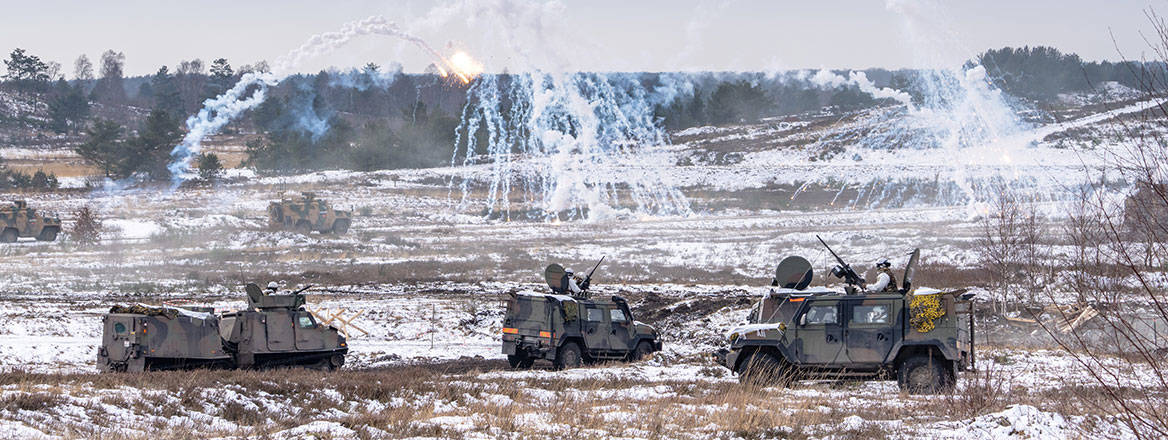
This Research Paper addresses the utility of measuring lethality as a focal point in force design.
Overview
With the UK and US military facing potential numerical disadvantages in future conflicts, this Research Paper explores how lethality – defined as the rate at which a force inflicts damage relative to the casualties it incurs – can be used as a metric to guide force development and ensure operational success. Lethality should be understood as the output of combat power, or an attempt to predict effect rather than inputs to operations.
Key recommendations include:
- Adopt a multi-metric approach to measuring lethality: Avoid oversimplified, aggregated metrics that obscure critical dependencies. Instead, measure lethality using four distinct metrics: overmatch, potential, endurance and efficiency.
- Develop an overmatch matrix: Map out enemy systems and align British Army capabilities to evaluate the proportion of the enemy that is overmatched or held at risk.
- Evaluate potential lethality: Assess the maximum damage a unit can inflict under optimal conditions and identify gaps in training or capability that hinder performance relative to that potential.
- Focus on endurance: Measure how long a force can sustain lethal output before requiring resupply or rotation, emphasising survivability and logistical support.
- Prioritise efficiency: Evaluate weapons performance relative to the cost and industrial capacity to sustain effect, to enable lethality to be maintained over the course of a protracted conflict.
Register or log in to continue reading
Account creation is quick, free and gives access to all RUSI research and more
- FREE account
- One-time set-up
- Easy to manage
Available Downloads
WRITTEN BY
Nick Reynolds
Research Fellow, Land Warfare
Military Sciences


Dr Jack Watling
Senior Research Fellow for Applied Military Sciences
Military Sciences

- Jim McLeanMedia Relations Manager+44 (0)7917 373 069JimMc@rusi.org