

Evaluating Russia's Helicopter Programme Between 2022 and 2026

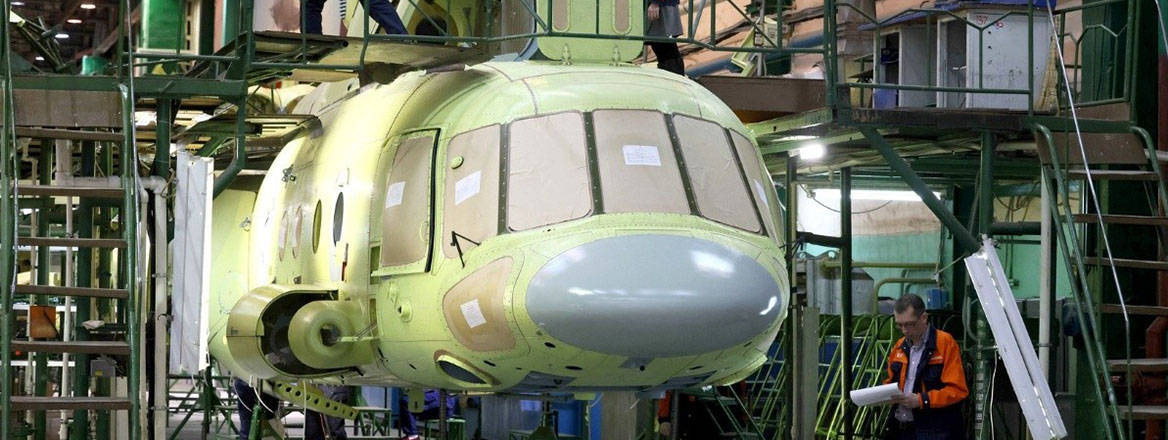
Russia remains committed to its national helicopter industry in the face of significant attrition and the loss of the international market.
Overview
Russia's interest in helicopters remains strong: state-backed civilian investment is helping to replace wartime losses, preserve military-relevant production capacity and sustain a mobilisable reserve of aircraft, crews and support infrastructure.
This paper assesses Russia's helicopter programme from 2022 to 2026. It finds that by using civilian backed programme to support production, Moscow is maintaining a dual-use helicopter ecosystem that directly benefits the armed forces.
This has permitted Russia to replace Mi-8 losses incurred in Ukraine as part of its national fleet and sustain ongoing deliveries. However, the sector faces serious structural pressures: the collapse of export revenues, cost-capped state procurement, supply-chain disruption, debt and a persistent shortage of engines and spare parts. Engine production at UEC-Klimov likely remains the main constraint on higher output and on the operational readiness of the wider fleet.
Key Recommendations
- Treat civilian helicopter procurement as defence-relevant investment, given the common industrial base, adaptable airframes and Russia’s state-owned national fleet framework.
- Consider ongoing industrial investments as a key indicator that Russia retains an interest in air assault forces and exploiting vertical lift to support military operations.
- Track the KPGA-2030 mid-programme revisions for evidence of changes in funding, production priorities and military demand.
- Assess the shadow reserve alongside military inventories, which includes pilots, maintainers, repair capacity and state-leased Mi-8s.
- Monitor engine production and spare-parts availability as the leading indicators of Russia's ability to increase helicopter output and maintain fleet readiness.
For defence and security stakeholders, this paper shows that Russia retains a viable helicopter industrial base and can sustain core Mi-8 production, but its ability to expand output or restore broader fleet availability depends on overcoming engine and component constraints.
Register or log in to continue reading
Account creation is quick, free and gives access to all RUSI research and more
- FREE account
- One-time set-up
- Easy to manage
Introduction
Russia's national state inventory has replaced the approximately 60 Mi-8 helicopters lost during fighting in Ukraine. Furthermore, industry is delivering a steady output of helicopters thanks to a large-scale investment programme that strengthens Russia's industrial base and its shadow reserve. This is despite navigating structural challenges, including profit-capped procurement orders, supply-chain disruption and the loss of the export market.
To evaluate the current state of the Russian helicopter industry, the research for this paper focuses on Russia's dual-use 'Hip' helicopter fleet – the traditional 'cash-cow' of the Russian helicopter industry and their associated TV3-117/VK-2500 engines.
Media reports and leaks have previously offered fragmented data on Russian helicopter production. While this data is useful as a snapshot of helicopter production, in isolation they provided limited insight into the overall state of the Russian helicopter industry, dynamics and trajectory.
With Russia's 2022–2030 aviation industry programme now at its midpoint, this paper takes stock of both the successes and challenges in the Russian helicopter industry and considers the industry's overall progress and trajectory. It first outlines the background of the Russian helicopter industry and industrial programmes and subsequently evaluates the dual-use characteristics of Russia's helicopters industry and platforms. It then explores the factors influencing the current level of investment offered by the state. Finally, the paper analyses the probable production rates for Mi-8 Hips and associated components, highlighting plausible constraints in engine and spare parts production.
WRITTEN BY
Christoph Bergs
Research Analyst, Airpower
Military Sciences


- Jim McLeanMedia Relations Manager+44 (0)7917 373 069JimMc@rusi.org
Footnotes
Правительство Российской Федерации, « Комплексная программа развития авиационной отрасли Российской Федерации до 2030 года » ['Comprehensive Programme for the Development of the Aviation Industry of the Russian Federation until 2030'], Order No. 1693-r, 25 June 2022. Author translation. See also « Стадия окрыления проходит » ['The Fledgling Stage Is Passing'], Коммерсантъ, 9 August 2024. Author translation.
Правительство Российской Федерации, « Приобретение вертолетов отечественного производства для последующей передачи в лизинг для нужд российских авиакомпаний » ['Acquisition of Domestically Produced Helicopters for Subsequent Transfer on Lease for the Needs of Russian Airlines'], Order No. 2027-r, 30 July 2026. Author translation.
Правительство Российской Федерации, « О внесении изменений в распоряжение Правительства Российской Федерации от 25 июня 2022 г. № 1693-р » ['On Amendments to the Order of the Government of the Russian Federation of 25 June 2022, No. 1693-r'], Order No. 1102-r, 4 May 2024. Author translation.
See, for example, GTLK, « Наши 25 » ['Our 25 Years'], Annual Report 2025. Author translation.
Правительство Российской Федерации, « Комплексная программа развития авиационной отрасли Российской Федерации до 2030 года » ['Comprehensive Programme for the Development of the Aviation Industry of the Russian Federation until 2030'].
Правительство Российской Федерации, « О государственном регулировании цен на продукцию, поставляемую по государственному оборонному заказу, а также о внесении изменений и признании утратившими силу некоторых актов Правительства Российской Федерации » ['On State Regulation of Prices for Products Supplied under the State Defence Order, and on Amendments to and the Invalidation of Certain Acts of the Government of the Russian Federation'], Resolution No. 1465, 2 December 2017. Author translation.
See, for example, РИА Новости, 'UEC Sues UAC for About ₽4.1 Billion', 7 March 2024, via Defense & Security No. 814, 11 March 2024.
Правительство Российской Федерации, « Комплексная программа развития авиационной отрасли Российской Федерации до 2030 года » ['Comprehensive Programme for the Development of the Aviation Industry of the Russian Federation until 2030'].
Правительство Российской Федерации, « Изменения, которые вносятся в акты Правительства Российской Федерации » ['Amendments to Be Made to Acts of the Government of the Russian Federation'], Order No. 2027-r, 30 July 2026. Author translation.
GTLK, « Движение жизни » ['Life in Motion'], Annual Report 2022. Author translation. See also GTLK, « Движущая сила » ['Driving Force'], Annual Report 2023. Author translation; GTLK, « Создаем новый транспорт для страны, для бизнеса, для людей » ['Creating New Transport for the Country, for Business, for People'], Annual Report 2024. Author translation; GTLK, « Наши 25 лет » ['Our 25 Years'].
See, for example, Vladimir Gavrilov, « Ми устали: 300 старых вертолетов могут встать на прикол в ближайшие пять лет » ['We are Tired: 300 Old Helicopters May be Grounded in the Next Five Years'], Известия, 15 December 2026. Author translation.