

Why So Quiet, Putin? Russia’s Role in the Iran-Israel Tensions

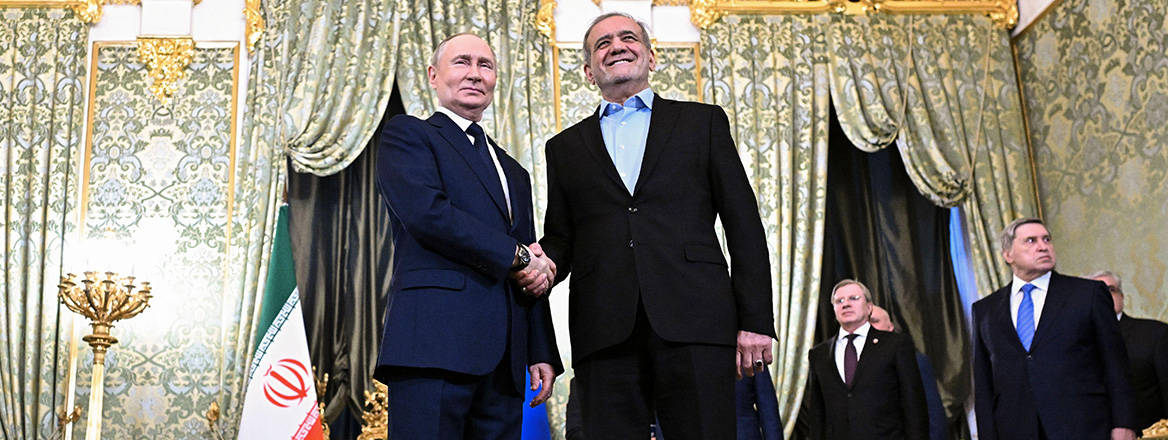
Putin must walk a fine line between doing the minimum required to support its nominal ally in the region, while ensuring that Russia retains its relevance in the Middle East.
As tensions between Iran, Israel and the US have ratcheted up in recent weeks and prospects of a regional war remains uncertain, Russia’s President Putin must walk a fine line between doing the minimum required to support its nominal ally in the region, while ensuring that Russia retains its relevance in the Middle East.
For Russia, there are practical and political reasons to stay out of a regional war. Some of these are linked to the Ukraine war, and some to its own domestic pressures. Ultimately, whether these tensions spill over into outright conflict, Moscow cannot afford becoming embroiled in another war.
Russia’s Links with Both Sides
It is true that Russia is one of the few powers that has a semblance of a relationship with both Iran and Israel. But this does not necessarily translate into much leverage or influence, or give Russia a particularly privileged position as mediator – its preferred role here.
The breakdown of many of Russia’s diplomatic relationships in Europe obliged Moscow to pursue alternative allies, many of which have facilitated its war in Ukraine, either through the provision of arms, ammunition or personnel. Moscow and Tehran also inked a technically significant strategic partnership agreement in 2025 – which stopped short of demanding any mutually binding security provisions. Although Moscow was under no actual obligation to act, the limits of this partnership were showcased amid Israel and Iran’s brief 12 Day War last year, which revealed Moscow’s constrained ability and indeed interests in Iranian defence, when Putin opted not to intervene.
But it is also true that the military importance of Iran to Russia has waned since 2023. Tehran, unlike North Korea, has not provided soldiers for the Ukraine war – a real demographic gap for Russia that needs to be plugged. In the first year of the conflict, Russia relied on Iran’s Shahed drone technology, but this has now been localised and reproduced in Russia as the Geran-2s. Supply chain vulnerabilities here are a less pressing issue for Russia than they would have been three years ago.
Russian-Israeli bilateral cooperation is largely confined to specific issues, such as deconfliction over Syria, and is not underpinned by any shared ideology or institutional framework
Russia’s relationship with Israel is similarly complicated, with a long history of mistrust, institutional antisemitism and theoretical Soviet support for the Palestinian cause. Putin’s government has sought better ties with Israel, and Benjamin Netanyahu’s own diplomatic isolation since the Gaza war has required him to forge relationships with non-traditional western allies including Hungary and India, as well as Russia. Israel’s rather more ambiguous position on Russia’s invasion of Ukraine – refusing to provide Ukraine with military aid or fall in line with the western consensus to sanction Russia – soured its already strained relationship with Kyiv. But Russian-Israeli bilateral cooperation is largely confined to specific issues, such as deconfliction over Syria, and is not underpinned by any shared ideology or institutional framework.
Indeed, Russia’s offer upon the outbreak of war on 7 October to mediate between Hamas and Israel was largely ignored – chiefly because Russia is not the key player in these relationships and has little leverage over Hamas, nor any history of successful mediation in the Israeli-Palestinian negotiations, despite its attempt to frame itself as an alternative to US-led mediation efforts.
Kremlin Inaction Over Action
As regional tensions have ratcheted this time, Russia has fallen back on its usual playbook – diplomatic theatre, flurries of meetings, occasional rhetoric, but ultimately little action. Moscow has good reason to be more cautious than usual.
With senior Middle Eastern leaders, the Kremlin has hosted a plethora of diplomatic meetings and calls in recent weeks, which have received much international scrutiny. In late January, Syrian President Ahmed al-Sharaa travelled to Moscow for the second time since October. Ali Larijani, Secretary of Iran’s National Security Council met Putin a few days later in Moscow, apparently to discuss the transfer of enriched uranium to Russia, although this appears unlikely to come to pass.
Despite this activity, the Kremlin maintained careful silence for almost two weeks on the Iran issue as protests broke out, until 15 January when Minister of Foreign Affairs Sergei Lavrov elliptically noted that a third party would not be able to alter the Iran-Russia relationship. These meetings were bookended by careful statements from Putin himself, who lightly criticised what he called ‘unprovoked aggression against Iran’ but did not mention the US specifically. His offerof mediation in calls with both Netanyahu and Iranian President Pezeshkian was belated.

Russia’s inaction in part stems from practical constraints due to its military preoccupation in Ukraine, but is also reflective of some important diplomatic messaging that Moscow is keen to convey.
First, while it sends an unfortunate message to Tehran that Moscow has limited interests in Iranian defence, the more important relationship for Moscow is with the Americans. The contours of that febrile bilateral relationship are still being drawn, but as delicate negotiations over a potential deal on Ukraine continue in the background, Russia is unwilling to risk destabilising the relationship to wade into the Middle East, particularly in a conflict where Russia has little power to affect change.
Second, Russia’s caution this time likely stemmed from the possibility of actual regime change in Iran, and the potential of having to engage with a new authority. This is not unusual for Putin – Russia acted similarly around the political changes in Syria in 2024, and in 2020 amid the political protests that threatened (but ultimately failed) to oust Belarusian President Alexander Lukashenko. As ever, the Kremlin’s first instinct is to wait, determine which way the cards might fall, and only then proceed with caution.
Third, while the adage that instability in the Middle East creates a favourable distraction for Moscow from its war in Ukraine may have held true a few years ago, this overlooks Russia’s interests in maintaining a stable Iran, as well as the opportunity to present itself as a reasonable mediator. This sends an important message – again targeted at the Americans – that Russia is a sensible party capable of negotiation; unlike, as Moscow has hastened to point out in the last 18 months, the Ukrainians. But it is a thin veneer that does not pass muster – President Trump had swiftly dismissed that idea last year, advising Putin to focus on his own conflicts rather than wade into others.


Fourth, there have been some domestic changes in Russia that might merit consideration. Russia’s point man on the Middle East, Mikhail Bogdanov, who had been in post as the President’s special envoy for over 10 years and was well respected as a diplomat with deep knowledge of the region, was dismissed in July last year. Bogdanov cited his age (he is 73) as the chief factor rather than ability, suggesting the departure was mutual, but the loss of a well-known figure with such institutional knowledge is difficult to replace. While the Ministry of Foreign Affairs is perfectly capable of producing a deputy to take over Bogdanov’s brief, hard-won regional relationships are more challenging to rebuild.
Ultimately, Russia’s inaction is itself revealing. It shows that while Russia is still keen to ensure that its situational partnership with Iran continues to serve Russia’s longer-term ambitions in the Middle East, the real focus of military resources and political interest will remain Ukraine. Even if current tensions increase to outright conflict, Russia cannot afford to become embroiled in another war, and Putin has no desire to ignite Trump’s ire and risk derailing the Ukraine negotiations – even as Russia has dialled up its attacks on Ukraine’s critical national infrastructure throughout the winter.
Putin is also in an election year. His party, United Russia, will aim for (and win) the lion’s share of the State Duma (lower house of parliament) seats in September, but even in massaged electoral campaigns like this, the party needs high voter turnout for legitimacy. Victory narratives (real or imagined) around the Ukraine war will feature heavily in its campaign strategy, and at the moment, the Middle East tensions offer little more than a sidebar to Putin’s real focus.
© RUSI, 2026.
The views expressed in this Commentary are the author's, and do not represent those of RUSI or any other institution.
For terms of use, see Website Terms and Conditions of Use.
Have an idea for a Commentary you'd like to write for us? Send a short pitch to commentaries@rusi.org and we'll get back to you if it fits into our research interests. View full guidelines for contributors.
WRITTEN BY
Emily Ferris
RUSI Senior Associate Fellow, International Security


- Jim McLeanMedia Relations Manager+44 (0)7917 373 069JimMc@rusi.org