


Shared interests among European and Asian middle powers, navigating a turbulent Sino-American unilateralism, sustain NATO’s Asian partnerships.
NATO developed partnership programs after 1991, when the threat from the Soviet Union evaporated and the alliance was led into activities beyond the foundational mission of collective defence. The first generation of partnerships served NATO enlargement and the stabilisation of post-Soviet Central Asia. A second generation following 9/11 supported missions on counter-piracy and Afghanistan. The current third phase of partnerships reflects a shift of attention toward the rise of China from 2019, producing the ‘Indo-Pacific 4’ (IP4) made up of Australia, Japan, New Zealand and South Korea.
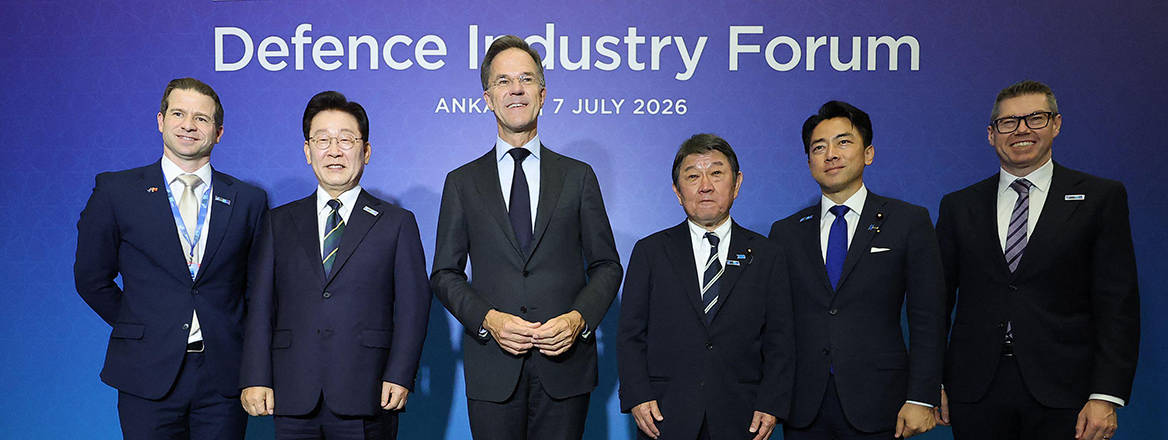
For the 2026 Ankara summit the NATO Secretary General invited the IP4 defense ministers. South Korea was represented at Presidential level, reinforcing the country’s prominence in events centered on defence industry partnership and procurement. Other IP4 members sent ministers of defence, and Japan sent both defence and foreign ministers (PM Takaichi having committed to domestic legislative duties). Compared to the 2022 NATO summit in Madrid with ‘the first-ever participation of the Heads of State and Government of the IP-4 partners in a NATO summit’, and the stronger statement in 2025, this level of representation may be read as an indication of decline. Alternatively, the attendance by defence ministers may be interpreted as a sign that the partnership has matured into a more pragmatic functionality.
Looking back, the IP4 has been challenged from the start due to caution that allies’ bilateral diplomacy with China could be overshadowed by a collective NATO (and therefore US-dominated) stance on China. This ambivalence caused an early proposal to establish a NATO liaison office in Tokyo to whither on the vine. A lack of uniformity in the policies of IP4 members toward China has meant their agenda tended more to other shared interests like countering North Korean nuclear proliferation or mounting a cooperative defence industry response to Russia’s war on Ukraine.
This shift in the US stance away from NATO’s global role and an international coalition to balance China suggests US interests may be diverging from those of NATO’s Asian and European partners
Even if it is not explicitly targeted, China remains unhappy with NATO’s Asian partnerships. As Liselotte Odgaard put it, NATO’s outreach reinforces Beijing’s ‘concerns about encirclement and the extension of transatlantic security structures into Asia.’ NATO can deny that it seeks an operational role in China’s ‘backyard’ as much as it likes, but that does nothing to diminish the example it sets by legitimising the principle of collective defence in the region, and shared interests among America’s allies in, and beyond, East Asia. Understandably, the PRC stigmatises ‘block formation’ that runs counter to its interest in separating Asian allies from America, from Europe and from each other (not to mention encouraging Europeans towards a form of ‘strategic autonomy’ that is measured by degrees of separation from America).
The Influence of the War in Ukraine
Ironically, China’s choice to back Vladimir Putin’s 2022 escalation of war against Ukraine has been the main catalyst for mutual attraction between NATO and America’s principal Pacific allies and has validated the notion that the security of the two theatres is ‘indivisible’. The 2022 summit concept asserted that China’s ‘stated ambitions and coercive policies challenge our interests, security and values . . . The deepening strategic partnership between the People’s Republic of China and the Russian Federation and their mutually reinforcing attempts to undercut the rules-based international order run counter to our values and interests.’
Even if Indo-Pacific and Euro-Atlantic security ‘indivisibility’ initially appeared abstract or politically expedient, it has materialised for more empirical reasons. First, Russia’s aggression created opportunities for Asian (especially South Korean) defence manufacturers to meet European demands for restocking armouries stripped bare to supply Ukraine. North Korean troops deployed to fight Ukrainians alongside Russia, with Russian technology transferred to Pyongyang in return. Precious lessons of modern warfare travel in both directions. As Ukrainians succeeded not just in holding off defeat but achieving operational success, Asian partners’ appreciation of NATO partnership as a platform for accessing the world’s most over-subscribed vocational school for modern warfare only increased. Lessons disseminating Eastward that started with the DPRK are now flowing to Japan and beyond to Taiwan. IP4 has come to be perceived as a ‘network linking the Euro-Atlantic and Indo-Pacific security environments through industrial cooperation, interoperability, technological innovation and strategic coordination.’

One analyst suggested the trajectory of the IP4 partnership is influenced by two intersecting dynamics: ‘gradual retrenchment and reprioritisation of US strategic commitments’ and ‘the emergence of more hedging-oriented European approaches to China and the Indo-Pacific.’ Asian nations’ rising interest in the benefits of NATO partnership for national security as a compliment to US alliances could be counted as a third factor.
Despite Beijing’s suspicion that an American hand was pushing Europeans toward the Indo-Pacific, the second Trump administration must now be counted among the sceptics of the ‘indivisibility’ principle. According to the latest US National Defence Strategy, the division of Euro-Atlantic and Indo-Pacific security is not merely possible, but desirable. What room is there for the IP4 in ‘NATO 3.0’ described by Undersecretary for Defence Policy Elbridge Colby (who reportedly sought the cancellation of the UK Carrier Strike group deployment to Japan), as Europeans concentrating exclusively on shouldering the burden for conventional defence of their continent? Following the failed tariff offensive, the second Trump administration pursued détente with China under a framework of ‘constructive strategic stability’, which would imply not causing offense to Beijing by – for instance – ‘ganging up’ against it with the Europeans and Asians together.
This shift in the US stance away from NATO’s global role and an international coalition to balance China suggests US interests may be diverging from those of NATO’s Asian and European partners. Even if Washington loses interest, the IP4 values access to NATO as a platform to access lessons from Ukraine. Japan’s Prime Minister Takaichi is seeking to leverage the G7 and NATO to manage supply chain pressure from China, while the US has no interest in the use of these structures to complicate US diplomacy with Beijing or over Taiwan.
'Europeanisation' of NATO
What does the ‘Europeanisation’ of NATO – noted as a theme of this summit – augur for NATO’s Asian partnerships? This is related to a question of whether the Europeanisation of NATO is destined to make the NATO-EU relationship more or less cooperative. At first glance, a more Euro-centric alliance could be less likely to engage external partners at the expense of diplomatic autonomy in relations with China. NATO’s Asian partnerships could be seen in competition with the EU’s own Asian partnership structures. France was always wary that its diplomatic freedom of action could be constrained by a common NATO policy on China. EU members such as Spain that are pulling toward closer relations with Beijing are also likely to apply the break on extending NATO attention to Asia.


On further examination, the opposite outcome seems more likely. Recent IP4 discussions reportedly covered ‘interoperability, co-development, joint procurement, supply-chain security, critical raw materials and industrial resilience.’ IP4 could facilitate cooperation in areas where the EU is becoming more active, such as defence industrial cooperation.
The more Washington pushes its European and Asian allies to shoulder a greater share of the burden of their defence, the more they will discover shared interests in areas like lessons-learned exchanges on modern warfare, co-development and transfer of weapons systems, secure (non-Chinese and perhaps even non-American) technology supply chains, and managing the transition to a lower level of defence dependence on America. The more US policy of ‘Europeanising’ the Ukraine war succeeds, the more European NATO and NATO Asian partners will be drawn together by shared interests in the sources of Ukraine’s military success and opportunities that flow from post-conflict reconstruction.
The future of NATO’s Asian partnerships therefore consists in more knowledge exchange supporting functional rather than operational cooperation, less emphasis on collective China policy, and more on shared interests in capabilities for modern warfare and the procurement and co-development of cutting edge weapons systems. In conclusion, even though officials in Beijing and Washington express opposition (for different reasons) to the ‘indivisibility’ of Asian and Euro-Atlantic theatres, there is probably no factor doing more to drive NATO and its Indo-Pacific partners together more than the strategic posture and actions of America and China.
© RUSI, 2026.
The views expressed in this Commentary are the author's, and do not represent those of RUSI or any other institution.
For terms of use, see Website Terms and Conditions of Use.
Have an idea for a Commentary you'd like to write for us? Send a short pitch to commentaries@rusi.org and we'll get back to you if it fits into our research interests. View full guidelines for contributors.
WRITTEN BY
Dr Philip Shetler-Jones
Senior Research Fellow, Indo-Pacific Security
International Security


- Jim McLeanMedia Relations Manager+44 (0)7917 373 069JimMc@rusi.org