

‘We Don't Do God’: Reappraising Religious Understanding in Foreign Policy

While religion is instrumentalised by adversary states, strategic analysts should better understand the classes of its application.
Operation Epic Fury was intended to break Tehran’s will – as US President Trump at times presented it – using a rapid strike campaign against Iran's nuclear and military infrastructure that would also restore US deterrence.
The results exposed a dangerously naïve Western assumption: that religious considerations are marginal in geo-strategic decision making. Whilst not the main conflict cause, faith is nonetheless a mobilising influence, defining how principal actors perceive victory or defeat. The West’s inattention in this area found notoriety in 2003, during the Iraq war-era, with former Downing Street Director of Communications Alastair Campbell’s dismissal of a question about the faith of Prime Minister Tony Blair: ‘We don't do God’. Whilst this may have been indicative of Western attitudes, it is certainly not the case everywhere – least of all in the Middle East.
Iran's Martyrdom and End-Times Logic
The first strategic misread with Epic Fury was the US-Israeli coalition assuming that assassinating Supreme Leader Ayatollah Ali Khamenei, would cripple Iran's command structure and force rapid capitulation. Unlike the rival Shia authority of Iraq-based Ayatollah Ali al-Sistani, the Iranian system, underpinning the Islamic Republic since 1979, is grounded in the Khomeinist doctrine of velayat-e faqih (guardianship of the Islamic jurist). In it, religious and temporal authority are fused, in both the person and office, of the Supreme Leader. He was not therefore a mere nominal political figurehead but the embodiment of the power of the Islamic Republic. Thus, drawing on a political-religious tradition where suffering narratives motivate resistance, the assassination effectively transformed Khamenei instantly into a holy martyr, especially as it was carried out in the holy month of Ramadan. His replacement was Mojtaba Khamenei, a hardliner who remains in power.
In contrast to Western thinking, Shia political memory does not treat defeat and death in purely material terms. The foundational narrative of Shia endurance, the defeat and martyrdom of Husayn ibn Ali at Karbala in 680 CE, is remembered not as a shameful defeat, but as a model of righteous resistance and sacrifice against perceived oppression. Iranian revolutionary rhetoric has long drawn on this inheritance, presenting its confrontation with the US, Israel and the West as a sacred struggle against the ‘Great Satan’. Thus, far from ending the conflict, Khamenei’s assassination immortalised and sacralised it. In addition, it strengthened hardline factions within the regime, negating the momentum of recent opposition protests.
The task for strategic analysts is to avoid superficial generalizations and carefully interpret whether Mahdist language functions contextually as literal belief, mobilising rhetoric, factional signalling or propaganda
Another theological factor is the Iranian Shia eschatological expectation of the end-times return of the messianic Mahdi, who since 874 CE has been hidden in occultation as the Twelfth Imam. Upon his return at the end-times, Shia believe he will establish world peace and justice. Since the 1979 Islamic Revolution, Iran has developed its own version of active Mahdism, evolving from an apparently passive eschatological doctrine into an active political ideology with serious strategic implications. This eschatology became state policy with such goals as the destruction of the State of Israel, considered the main obstacle preventing the Mahdi’s return, and, in this context, Western concerns around Iran’s possession of nuclear capabilities are understandable.
The relevance is that Mahdists have risen to prominence within positions of authority in state structures and the Islamic Revolutionary Guard Corps has become an increasingly Mahdist oriented ideological army. Given the apocalyptic nature of Mahdist ideology, the West must realise it is confronting a military-political opponent who is in part driven by a strong core religious ideology and any response must factor this in.
This does not equate to describing Tehran’s actions as solely intended to initiate an apocalyptic conflict with the West. Iran knows how to behave pragmatically. Rather, the task for strategic analysts is to avoid superficial generalizations and carefully interpret whether Mahdist language functions contextually as literal belief, mobilising rhetoric, factional signalling or propaganda. In that way operational commanders will be better placed to respond effectively.
The analytical point is not that Iran behaves irrationally by Western standards, but that it judges costs differently inside its own political-theological framework. Secular deterrence models treating pain and loss in purely material terms struggle to interpret adversaries who actively welcome and view suffering as both motivational force and sign of divine favour.

For Tehran, victory means survival even at great cost, which it sees as evidence of both revolutionary steadfastness and divine approval. Iran's victory threshold is not Washington's. Any kinetic pain that the West inflicts, may simply produce the opposite of its intended political effect.
The West Also Has Religious Narratives
The religious dimension is not just confined to Tehran. The US and its allies are also theologically divided. A prominent strand is Christian Zionist support for confrontation with Iran, as exemplified through Pastor John Hagee, whose public statements framed the strikes in explicitly prophetic terms, praising the operation’s execution as a fulfilment of biblical prophecy. For such groups, Iran is both adversary and crucial Biblical prophetic actor, particularly when read through Old Testament texts such as Ezekiel 38 and the war of Gog and Magog. The prophecy being that Israel will be attacked from Persia/Iran, thus ushering in the Second Coming of Christ. Whilst these ideas are not reflective of all evangelicals, nor US policy, by influencing key actors they become strategically relevant.
Regarding these narratives entering command culture, the Military Religious Freedom Foundation reported US service members alleging complaints commanders briefed the conflict as part of God's plan linked to the apocalyptic return of Christ. If true, they raise serious questions about boundaries between private belief, military professionalism and official policy.
Israel's governing coalition adds a further dimension. Prime Minister Netanyahu's dependence on far-right religious nationalist partners, including the Religious Zionist Party, has given theological claims about land, sovereignty and confrontation with Iran greater political salience. There is also a movement amongst fringe Jewish Messianic movements supported by Christian Zionists, advocating the rebuilding of the Third Temple. Both groups see its completion as accelerating the actual coming of their respective Messiah. This reflects a rightward drift in which demographically, the politically religious component in Israeli society is increasing. Strategy that ignores this trajectory risks misreading Israeli domestic constraints on any future settlement.
The Vatican as Strategic Actor
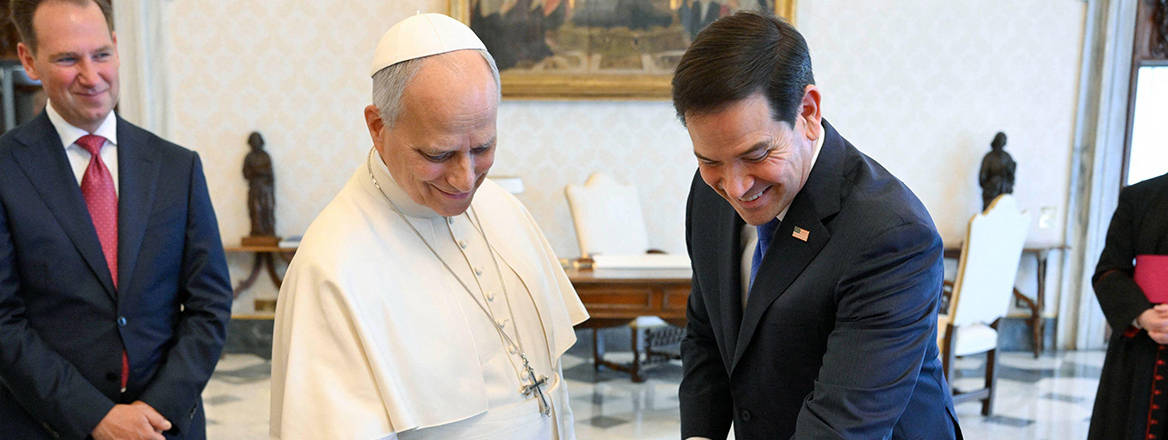
The third neglected dimension is the Catholic response. Pope Leo XIV appealed for a peaceful resolution in accordance with international law, calling Trump's threat to destroy Iranian civilisation ‘truly unacceptable’ and warning against drawing the Holy Name of God into ‘narratives of death’. His intervention matters. Whilst not commanding armies, the Vatican deploys unique transnational moral and diplomatic authority.

The Catholic just war tradition, rooted in Augustine and developed by Aquinas, offers a framework for judging the moral permissibility of force. Its tests are just cause, legitimate authority, right intention, last resort, proportionality and reasonable prospect of peace. Applied to Operation Epic Fury, Catholic critics argue that the strikes fail those tests: diplomacy was not exhausted, US objectives shifted between nuclear denial and regime change and civilian harm has become impossible to ignore. Amnesty International called for accountability after a US strike on the Minab school reportedly killed over 120 children. For just war analysis, such incidents are not simply humanitarian tragedies, they crucially test whether means remain proportionate to ends.
Catholic opinion is not monolithic. Supporters including Vice-President J.D. Vance, Marco Rubio and others argue that Iran's nuclear programme and regional violence constitute a grave threat, and force may be justified to prevent greater destruction. What is important here is not that there is one clear answer provided, but that the debate at this level is taking place at all.
Trump may therefore have misread not only Iran, but also the Vatican. The Holy See has a long record of effective mediation precisely because it can speak across political and religious divides from a position of spiritual authority and diplomatic neutrality. In a conflict where Iran's leadership claims religious legitimacy, Vatican channels may be able to communicate in ways that conventional hard-power diplomacy cannot. That back-channel approach has yielded results before when the Vatican played a role in securing the release of British naval personnel detained by Iran in 2007. Should the conflict reach an impasse, a purely coercive strategy may yet require the kind of discreet religious diplomacy that has been publicly dismissed.
Strategy After ‘We Don't Do God’
The lesson is not that Western governments should clericalise foreign policy. Military intelligence, deterrence theory, operational planning and diplomacy remain indispensable. But in faith-relevant conflicts, religious literacy is part of strategic literacy. It is not credulity. It is disciplined contextual interpretation, asking how clerics, commanders and state media weaponise theological language, rather than assuming they are simply irrational actors.
Secular policy cultures are effective at analysing capabilities, command structures and escalation ladders. They are less attuned to interpreting sacred narratives, doctrinal claims and religiously loaded ideas of suffering, victory and humiliation. The gravest risk is a Messianic dynamic gaining decisive influence on any side and acting to hasten what it believes to be an ‘end-time’ destiny event. Understanding that risk requires a theologically conceptual vocabulary from the West it currently lacks.
Operation Epic Fury was sold as a campaign to restore deterrence. Instead, it revealed that gap in full. Acquiring that vocabulary now is not an option but a strategic necessity. The time for ‘We don’t do God’ is now well and truly over.
© Andrzej Marszewski, 2026, published by RUSI with permission of the author.
The views expressed in this Commentary are the author's, and do not represent those of RUSI or any other institution.
For terms of use, see Website Terms and Conditions of Use.
Have an idea for a Commentary you'd like to write for us? Send a short pitch to commentaries@rusi.org and we'll get back to you if it fits into our research interests. View full guidelines for contributors.
WRITTEN BY
Andrzej Marszewski
Guest Contributor


- Jim McLeanMedia Relations Manager+44 (0)7917 373 069JimMc@rusi.org