


Ukraine’s digitalised warfare owes less to AI than to integrating systems and data under strong authority – lessons the UK and NATO should heed.
The war in Ukraine has been dominated by headlines about the cutting edge of technology in warfare, especially in the automation of functions and processes by AI. Yet AI and automation are not proving as consequential to operational successes as those efforts to integrate capabilities into coherent digital architectures. To draw the right lessons from Ukraine’s digitalised warfare experiences, one must consider the constraints and frictions in its uses of AI and automation, especially in the context of its disunified IT capabilities. Similarly, the manner through which situational awareness platforms like DELTA are integrated should be considered for NATO, with specific lessons on flexibility in data integration layers and the role of a strong implementation authority for the UK’s Digital Targeting Web.
This article draws on the author’s observations and conversations from Ukraine.
The Limits of AI and Automation
While the digitalisation of the Ukrainian Armed Forces (AFU) is justifiably lauded, it would not be accurate to call the AFU a truly automated nor AI-enabled force. Platforms and C2 (command and control) systems frequently have tasks automated – sometimes using AI – but the automation of full functions and processes is not widespread.
The deployment of AI, especially machine learning models, is entirely reliant upon large quantities of high-quality data to both train and operate models, thereby requiring integrated data feeds. Essentially, AI allows for efficient exploitation of outputs from systems that have already been integrated. Absent the fusion of data streams alongside networking and hosting infrastructure, these algorithms are useless. And despite the advances in integration through common C2, air defence, and situational awareness platforms (see more below), the relatively decentralised nature of the AFU and its innovation renders it often difficult to obtain reliable feeds of the necessary data for even routine situational awareness, much less the consistent, high-fidelity datasets necessary for advanced models to function accurately.
The manner through which these technologies are developed, deployed, integrated and iterated is as much of import as the capabilities themselves
This is why the current use cases for AI have been predominantly very narrow tasks. Ukrainian systems frequently use machine vision to identify and track objects in video feeds on edge devices, such as deployed sensors and strike and ISR drones, or use relatively-simple AI models to assist navigation in global-navigation-satellite-system-denied (or Starlink-denied) environments. Yet it is rare for platforms to perform more than these combat tasks, especially when it comes to combat engagement of enemy systems. For example, Ukraine's Sky Sentinel turrets are theoretically capable of autonomous engagement of enemy drones, but this capability is rarely, if ever, used. Ukrainian technicians and users described the autonomous capability as immature and largely ineffective due to the lack of quality data to train their models. Thus, the most effective and widespread method remains manual control of turrets by remote operators. This is unlikely to change for some time due to the relative expensiveness and complexity of training models to autonomously track and intercept the rapidly changing array of long-range strike drones used by Russia.
Situational awareness and C2 platforms now often incorporate applications using AI models for various tasks, such as target development, course-of-action (COA) planning and intelligence fusion. These applications are widespread across the world’s militaries, and assist in exponentially increasing militaries’ ability to process data and intelligence. Yet these ‘AI-enabled’ applications excel in very narrow tasks, and prove limited in anything other than their very specific contexts. For example, more Ukrainian teams are experimenting with COA tools to assist in operational planning. While showing promise, these tools are only beneficial if deployed in environments where sufficient relevant data feeds are accessible, where staff are trained on the strengths and limitations of a given model for a given type of planning, and where the models are sophisticated enough to still provide value to end users given these constraints. Such environments are rare enough to lead to questions about the cost-benefit of prioritising AI for its own sake. Future deployments of more general AI capabilities will depend on the maturity both of the digital structures underpinning capabilities as well as of the models themselves.
Battlespace Integration and the Digital Targeting Web
At least as important as the lessons on AI and automation from Ukraine are those drawn from Ukrainian experiences integrating their C2 and battlespace management systems. DELTA, originally a situational awareness platform that has expanded to cover functions from targeting to operational planning, has been publicly detailed at length, especially regarding its many applications. Yet there is less discussed about the platform’s backend, specifically the manner through which data is pushed and pulled between the infrastructure and millions of users, systems and sensors. These aspects bear significance to ongoing and future modernisation initiatives, including the UK’s Digital Targeting Web (DTW).
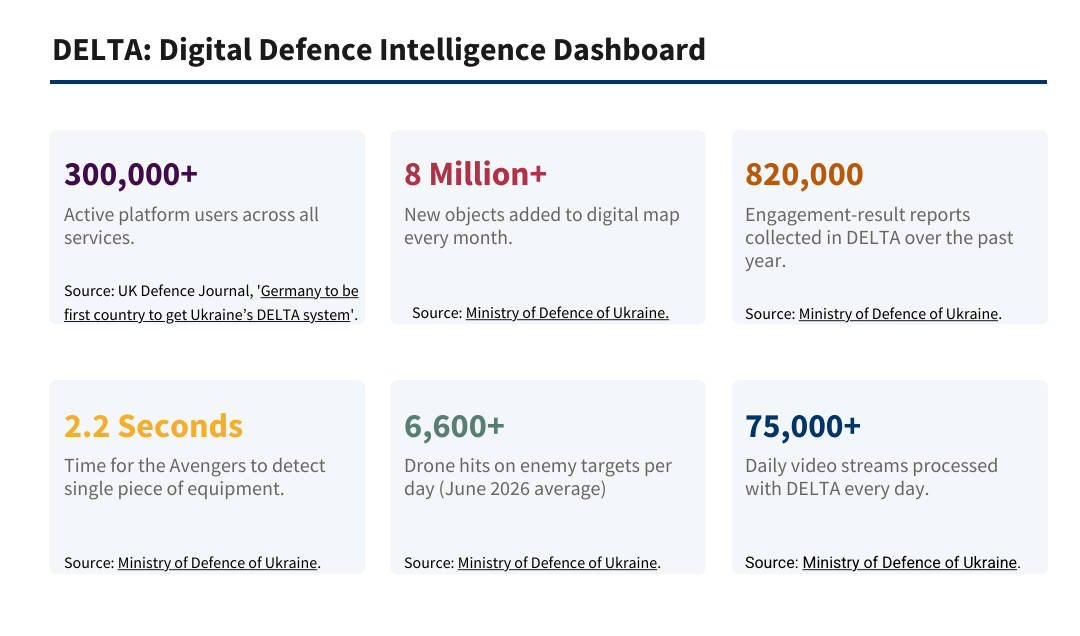
The DELTA platform, its applications and data are hosted on hyperscale infrastructure located outside Ukraine, with some applications and data with rapid operational requirements hosted on-prem or in deployed environments. Using browser interfaces (typically requiring a resilient, moderate-bandwidth connection), data is pushed to or pulled from the platform using one or more of a long and ever-growing list of common application programming interfaces (APIs). Using commercial best practices, this model allows heterogeneous systems and platforms to interoperate with minimal dedicated engineering support.
This architecture is scalable, allows for Ukrainian ownership of its data and digital structure, and is rapidly iterable, with updates every two to three weeks. The vulnerabilities are well known: reliance upon contested communications and bandwidth, lack of hosting sovereignty, and, at times, latency. The DELTA teams are actively working to mitigate these vulnerabilities where possible, such as enabling some federated structures where operationally and technically feasible, as well as thinking about future on-prem capabilities for secret data and systems. However, solutions are not even considered unless they do not diminish operational capabilities.
The DTW does not – and should not – adopt DELTA’s model for interoperability wholesale, but can glean some lessons. The API-centric model enables scalable and largely seamless data sharing across systems, but the architecture’s success is only made possible through an assured, centralised hyperscale hosting platform, as well as strong, but politically vulnerable communication links through Starlink. Operational necessity drove these decisions, and they have been proven through operational successes. But DELTA’s API model is a brittle form of integration, as it requires live bearers and known endpoints. DELTA’s digital ecosystem requires assured connections to pick up requests from known endpoints in systems, meaning that requests are not held to be delivered later if connections are disrupted, while new systems must be explicitly added to interoperate with others.
If the DTW’s data integration layer is intended to use their SECRET cloud in the same manner as DELTA uses their hyperscale compute, the latter’s model may be theoretically desirable to fully adopt. Yet UK SECRET cloud is in no way expected to rival hyperscale hosting capabilities, while delays on its deployment should lead to hesitation about overreliance upon this capability for the DTW’s structural integration. The DTW’s integration layer is expected to be composed of an API-management layer, but DTW stakeholders must ensure that the layer does not begin and end there. The data integration layers connecting operational-echelon digital webs must move from inclusivity in point-to-point connections to true node agnosticism to enable operations in the contested environments where capabilities are rapidly iterating and being replaced. API-centric models of interoperability are part of this solution, but do not lead to fully integrated capabilities alone.
NATO countries should, however, consider how to emulate DELTA’s approach to building a library of common APIs in building multinational architectures. The model can be easily adapted to allow for federated national data sharing through chosen protocols, enabling (relatively) painless interoperability across systems to enable a common operating picture at senior NATO echelons, especially where communications are established and assured.
Risk and Relationships
The manner through which these technologies are developed, deployed, integrated and iterated is as much of import as the capabilities themselves. While many of these factors have been discussed at length elsewhere, several bear mentioning.
Sovereignty and Assurance Tradeoffs
The architectural choices made in Ukraine’s digitalised capabilities are the result of a specific risk calculus that is not representative of most of Europe at the moment. Ukraine’s military success depends on a number of technology providers potentially vulnerable to political disruption – most notably Starlink, but also including their extra-territorial hyperscale hosting. As mentioned above, the choices were driven by a calculation about operational necessity, alongside consideration of resilience and continuity of services, given the onslaught of Russian kinetic and non-kinetic disruptions. Higher levels of sovereignty remain desirable, but come secondary to capability and continuity.

Ukrainian capability assurance follows a similar logic. Lengthy testing and assurance processes are often forgone given the pace required on the battlefield, meaning that capabilities – whether drones or software updates for DELTA – are often tested on deployment. This model is able to function given the pace of iteration, with engineers able to deploy updates and patches every two to three weeks. NATO militaries will not be able to match this speed of deployment and iteration in a non-wartime context, given a lower risk tolerance, but are beginning to consider less arduous assurance processes in certain contexts to enhance their capabilities’ temporal relevance.
Adoption and Authority
The capabilities that Ukraine has been able to deploy are the object of desire for many NATO militaries, but it is the AFU’s ability to scale their innovations across the force that truly sparks envy. Yet the whole-of-force adoption of a platform like DELTA does not occur simply because a capability is cutting edge. The capabilities of DELTA are only significant to the degree that the platform can receive data feeds from units across the force, which is itself dependent on how the wider military organisations and leaders incentivise (or coerce) the adoption of a capability.
DELTA has slowly grown to comprise an entire ecosystem of capabilities used by more and more users. The relatively federated nature of Ukrainian military units in terms of capabilities, concepts of operation and digital architectures means that a number of units were reticent to adopt DELTA as their central digital platform for situational awareness, C2 and other functions. Yet adoption of such platforms can be seen as akin to the network effect from social media: the more users join, the more benefit is derived from the platform. The more operators that integrate with DELTA, the more data is available, and therefore the better the situational awareness and other functions can be. The DELTA team therefore sought to obtain a critical mass of users from across the force, which would then all but ensure the remainder of the force would adopt the platform.


Besides the quantity of data to incentivise, DELTA would not have seen its scale of success without a strong authority driving adoption. The Ukrainian former Commander-in-Chief Oleksandr Syrskyi directed a consolidation onto DELTA across the AFU so that he could track tactical activity across the front. A similar dynamic was seen with US General Christopher Donahue, who drove adoption of the Maven Smart System in a largely analogous manner, first in XVIII Airborne Corps, then in NATO. The DTW currently lacks this degree of seniority, a fact that could impede their ability to incentivise, command and coerce the rest of the sector to align behind their vision.
Relationships with End-Users and Industry
To ensure that modernisation visions remain aligned with operational needs, development teams increasingly embed their engineers with end users. The DELTA team maintains leads across combat units, permitting constant feedback loops where end users present their challenges and DELTA engineers iterate solutions. As with much of the Ukrainian defence ecosystem currently, this coordination is often still ad hoc, with information sharing often occurring through informal channels that are centred on personal relationships. That said, teams have grown adept at triaging concerns, and are beginning to improve the standardisation of their communication channels. One example cited to the author is an open pipeline where anyone – user or engineer – can recommend services to add to the DELTA ecosystem of capabilities.
In fairly stark contrast to the accommodating nature of end-user/engineer relationships were descriptions of relationships with industry. Specific to DELTA, if unwilling to accommodate the integration and data-sharing requirements of the platform by default, most vendors are simply excluded from contracting. Such an approach would be difficult to replicate across most NATO militaries, given the number of legacy systems requiring dedicated support and commercial dependencies upon large-scale IT providers, but should be at least kept in mind when considering future initiatives.
The Keys to Victory are Boring
Ukraine’s defence innovation has captured the imaginations of journalists, analysts and commanders alike with high- and low-tech drones being orchestrated and automated through various algorithms. Yet the innovations with the greatest operational impact are typically far less glamorous. The increases in scale and pace of functions like targeting are not due to AI or automation, but to efforts in integrating digitalised systems and IT infrastructure across the force. Success in digitalised warfare depends on the quality and authority of a military’s systems engineers, not advancements in its AI agents. While keeping end-user needs in mind, leaders, analysts and policymakers need to understand the backend of their capabilities before they ever dictate the frontend.
© RUSI, 2026.
The views expressed in this Commentary are the author's, and do not represent those of RUSI or any other institution.
For terms of use, see Website Terms and Conditions of Use.
Have an idea for a Commentary you'd like to write for us? Send a short pitch to commentaries@rusi.org and we'll get back to you if it fits into our research interests. View full guidelines for contributors.
WRITTEN BY
Noah Sylvia
Research Fellow, C4ISR and Emerging Tech
Military Sciences


- Jim McLeanMedia Relations Manager+44 (0)7917 373 069JimMc@rusi.org