

Trump Should Carefully Consider Bringing Down the Iranian Regime

Circumstances in Iran do not map easily onto the conditions in Venezuela that abetted Maduro’s kidnapping.
The US and Iran were partners until the latter’s 1979 revolution. Since then, their relations have been tense, ranging from agreement – official or not – to threats and hostile actions. The US has worried of Iran’s ongoing effort to produce nuclear weapons and destabilise the Middle East. There were negotiations, but still, in June 2025, the US bombed Iranian nuclear sites. Since then, the Trump administration has warned Iran but is also willing to negotiate with Tehran.
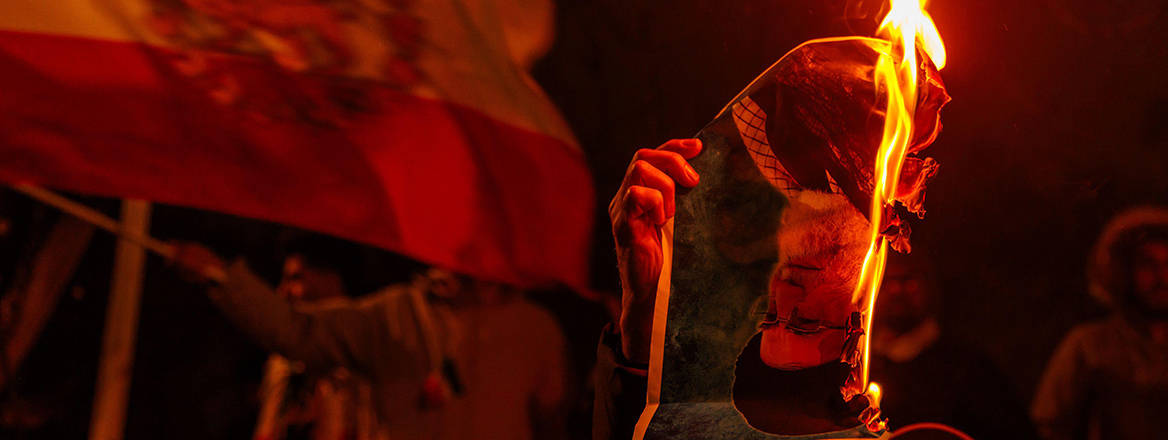
As with the outbursts of the past, Iran’s severe economic troubles combined with deep political resentment among its people regarding the violation of basic human rights have brought the current unrest. It is a major concern for the Iranian regime. Some claim ‘the era of regime change in Iran has arrived.’ If the Trump administration sees the ongoing unrest in Iran as an opportunity to seek regime change in Iran, it would be a bold, complicated and risky strategy. There are several factors to be considered by the Trump administration, such as the cost, the balance of power inside Iran, and if Israel and Arab states should be involved (and if so, how much?). The Trump administration can carry out a limited operation but conducting a full-scale campaign aimed at bringing down the Iranian regime would be a very different challenge.
The Crisis in Iran
Despite its desperate attempts to present it as a victory, the Iranian regime absorbed severe blows in the June 2025 war, including to its image. The main threats to it are the enormous economic hardships, such as inflation, unemployment, shortage of electricity, water scarcity, and the collapse of the rial. Iran’s economy has been in a bad shape due to sanctions but also because of poor decision-making, mismanagement and corruption. That made the economic crisis in Iran much worse. To paraphrase President Ronald Reagan: the Iranian regime is not the solution to those problems; it is the problem. It does not give much hope to those in Iran –including inside the regime – who want to reform it. This dead-end brought many Iranians to strive for regime change. Yet they have been seeking to avoid the chaos and uncertainty of Egypt in 2011, when the regime there was toppled, let alone a civil war of the kind in Syria, Libya, and other Arab countries. This deep concern is a major part of why many in Iran hesitate over whether – and how – to participate in the current outburst.
Following the unrest in Iran in 2022-23, some Iranian officials investigated fleeing to Venezuela if the Iranian regime collapsed. This escape route might be closed soon, which could make the Iranian elite either more willing to compromise, or to the contrary, to double down, in the belief it is their only way to survive
So far, Iran’s Supreme Leader Ayatollah Ali Khamenei, despite his age and poor health, still seems to be in charge. He has been warning the protesters, trying to deter them from continuing with their actions, while increasing the crackdown. ‘Iran's armed forces have been placed at the highest level of readiness.’ The regime relies on the Basij militia and particularly on the Islamic Revolutionary Guard Corps (IRGC). As long as those units, or at least most of them, stay loyal to the regime and are operational, the regime can survive – the political elite and millions of other Iranians still support the regime. They face an opposition that is motivated and has a certain momentum, but it lacks organisation, united leadership or armed forces to protect its members. So far, the regime has killed several hundred and arrested thousands of people, and cut internet and telephone lines. Those factors must be considered by the Trump administration regarding whether and to what extent the he is willing to intervene. It seems that if the Iranian regime keeps it together and there is no critical mass of Iranian people determined to bring it down, then the US should think twice before initiating a major campaign aimed at toppling the Iranian regime.
Implications and a Comparison to the Crisis in Venezuela
The regime in Venezuela it still there, but it is clearly vulnerable. If the Trump administration would run Venezuela, it is bad news for Iran, because Iran would lose a partner. The two states cooperate on several levels, including oil and finance. This partnership is important in other aspects; both regimes are isolated and face resentment and anger at home. Following the unrest in Iran in 2022-23, some Iranian officials investigated fleeing to Venezuela if the Iranian regime collapsed. This escape route might be closed soon, which could make the Iranian elite either more willing to compromise, or to the contrary, to double down, in the belief it is their only way to survive. Either way, by going after Venezuela first, Trump made Iran weaker, and it might have been part of his plan to begin with. Perhaps, not have been aimed at regime change in Iran, but instead at making Iran willing to reach a deal that pleases Trump.
Unlike in Venezuela, Iran has more options to retaliate against US forces, diplomats, etc., particularly those who are nearby. Iran can also try to block the Hormuz Straits. The US military can stop Iran from doing that, but this could lead to a war. This is only one of the scenarios of rapid escalation following striking Iran, and the US military needs time to prepare for them.

Some in the US, including in the republican side, particularly in the MAGA movement, opposed striking Iran in June 2025. There is resistance among MAGA members to regime change in Venezuela, which, like regime change in Iran, is not a US goal. They assume that getting involved in other countries does not serve the US and whatever happens in those countries should be left to the people there. Even if there is a full-scale mutiny in Iran, some in the US might still urge the Trump administration not to intervene.
The Leadership Issue
President Trump has threatened Iran several times, indicating that in response to the present conditions the US is ‘going to hit them very hard.’ There is planning about that. Yet striking Iranian bases would not stop Iran from continuing to shoot demonstrators. For that, the Iranian regime needs light arms, which could be stored anywhere. Furthermore, despite the cost and the risks, the Iranian regime can decide it is worth it. The Iranian regime is willing to pay a high price. They absorbed significant casualties during the June 2025 war, including losing top officials, and survived. The Iranian regime has marked six years since the assassination of Qasem Soleimani, during the first presidency of Trump. The Iranian regime may be worried that Trump is considering going after other Iranian leaders, as was his course of action in Venezuela. However, in Iran, regime change requires the removal of not only one person – a top figure or president – but also taking out an entire elite that backs the Iranian regime.
The Iranian opposition does not have a well-organised elite or a united leadership. Some suggest the return of Crown Prince Reza Pahlavi. Throughout Iranian history, kings have represented the preservation of state. Yet it is not clear how many in Iran would support him, even as a temporary leader, until there are elections. Meanwhile, Trump refuses to meet with Pahlavi.
The Role of Israel, Arab States and Arab Groups
Iran might retaliate against US forces near her, including by using pro–Iranian militias and partners. Iran could go after US allies too, to try to destabilise states such as Jordan. Also, if the US kills senior Iranian officials, as part of regime change or just to retaliate and try to restrain Iran from killing demonstrators, Iran can try to assassinate top Arab figures like the Syrian president, who is liked by Trump. It would also reduce the chances of rebuilding Syria.
The Iranian regime did not recover from the June 2025 war, including the rebuilding of its air defence. Without a strong air defence, Israel can easily bomb targets in Iran, and by doing so, assist the opposition
The long and highly costly wars in Iraq and Afghanistan are still a grim memory for the US, that serve as a warning for another regime change. After trying to create a pro – American regime in Iraq and Afghanistan, now the US would try it again, in the country between them? Iran, which assisted insurgents to attack US forces in both Iraq and Afghanistan, would obviously fight much harder when it comes to her own territory. Even if a clash with Iran would be much shorter and far less costly, yet it might still be too expensive and long for President Trump.
The US can reduce the cost of confronting Iran by joining forces with US allies in the Middle East. Israel has a long conflict with Iran. Despite the uncertainty regarding Iran, if the regime there is toppled, Israel is willing to risk it, because for Israel, it could not be any worse than the current regime. Lately, Israel has been concerned the Iranian regime might try to divert attention from the outburst in Iran, to Israel, by striking Israel, which would return a favour. Yet the Iranian regime did not recover from the June 2025 war, including the rebuilding of its air defence. Without a strong air defence, Israel can easily bomb targets in Iran, and by doing so, assist the opposition. It might not be enough to bring down the regime, and the latter can also use it to claim Iran is under attack, urging the Iranians to support the regime. Overall, officially involving Israel in trying to topple the Iranian regime by force can complicate the situation for the Trump administration and be for the latter a double-edged sword.
Gulf Arab states have to wonder if President Trump has just drastically changed his policy toward Iran. Most of them hate the Iranian regime and want to get rid of it. However, those Arab states are very concerned about retribution against them. Iran can blame them for assisting US forces or even allowing the US to use land and air space to strike Iran, whether or not it is true. Trump does not want this because then he has to protect those Arab states, or risk losing their participation in the huge deals arranged with the US. Also, a fight between the US and Iran might raise the price of oil, particularly if Iran strikes oil infrastructure in Arab states. Such problems can harm the US economy, impacting on Trump’s domestic approval ratings, the upcoming midterm elections and eventually his legacy.
If Trump wants to confront Iran, he needs a united Arab front behind him
There is high tension between UAE and Saudi Arabia, due to disputes about which state is more dominant in the Arab world and how to handle Arab countries such as Yemen and Sudan. If Trump wants to confront Iran, he needs a united Arab front behind him and certainly does not want the two most important and powerful Arab states in the Gulf to maintain deep disagreements.
Qatar has to be worried that the US would use its Qatari-based forces to strike Iran, resulting in Iran striking Qatar. Qatar is under official US protection, which would be put to the test if Iran attacks Qatar following a US strike in Iran. Trump can use this to justify bringing down the Iranian regime. Yet Trump does not want to be entangled in a fight aimed ostensibly at protecting Qatar.
Iran’s main partner in the Middle East, Hezbollah, is at a low point following massive losses in the recent war with Israel, which resulted in the demand for Lebanon to disarm. Hezbollah took another hit because Venezuela provided money laundering and drug trafficking services. Those setbacks already put pressure on Hezbollah and make it more desperate, which is likely to increase if Hezbollah fears it might lose its patron, the Iranian regime. Hezbollah might be willing to strike Israel, maybe even with everything it has left, if the US tries to topple the Iranian regime. The Trump administration wants to stabilise and rebuild Lebanon, not to see another destructive war there. Although Trump seeks to disarm Hezbollah, by force through Israel if necessary, but it is a tall order and could be costly to Israel – although mainly to Lebanon.
Iran’s partners in the Gaza Strip, Hamas and Palestinian Islamic Jihad are much weaker following the 2023-2025 war with Israel, yet they are believed to still operate – including in the West Bank. Iran could urge them to do whatever they can do to disrupt the second stage in Trump’s Gaza plan and to ignite an outburst in the West Bank. Also, the Houthis can still launch missiles and drones on ships in the Red Sea, mainly at the Bab El Mandeb strait, the gates to the Red Sea. Their goal would be to disrupt international shipping lanes, opening another front. The US military fought them before and again the financial cost of another campaign there could be high.
Following the crisis in Venezuela, Russia and/or China might want to show Trump he can’t topple each regime he wants
The EU is concerned about Iran’s regime and has been condemning the crackdown in Iran. However, the EU would not join the US, at least not officially, in trying to topple the Iranian regime. China and/or Russia would most likely not intervene, let alone militarily, if the US strikes Iran. The latter is not that crucial to China and Russia, but it has some importance for them. Furthermore, following the crisis in Venezuela, Russia and/or China might want to show Trump he can’t topple each regime he wants. If China/Russia stand by Iran, or try to challenge the US in another area (Taiwan? Ukraine?) as retribution to the US’s new regime change policy, it might lead to a bigger crisis and, in the worst case, to a dangerous escalation with the US.
Conclusion
The Trump administration has to take into consideration various factors, constraints, and risks if it wants to use force against Iran, as part of regime change or otherwise. It means overcoming fierce resistance at home, including inside MAGA. Also, as long as the Iranian regime stands firm, and since the Iranian opposition lacks organisation and a united leadership, it would be a tall order to get rid of the current regime and replace it with a stable government. The US would have to remove from power not only the current Iranian leadership but the entire elite that backs it up. It would be much harder than the successful operation in capturing the leader of Venezuela. The US also has to take into account the role of Israel, Arab states and other groups. Meanwhile, Trump, by showing his support for the protesters in his warning to Iran, has prepared the public for a clash. He could already launch a limited strike, but starting a full-scale operation is a different story. Maybe covert operations could be an alternative, although such a policy might have a limited effect, and even that would take time.
© Ehud Eilam, 2026, published by RUSI with permission of the author.
The views expressed in this Commentary are the author's, and do not represent those of RUSI or any other institution.
For terms of use, see Website Terms and Conditions of Use.
Have an idea for a Commentary you'd like to write for us? Send a short pitch to commentaries@rusi.org and we'll get back to you if it fits into our research interests. View full guidelines for contributors.
WRITTEN BY
Dr Ehud Eilam
Guest Contributor


- Jim McLeanMedia Relations Manager+44 (0)7917 373 069JimMc@rusi.org