

A Russian Oligarch Speaks Out, But Not Against Russia's War

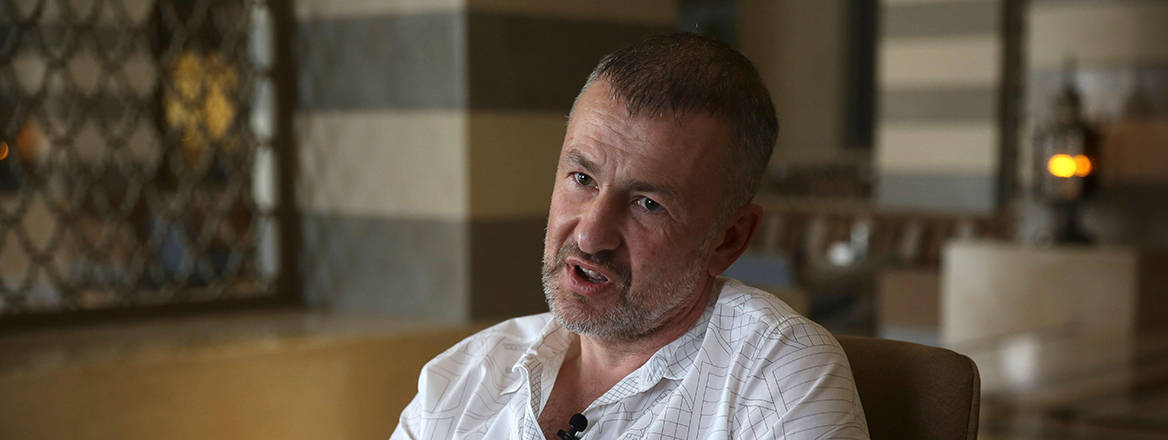
Russian industrial magnate Melnichenko, writing in the Economist, shares an incoherent worldview and shows how Russia’s business elite rationalise the Ukraine war.
In July, Russian oligarch Andrey Melnichenko wrote an essay in The Economist that the publication presented as a brave vision of change for Russia. Yet apart from several allusions to the harm the war on Ukraine has had on Russia’s prosperity and development, Melnichenko’s piece nonetheless attempts to advance common Russian tropes justifying Moscow’s naked aggression against Ukraine.
Melnichenko’s argument centres on the claim that the West’s involvement in Ukraine should be viewed at its core as a violation of Russia’s ‘sovereignty,’ which is ‘perceived as a threat’ by the international community that supports Ukraine. According to him, Ukraine’s security will not be resilient if it is ‘built on the permanent negation of Russia’s sovereign agency.’ This reframing of sovereign rights does not reflect any realistic definition of what any nation may do as an expression of its agency. The multinational support Ukraine receives is first and foremost a result of the violation of the country’s sovereignty by a regime in Moscow intent on remaking the country in its image. In 1945, when the Crime of Aggression was first prosecuted in Nuremberg, armed attack against another state was described by the tribunal as the ‘supreme international crime’ as it ‘[contained] within itself the accumulated evil’ of all of war’s injustices and offenses. Unprovoked assault is the reason why aid to Ukraine continues to flow, not fanciful notions of subduing Russia’s legitimate sovereignty. Moreover, Ukraine’s sovereignty, unlike Russia’s, has not posed a threat to its neighbours; it has only demanded that its political and territorial integrity be respected.
That Russia is now viewed primarily as a threat that must be managed is a result of its own volition. It is true now that many across Europe do not believe they can negotiate in good faith with Moscow and no longer give pronouncements by the Kremlin much weight
Melnichenko goes on to describe what he views as biases within international norms and institutions. Russia’s wartime experience, he writes, has shown that globalization ‘was never neutral.’ The levying of sanctions against him are evidence that ‘rights considered inviolable dissolve the moment a political decision is taken.’ Melnichenko does not realize that the policies that dictate international business and finance were never supposed to be neutral. The punitive and restrictive tools that have hampered Russia’s war machine were intended for instances of armed aggression precisely like what Russia has perpetrated in Ukraine. In 1940, President Franklin Roosevelt ordered the US Treasury Department to freeze assets in Norway and Denmark to prevent the Nazis from gaining access to them. This was part of the beginning of global sanctions regimes. During the Cold War, the US and its allies sought to create additional financial tools of coercion in an effort to establish a global rules-based order. While the system that emerged was imperfect, the most powerful methods of economic pressure were designed to be levied against states that violently oppressed their own citizens or those of other nations, as Russia has done.
Russia is also noticeably absent in Melnichenko’s retelling of the flaws of the modern system of international relations. ‘The institutional infrastructure built to supply [international security] – norms, enforcement bodies, shared legitimacy frameworks – has never been weaker,’ he writes. But the Kremlin’s leading role in undermining the global order does not feature in the piece. Moscow has violated the UN Charter and detained representatives of international monitoring missions. It has intimidated foreign diplomats, detained foreign nationals on trumped up charges, and launched disinformation campaigns to roil the political systems and societies of democratic states around the world.

Help your search results show more from RUSI. Adding RUSI as a preferred source on Google means our analysis appears more prominently.
In Melnichenko’s retelling, ‘Moscow’s security concerns were heard but never addressed,’ leading the Kremlin to seek ‘a new European security order in which Russia is a participant rather than a managed object.’ That Russia is now viewed primarily as a threat that must be managed is a result of its own volition. It is true now that many across Europe do not believe they can negotiate in good faith with Moscow and no longer give pronouncements by the Kremlin much weight. But the West engaged constructively for two decades after the end of the Cold War, even when Putin abandoned democratic norms and murdered his opponents. Moscow – not any other capital or foreign entity – made the decision to transition from being a peaceful participant in global policy and business to a belligerent that is not trusted by the international community.
While Melnichenko correctly observes that Ukraine has its own state and society, he still repeats a common Russian trope about Kyiv not possessing real agency. That the country is led by a puppet regime beholden to Western interests is a claim that can be swiftly disproven by the historical record. For years, Ukrainian elections have mattered. They have produced diverse political and ideological coalitions that have not aligned with the interests of foreign partners. True Ukrainian agency, in the form of domestic popular movements such as the one that brought Volodymyr Zelensky to power, have continued to effect change even under martial law. Perhaps most convincing is the reality that Kyiv’s foreign policy does not fully align with the US. The White House has pushed for concessions and opposed some operations that Kyiv has pursued because they are in the country’s interest. Ukraine’s actions are those of a sovereign nation fighting for its survival, not a client state doing the bidding of great powers.
Melnichenko describes several scenarios for Russia’s future. The country could end up as China’s vassal or as a rump state controlled by the West. It could disintegrate in a repeat of the USSR’s demise, or become an isolated fortress, like North Korea. According to him, none of these are outcomes that would be good for the world. ‘A humiliated Russia,’ he writes, would ‘generate aggressive revanchism.’ Maybe Melnichenko hasn’t noticed, but a proud Russia has already adopted this course.
© Artur Kalandarov , 2026, published by RUSI with permission of the author.
The views expressed in this Commentary are the author's, and do not represent those of RUSI or any other institution. His views do not necessarily reflect those of his firm.
For terms of use, see Website Terms and Conditions of Use.
Have an idea for a Commentary you'd like to write for us? Send a short pitch to commentaries@rusi.org and we'll get back to you if it fits into our research interests. View full guidelines for contributors.
WRITTEN BY
Artur Kalandarov
Guest Contributor


- Jim McLeanMedia Relations Manager+44 (0)7917 373 069JimMc@rusi.org