

Putin’s Political Longevity – A Framework of Considerations

Historic economic and social conditions point to a change of leadership in Russia, but a triggering event is still on the horizon for Putin.
In October 2025, your author published a paper with RUSI concluding that Putin had the resources to continue and even expand the war in Europe. Since then, things have got worse economically, militarily and socially. In April 2026, Thomas Nilsson the head of Sweden’s Military Intelligence and Security argued that that Russia’s economy was much weaker than official figures report and that Moscow was ‘living on borrowed time’. How weak is Russia? How much of a threat are current conditions to Putin’s reign?
This article develops a framework intended to identify when an authoritarian leadership enters a historically significant zone of vulnerability.
The purpose is not to predict regime collapse. That would be foolish. The aim is to produce a historical framework of conditions that coincided with leadership (not regime) change in an array of dictatorships (including Russia) in the past.
The Logic of the Framework
Historical experience suggests that economic weakness alone rarely determines political outcomes. Venezuela demonstrated that severe economic stress could coexist with regime survival. Egypt demonstrated that a leader can be removed without state collapse. Russia in 1998 experienced crisis and leadership transition while the state endured.
The overall score of Russia today puts it in the High Stress and Increased Vulnerability Category
The collapse of the Soviet Union in 1991 combined:
- Economic stress - years of economic stagnation, consumer shortages and a fiscal crisis).
- Elite fragmentation - hard liners versus reformers, KGB & Military uncertainty, institutional decay and contestation by Yeltsin, exiting member states.
- A powerful trigger event (The August 1991 Coup Attempt).
The Framework therefore assumes economic stress creates pressure, elite fragmentation creates vulnerability and trigger events determine timing.
The weight (score) attached to each variable is derived from the historical precedents of dictatorship that fell.
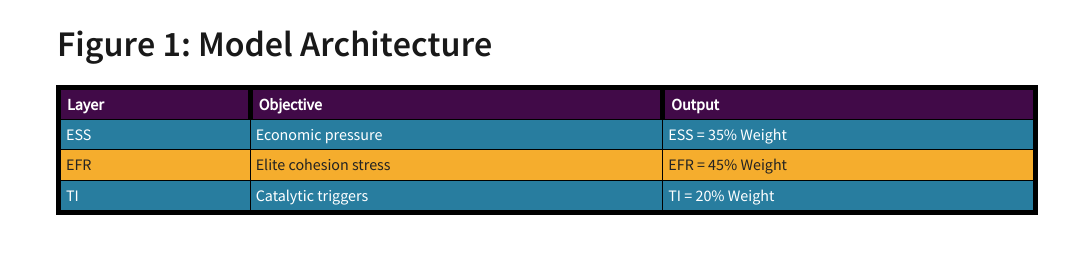
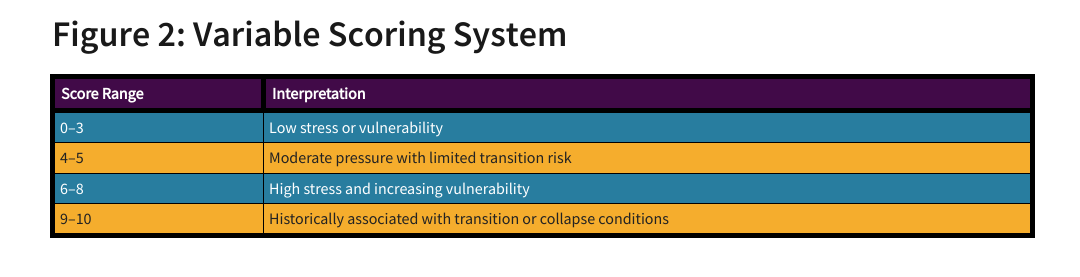
A recurring challenge in political-risk analysis is converting qualitative observations into structured assessments. The Leadership Vulnerability Framework addresses this by assigning scores to Economic System Stress (ESS), Elite Fragmentation Risk (EFR) and Trigger Index (TI) on a ten-point scale. Scores are not intended to represent precise measurements. Rather, they provide a disciplined method of comparing historical and contemporary cases.
The scoring system is:
Economic Stress
Economic stress is measured by the divergence between government reported economic performance and measurable reality. The reason to use this measure and not humdrum economic reports is because the government will only lie when things are bad and when it is afraid of the effect on the public.
Some of the measures used here are measured inconsistences between:
- Declared inflation and central bank interest rates.
- Fiscal arithmetic and military expenditure.
- Stable banking conditions and evidence of monetization of the cost of war - as well as corporate indebtedness and debt service arrears.
- Real wages, wage arrears and inflation.
- War, the labour market and coming conscription.
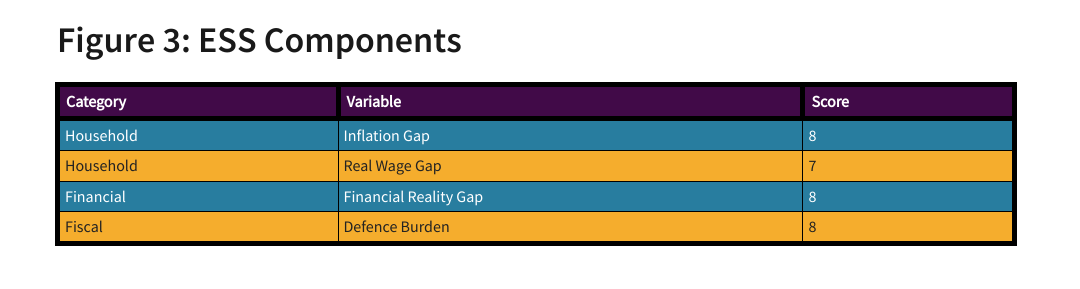
ESS combines household stress, financial stress and fiscal stress. Household stress includes inflation, real wages and wage arrears. Financial stress includes credit distortions, regional financial strain and the Financial Reality Gap. Fiscal stress includes budget deficits, defence burdens and resource dependence; dislocation of labour markets by war casualties and recruitment. Under current assumptions ESS is estimated at approximately 7.8, placing Russia in the framework’s high-stress category.
The Financial Reality Gap is a specific attempt to measure divergence between reported banking health and observable financial strain. A system reporting low non-performing loans and strong profitability should not normally exhibit rapidly rising forbearance, hidden support mechanisms, increasing wage arrears and widespread corporate distress. Historically, major banking and financial crises have often been preceded by such divergences. The FRG is therefore treated as a core component of Financial Stress.
The final ESS score represents a synthesized assessment of these pressures.
Elite Fragmentation Risk
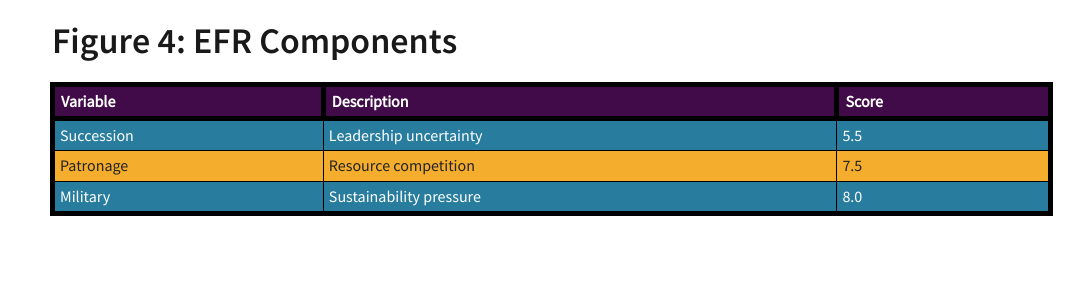
EFR checks whether the elite backs the leadership. It evaluates succession uncertainty, patronage compression, security competition, regional fiscal stress and military sustainability. Authoritarian systems can endure economic stress while elite cohesion remains intact. They become more vulnerable when competition for resources increases or when uncertainty develops regarding future leadership arrangements.
EFR is intended to capture pressures acting upon the cohesion of the ruling coalition rather than popular dissatisfaction.
In the past nine months one important measure of emerging Elite Fragmentation has been the increasingly vocal media condemnation of domestic oppression and the ‘Stalin Cult’; the internet blackout and the emergence of the war in Ukraine as the cause of economic difficulties for ordinarily people. The fact that these issues can be articulated publicly indicates that not all the elite is onboard with the polices behind them.
Trigger Index
The TI captures catalytic events capable of converting latent pressure into political action. Military setbacks, financial accidents and banking instability, succession crises, elite defections, succession disputes and social unrest and major protest movements all fall within this category. Current trigger pressure remains materially below the levels associated with major historical transitions.
Upcoming potential Triggers include:
- Conscription.
- Economic collapse (particularly food inflation and energy scarcity);
- Military defeat.
- The loss of Crimea.
- Bad results in the forthcoming presidential and Duma elections.
For the TI, scores are derived from the probability and severity of catalytic events capable of converting latent stress into political action.
Historical Validation
The Framework was tested against Venezuela 2014, Egypt 2011, Russia 1998, Romania 1989 and the Soviet Union in 1991. The Framework scored well both statistically and in terms of qualitative ratings and outcomes:
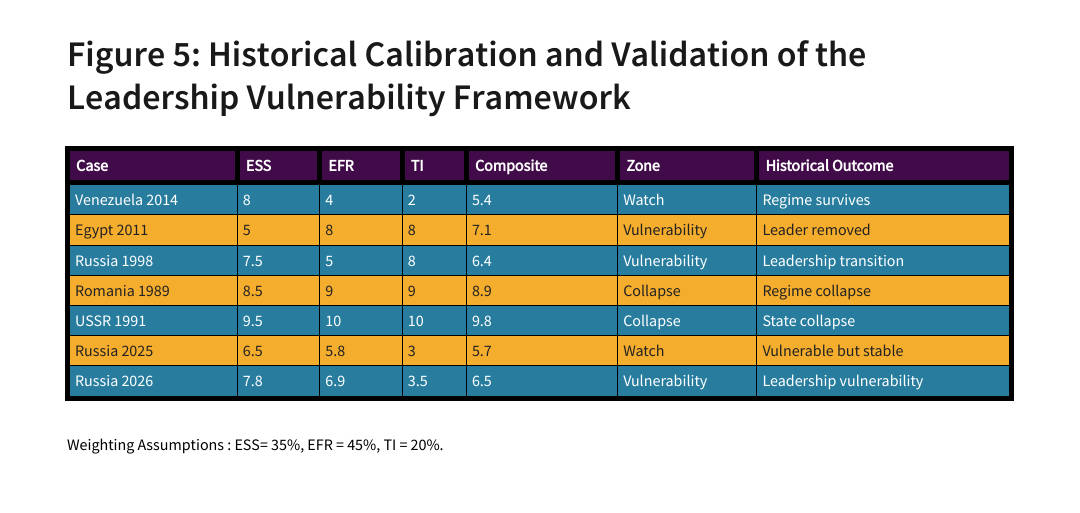
The overall score of Russia today puts it in the High Stress and Increased Vulnerability Category.
A System Moving in the Wrong Direction
One of the principal advantages of the Framework is that it can be applied retrospectively. This allows one to see the direction of travel.
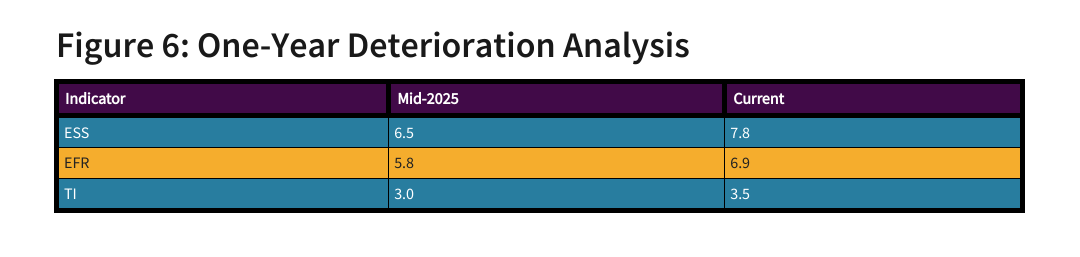
Over the past year ESS has increased materially, rising from approximately 6.5 to 7.8. EFR has followed a similar trajectory, increasing from 5.8 to 6.9. Trigger pressure has increased only modestly from 3.0 to 3.5.
This pattern is important because it suggests deterioration is occurring primarily within the underlying structural variables rather than through the emergence of a single catalytic event.
Conclusion
Vladimir Putin’s leadership appears to be entering a grey zone of increasing vulnerability. Economic stress is high, elite pressures are rising and discrepancies between official military, economic and social narratives and observable realities continue to widen.
However, Russia has not entered a collapse zone, and the Framework does not imply imminent leadership change. However, it has entered a historically significant leadership-vulnerability zone in which increasing fragility and increasing propensity for risk-taking may coexist.

In plain text, this is a cornered Putin. A Putin who has nothing to offer his people except more of the same except worse: a draining economy; a war longer than the First World War and more murderous than the Soviet war in Afghanistan with no tangible benefits to show for it. ‘Worse’ because the increasing cost of war in economic and human terms cannot be achieved by market means. It will take increasing repression to allocate resources to the task.
And now looms the threat of conscription to continue fighting it. Russia’s losses are running at 1300 – 1,400 per day killed and wounded. Recruitment is hovering around 1000 per day. The policy goal is to recruit 409,000 people in 2026. Conscription would violate Putin’s social contract not to let his ‘Special Operation’ hurt the urban elite. The economic effects of the war are already doing so. But conscription could be a flash point.

It is comforting to think that a leader in this predicament is weakened and therefore enjoys less power. But weakness is likely to make Putin more isolated. His perceptions may become even more divorced from reality. His feeling of insecurity is likely to increase. That would make Putin more unpredictable and dangerous. Dying fish flap hardest!
The temptation for Putin is to extend the war in the form of a step change in Grayzone escalation to Europe in the hope that this will undermine European support for Ukraine but not trigger NATO Article 5 type military action against Russia.
In a nutshell, as the Ukraine war becomes more economically unsustainable and Putin’s regime weakens, this may mark the moment when Putin will escalate his European war out of desperation. Failure of this policy would increase the likelihood that Putin will be replaced. But by what?
A military putsch is unlikely. A popular revolt even less so. And a Kremlin elite coup is as likely to be more extremist than less so. Furthermore, in the background, the threat of nuclear weapons will always be lurking.
© David Roche, 2026, published by RUSI with permission of the author.
The views expressed in this Commentary are the author's, and do not represent those of RUSI or any other institution.
For terms of use, see Website Terms and Conditions of Use.
Have an idea for a Commentary you'd like to write for us? Send a short pitch to commentaries@rusi.org and we'll get back to you if it fits into our research interests. View full guidelines for contributors.
WRITTEN BY
David Roche
- Jim McLeanMedia Relations Manager+44 (0)7917 373 069JimMc@rusi.org