

Options for a NATO Multinational Drone-Interception Squadron

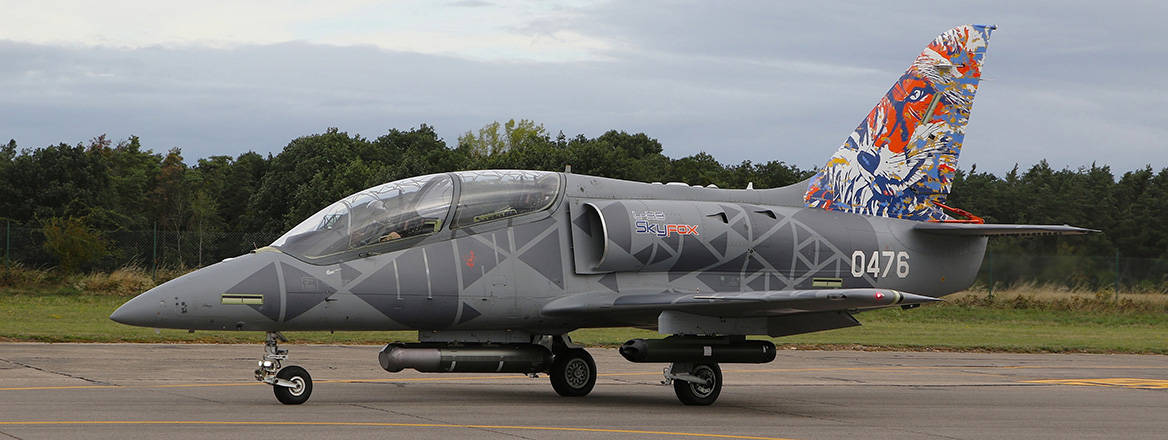
A dedicated multinational NATO squadron of armed jet trainers could shoot down Russian drone incursions without burning through frontline fighters and scarce air-to-air missiles.
There has been a steady increase in incursions by Russian (and sometimes accidentally by Ukrainian) one-way attack (OWA) and decoy drones into NATO member states’ airspace over the past 18 months. In September 2025, a pair of Royal Netherlands Air and Space Force F-35As shot down several Russian Geran or Gerbera drones over Polish territory, probably using AIM-120 AMRAAM radar-guided missiles. During breaches of Romanian airspace, Romanian Air Force F-16s shot down at least three drones in July, and a Spanish F/A-18 shot down a Russian drone in August. In September, Italian Air Force Eurofighters shot down an unknown drone in Lithuania. The Ukrainian Air Force (UkrAF) F-16 fleet has shot down well over 1,000 OWA drones since its introduction in 2024, but this heavy tasking has rapidly used up available airframe fatigue life leading to maintenance backlogs, and the UkrAF is now facing serious shortages of air-to-air missiles.
The problem is clear: regular OWA drone interception patrols and scrambles are not a sustainable use of expensive frontline fast jet capacity, flying hours and limited stocks of high-end air-to-air missiles. Fast jet squadrons and associated missile stocks are already heavily tasked across Europe and are arguably the most critical capability set for deterring direct Russian aggression in the coming years. Alternative means to sustainably intercept and shoot down Russian drone incursions are urgently required, to allow high-end fighters and missile stocks to be preserved for mission sets that only they can fulfil.
A multinational squadron dedicated to drone-interception duties under a NATO banner offers an obvious solution that could be rapidly created and deployed if prioritised by senior military and political leaders.
Operational Requirements
To be worth the political and financial capital required, such a unit would need to be capable of intercepting the increasingly common jet-powered Geran-3 and Geran-4 OWA drone models at night, in marginal weather conditions and in GPS-degraded or denied environments. This is because a capability only able to intercept propeller-powered drones would be easy for Moscow to adapt to by simply launching probing incursions during inclement weather, at night and using jet-powered OWA drone types. The Geran-4 is a faster derivation of the Geran-3, with a more powerful engine and airframe optimisation that enables it to fly at cruise speeds of 350–500 kph, or 188–270 knots (kts), depending on altitude, fuel load and warhead size fitted. The Ukrainian Intelligence Services estimate Russian production of jet-powered OWA drones at around 3,000 per month, so harassment will remain affordable at scale, and the size of the potential strike drone interception challenge for NATO air forces in any direct clash is significant.
Intercepting Russian OWA drones is a specialised skill set that requires regular, realistic practice for aircrew and command and control structures alike
Russian Geran series drones are frequently equipped with approach-warning sensors designed to detect spotlight illumination and laser designators. These can trigger pre-programmed evasive manoeuvres by the drones – usually turns and shallow dives to increase speed and reach very low altitudes. The drones are painted matt black, and often fly in large groups, with some fitted with first-person view cameras and even MANPADS (man-portable air defence systems) missiles that can be used via relay link to try and shoot down or collide with intercepting helicopters and fixed-wing aircraft.
Navigation is a challenge under realistic night-time conditions, where GPS will often be jammed or spoofed by Russian electronic warfare systems. Friendly (or Russian) air defence engagement zones, international borders and civilian airspace boundary concerns mean navigation must be highly accurate during transits and intercept attempts to avoid friendly fire risks or violations. A crew can be guided to a rough intercept location and vector, but must then be able to rapidly find, track and engage a small, black, potentially manoeuvring drone or group of drones in near total darkness. For aircraft lacking a suitable radar, this means a crew of at least two people is needed. A twin cockpit allows a specialist sensor operator to scan the sky for the small thermal contrast signature of a drone using a well-stabilised sensor ball or targeting pod, while the pilot uses night-vision goggles (NVGs) to keep a careful lookout, aim weapons and navigate.
What this means in practice is that intercepting Russian OWA drones is a specialised skill set that requires regular, realistic practice for aircrew and command and control structures alike. It is not something that flying instructors at a training wing or reservist multirole pilots could simply maintain proficiency in as a part-time secondary duty.
Aircraft Options
Suitable aircraft for a dedicated counter-drone interception squadron must have several properties:
- Available rapidly to fill the urgent need for NATO counter-drone interception capacity and counter steadily increasing Russian airspace violations on the Alliance’s borders.
- Significantly cheaper to acquire and to operate than frontline fighters.
- Fast enough to efficiently intercept jet-powered Geran-3 and -4 drones without a perfect intercept vector and/or a lengthy tail-chase.
- Weapon options that enable efficient, safe intercepts without unsustainable cost and integration or procurement timelines.
- Twin seat to enable a sensor operator to reduce pilot workload and increase interception efficiency.

There are relatively few options that meet all these criteria. Piston-engined aircraft in production today are generally not fast enough, especially once the drag and weight of weapons and a targeting pod or sensor ball are added. Turboprop-powered advanced trainer aircraft such as the Pilatus PC-9 and Embraer A-29 Super Tucano offer more potential. Such trainers are in widespread service, have twin-seat cockpits and can carry weapons such as .50 calibre machine guns, 7.62mm minigun pods or 70mm rocket pods alongside a sensor ball.
One PC-9 is already in use by a volunteer group in Ukraine to intercept Geran-2 and Geran-3/4 drones, using 7.62mm minigun pods. In discussions with the author, they explained that to reliably intercept jet-powered drones, 300 kts is the minimum speed needed. The PC-9 with gunpods and a sensor ball is only capable of reaching such speeds in a dive, which imposes limitations on what can be intercepted and the window available to achieve a guns-kill once lined up behind a target. Nevertheless, the group has used it to successfully intercept several jet-powered Geran-3/4s during daylight and at night using this technique.
However, the PC-9 is no longer produced, though it is available in reasonable numbers on the second-hand market. The newer, lighter and more powerful PC-21 advanced trainer is much faster and can easily reach 300 kts in level flight, but has small wings that are not designed or stressed for armament. Swiss neutrality laws would also probably prevent any armed variant being sold new to a NATO squadron or individual nations likely to use them in combat.
The A-29 Super Tucano is a more powerful aircraft than the PC-9, and is currently in active production. It is larger and significantly heavier, having been designed from the outset as a light attack aircraft, with .50 calibre machine guns in the wing that add less drag than gunpods, and an integrated sensor ball to find and track targets. The Super Tucano’s performance, handling, avionics and missionised twin-seat cockpit make it eminently suitable for intercepting propeller-powered Geran-2 and Gerbera OWA drones. However, the A-29 is significantly slower in both cruise and climb than the PC-21, and lacks sufficient performance with a useful payload to reliably intercept jet-powered Geran-3 and Geran-4 drones, at least without a significant height advantage and an almost ideal interception vector from a controller.

Advanced jet trainer aircraft offer other options, such as existing light fighter variants of the Leonardo M-346 and ;KAI TA-50. Having had the chance to evaluate both, the author can attest that both types could be highly effective in the dedicated counter-drone interception role. Both carry a compact radar in the nose, offer a twin-seat cockpit to increase crew capacity during complex intercepts, have excellent transonic performance (supersonic in the case of the FA-50), carefree and precise handling at all speeds, and multiple potential weapon options. They would also offer the benefit of a common type for certain existing NATO member states such as Poland with the FA-50 and Italy with the M-346A, reducing maintenance and aircrew training overheads for a new unit. However, the drawbacks on both are operating costs that are less than but not dramatically less than some frontline fast jets like F-16 and Gripen C/D. Delivery timelines would almost certainly take any possible NATO squadron formation date to at least 2030 due to a significant existing order book for both types. Both M-346FA and FA-50 would also need external fuel tanks to provide decent endurance on station, which would reduce pylon space available for the necessary rocket pods and targeting pod.
The final, and perhaps most compelling, available option is the Aero L-39NG. This aircraft is significantly cheaper to operate than other advanced jet trainers, with comparable operating costs to turboprop trainers like the PC-9. It is smaller, lighter and less powerful than the M-346 and FA-50, but it can still easily reach 300 kts at medium altitude in level flight with external stores. The author had no difficulty intercepting multiple simulated Geran-4 class targets flying at up to 270 kts at medium altitude and 220 kts at low altitude with it during an evaluation sortie in August 2026. The L-39NG also has docile low-speed handling characteristics down to below 100 kts, so could intercept slow-flying Geran-2 and Gerbera drones with low-overtake velocities and higher safety margins when context allowed.

Two targeting pod options, LAU-32 rocket pods, and .50 calibre gunpods have already been integrated as stores options. The L-39NG does not have a radar, however, so like turboprop options it would need to be vectored onto incoming threats by either ground-based fighter controllers, an AWACS or more capable fighters such as F-35. It could then acquire and track the target using one of the two targeting pod options already integrated onto the aircraft. Perhaps most importantly, the Aero production line for the L-39NG has a smaller order backlog and more spare capacity than other advanced fast jet trainer lines, so a NATO squadron could be equipped far more quickly with this type. It would also be easy to train aircrew and maintenance crew for in most Eastern European member states, since there is heavy commonality with the legacy L-39 that most operated for decades as a jet trainer.
Weapon Options
Effective weapon options for sustainably intercepting OWA drones in the build-up to conflict, and large numbers of them if a conflict breaks out, are also limited. Air-to-air missiles are too scarce, expensive and necessary for other tasks, which leaves air-to-air rockets and machine guns or cannon as the sustainable options. With either, a well-stabilised targeting pod or sensor ball and a trained operator is essential to find, visually identify and then designate each drone target during an intercept. One with a laser rangefinder is much better than one without, as it can then provide an accurate ranging cue to the intercepting pilot and help them judge their separation, closure rate and aim weapons effectively.
Machine guns and/or rapid-firing aircraft cannons are cheap to fire but come with notable limitations. First, it is difficult to precisely line up a shot on a small, black-painted, potentially manoeuvring OWA drone during the day, and it is even more difficult at night under NVGs. At low altitudes, turbulence means the intercepting aircraft and drone move around far more than at medium altitudes, making a precise firing solution harder to achieve. When drones are flying low a gun/cannon strafing pass from above brings the risk of a fatal overshoot into the ground, thus making pilots use a more difficult co-altitude approach and firing profile.
The warhead in the drone, which can be up to 90 kg in weight, frequently explodes when hit and can easily damage or destroy intercepting aircraft that fire when too close
This difficulty increases significantly if the aircraft being used does not have a fire control radar that can give the pilot a radar-assisted target cue and aiming solution through a heads-up display. All the turboprop trainer options, and the L-39NG, can only provide the pilot with an optical aiming cue and so guns/cannon will be significantly less accurate. However, a few hits with any gun or cannon are generally enough to destroy a Geran or Gerbera, so over sparsely populated areas a generous spray of rounds can be used to get the job done.
The second problem is that the warhead in the drone, which can be up to 90 kg in weight, frequently explodes when hit and can easily damage or destroy intercepting aircraft that fire when too close. Therefore, without a radar-assisted aiming solution, gunpods or cannons can be difficult for pilots to employ reliably against Geran drones without having to get close enough that they and their aircraft are at risk from shrapnel.
The third problem with guns or cannon is that the rounds fired that do not hit the drone will travel some distance before landing and potentially causing damage or injuries to people and property on the ground in friendly territory. This is also a risk with missiles – during an incursion in September 2025 by more than 20 Russian drones, an air-to-air missile fired by a Polish fighter malfunctioned and hit a house, thankfully without loss of life. However, guns and cannon are harder to assure against inadvertent collateral damage when used over friendly territory against airborne targets.
Air-to-air rockets are a far better option, with either laser- or infra-red guidance. They provide a means to shoot down drones faster, more easily and from a safer range than machine guns or cannons. Laser-guided rockets require the drone to be tracked and illuminated with a laser designator within a targeting pod or sensor ball from launch through to impact. IR-guided rockets simply need to lock onto the drone prior to launch. The aircraft can then break away after launch to start engaging other drones in a wave. These rockets have some limitations in bad weather, do not work well through cloud and laser-guided rockets are less reliable against very low-flying targets. Nevertheless, laser and IR guided rockets are still the best option available to aircraft for engaging OWA drones. Rockets could also be programmed to self-destruct after a certain distance to minimise collateral damage risks over friendly territory.
An aircraft such as the L-39NG with a targeting pod and two underwing pods with 14 total LGR275 rockets, flown by specialist aircrew, could routinely intercept and shoot down drone incursions in both competition and wartime. Such a squadron could be formed and equipped in only a few years, if seriously prioritised.
There are two currently available options which include the BAE Systems AGR-20 Advanced Precision Kill Weapon System Mk.II (APKWS II) and Thales LGR275 Laser Guided Rocket. Both cost far less per shot than traditional air-to-air missiles – around $25,000–50,000 per shot. They can also be carried and fired in greater numbers by each aircraft, usually from a 7-shot pod per underwing pylon. For European users, the LGR275 is likely to be a more compelling option due to a better proximity fuze and the fact that getting Foreign Military Sales shipments of the AGR-20 is currently very difficult due to heavy American use of the rockets against Iranian OWA drones in the Middle East since February 2026.
Conclusions
A single multinational NATO squadron of, perhaps, 16–24 aircraft with aircrew that train and deploy exclusively as counter-OWA drone interception specialists could bring major advantages to the Alliance for a far smaller cost than a traditional fighter squadron.
First, it could provide a dedicated NATO capability to sustainably counter one of Russia’s primary means of probing and undermining Alliance borders. An aircraft such as the L-39NG with a targeting pod and two underwing pods with 14 total LGR275 rockets, flown by specialist aircrew, could routinely intercept and shoot down drone incursions in both competition and wartime. Such a squadron could be formed and equipped in only a few years, if seriously prioritised.
Second, financial and personnel contributions to such a multination NATO squadron would offer a way to play a critical role in the day-to-day frontline defence of NATO for smaller Eastern and Central European air forces that currently struggle to equip and train high-end fast jet squadrons to a standard suitable for high-intensity operations. Detachments could be deployed to sit alert in countries like Romania, Poland and the Baltic states where Russian drone incursions are increasingly common.
Third, such a force would reduce the attractiveness for the Kremlin of using airspace violations by OWA drones as a tool to probe and undermine NATO red lines and air defence capacity. As a purely defensive tool, a multinational NATO squadron might also be less likely to raise opposition from certain Alliance member states than other options to bolster deterrence against Russian probing.
© RUSI, 2026.
The views expressed in this Commentary are the author's, and do not represent those of RUSI or any other institution.
For terms of use, see Website Terms and Conditions of Use.
Have an idea for a Commentary you'd like to write for us? Send a short pitch to commentaries@rusi.org and we'll get back to you if it fits into our research interests. View full guidelines for contributors.
WRITTEN BY
Justin Bronk
Senior Research Fellow, Airpower & Technology
Military Sciences


- Jim McLeanMedia Relations Manager+44 (0)7917 373 069JimMc@rusi.org