

NATO 3.0 to Emerge at Ankara Summit Amid Fragile Unity

European allies and Canada will try to ease recurring tensions with President Trump by stepping up in a rebalanced alliance: NATO 3.0. But transatlantic unity remains fragile.
A Grand Setting
President Erdogan’s neo-Ottoman 1,000 room palace, complete with a mosque and vibrant turquoise carpets (symbolising Turkey’s maritime power in the colour of its traditional tiles), will be the grand setting for the NATO summit on 7-8 July.
NATO officials hope to make this a show of unity in a year marked by Donald Trump’s threats over Greenland, criticism of Europeans for not showing enough support for his war in Iran, and cuts to American military presence in Europe. Their aim is to repeat the success of last year’s summit in The Hague, where NATO leaders agreed to invest 5% of GDP on defence. This major pledge helped placate President Trump but also sent a strong message of deterrence to President Putin.
Ankara is supposed to be about delivery, with a clear path to increased defence spending, faster defence production, and more sustainable support for Ukraine. ‘We will breathe life into the concept of NATO 3.0: a stronger Europe in a stronger NATO,’ Secretary General Mark Rutte said.
He has three reasons to be cautiously optimistic. Europeans are investing record sums in defence; they are backfilling (at least on paper) most of the gaps left by the US in NATO defence plans; and all 32 allies have already agreed the summit declaration.
The Trump Trillion
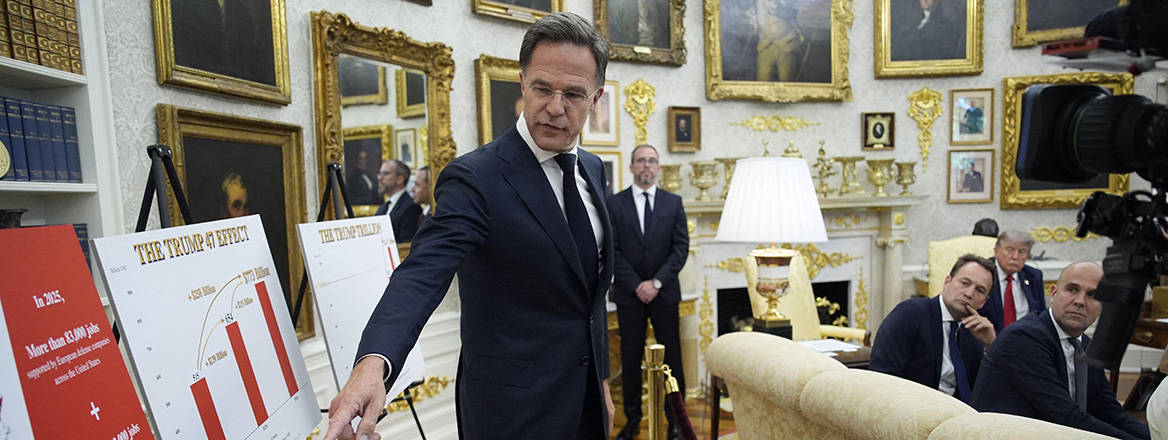
President Trump famously loves big, beautiful numbers. In 2019, then Secretary General Jens Stoltenberg persuaded him to drop criticism of NATO by announcing on Fox News that European allies and Canada had invested $100 billion dollars more in defence. Last month, Mark Rutte presented charts in the Oval Office showing over $1.2 trillion in extra defence expenditure since Trump’s first term, including a 20% increase in 2025. One chart was titled in big golden letters: ‘THE TRUMP TRILLION.’
Speaking in Washington, the Secretary General stressed that ‘several nations, including Estonia, Latvia, Lithuania and Poland, are already spending well over the agreed targets, while others are making remarkable strides.’
But converting all that cash into capabilities at scale and speed remains challenging, due to fragmented markets, red tape and protectionism. The NATO Summit Defence Industry Forum, which is part of the Ankara summit, aims to provide a platform for transatlantic defence industries ‘from Ankara to Arlington,’ and will also include Ukraine, the EU, South Korea and other NATO partners. Rutte announced in Washington that new contracts worth ‘tens of billions of dollars’ will be signed. They are expected to boost transatlantic co-production, increase rapid adoption of innovation, and focus on NATO priority areas such as space and surveillance, integrated air and missile defence, and deep strike capabilities.
Filling the Gaps
That process needs to be speeded up because of Russia’s threat, but also because the Pentagon informed allies in May that it would shrink the pool of capabilities assigned to the implementation of NATO defence plans in a crisis or conflict, known as the NATO Force Model.
NATO allies are also set to pledge €70 billion in military assistance to Ukraine for 2026 and ‘at least equivalent levels’ of support in 2027
The move is designed to ensure America can fight simultaneous conflicts in different theatres, while reducing Europe’s decade-long ‘unhealthy dependence’ on American military power and push it to take the lead for its own conventional defence. Information about US deployment plans is classified, but the cuts are reported to include a third of F15 fighter jets, half of armed drones, aircraft carriers and strategic bombers.
The good news ahead of the summit is that Europeans have stepped up. ‘In a matter of weeks, European allies have largely filled the gaps left by US reductions to the NATO Force Model,’ Supreme Allied Commander Europe General Alexus Grynkewich told Reuters. ‘And in those few areas where they haven’t, where they do not currently have a like capability to replace, we are looking at alternate capabilities with matching effect,’ he added. The main gap is strategic bombers, which Europeans simply do not have, and which cannot be replaced like-for-like. Europeans could resort instead to deep precision strike capabilities, but the problem is that they have very limited numbers and with not enough range. So, while the problem appears solved on paper, it is much trickier in practice.
A Short Declaration
The third reason for cautious optimism is that NATO ambassadors have already approved the text of the Ankara summit declaration, a short sharp text similar to the one adopted last year in The Hague.
The declaration reaffirms the ‘ironclad commitment to our collective defence under article 5’ of NATO’s founding treaty and states that European allies and Canada are delivering on the commitments made in The Hague. ‘We are building the future: a stronger Europe in a stronger NATO,’ the text says. ‘European Allies and Canada, working with the United States, are assuming greater responsibility for the Alliance’s defence.’
The declaration describes Russia as a ‘long-term threat to Euro-Atlantic security and stability.’ NATO allies are also set to pledge €70 billion in military assistance to Ukraine for 2026 and ‘at least equivalent levels’ of support in 2027. According to diplomats, this figure includes €30 billion from the €90 billion loan to Ukraine, plus €40 billion in bilateral support, roughly equivalent to the current level of assistance provided by Europeans, but without any direct US funding.

Help your search results show more from RUSI. Adding RUSI as a preferred source on Google means our analysis appears more prominently.

Finally, the text states that ‘Allies reiterate that Iran must never have a nuclear weapon and call on Iran to fully respect freedom of navigation in the Strait of Hormuz.’ While several NATO countries have pre-positioned mine clearing vessels and other capabilities in the region, it is unclear if any concrete decision will be made in Ankara to support reopening the Strait.
Moods
Early consensus on the summit declaration by all 32 allies could suggest that President Trump may not ditch it on a whim, as he notoriously did with the G7 declaration in 2018. Officials hope that the constructive spirit of this year’s G7 meeting in Evian, including as regards support to Ukraine, will extend to Ankara. But they also admit that a lot depends on the mood he is in on the day.
Almost at the same time as the declaration was adopted at NATO HQ in Brussels, Trump lashed out on Truth Social, repeating claims that NATO allies ‘were not there for us!!!,’ that Washington’s relationship with NATO ‘is not reciprocal,’ and it was ‘ridiculous for the USA to continue along this one-sided path.’ He also claimed that Germany’s spending was ‘MUCH LOWER between 2014-2025 than the US or other NATO allies.’
In response, German Chancellor Friederich Merz played up Germany’s defence spending at a meeting with Baltic leaders. Germany is doubling its defence budget within four years and ‘we have no reason to shy away from anyone,’ Merz said. In a subsequent call with Trump to congratulate him on the 250th anniversary of American independence, Merz stressed ‘that Germany is taking more responsibility for security in the Euro-Atlantic area.’
So, despite NATO’s best laid plans, the summit could provide Trump with a stage to berate other leaders, in particular Spain’s Prime Minister Pedro Sánchez, Italy’s Prime Minister Giorgia Meloni or outgoing UK Prime Minister Sir Keir Starmer, all of whom he has recently criticised. Much will depend on Mark Rutte’s ability to defuse these tensions, and on Trump’s excellent relations with Turkish President Recep Tayyip Erdogan. Trump said he was going to the summit ‘out of respect for President Erdogan,’ whom he calls ‘a hell of a leader.’ He will not want a fellow strongman to lose face on home turf by throwing the summit into disarray.
Even if all goes well in Ankara, NATO leaders may not get together again for the foreseeable future. The summit declaration fails to mention plans for the next summit in Albania in 2027, as had been agreed in The Hague. One reason is that Albania did not even reach the bare minimum of 2% of GDP on defence last year. The main reason is that right now, most in NATO are keen to avoid the yearly dose of drama which only undermines the alliance’s core mission of deterrence and defence.
© RUSI, 2026.
The views expressed in this Commentary are the author's, and do not represent those of RUSI or any other institution.
For terms of use, see Website Terms and Conditions of Use.
Have an idea for a Commentary you'd like to write for us? Send a short pitch to commentaries@rusi.org and we'll get back to you if it fits into our research interests. View full guidelines for contributors.
WRITTEN BY
Oana Lungescu
RUSI Distinguished Fellow; RUSI Europe Advisory Board Member


- Jim McLeanMedia Relations Manager+44 (0)7917 373 069JimMc@rusi.org