

Missing Intelligence: The Trump Administration, Iran and the US Intelligence Community

Despite intelligence dominance in the war with Iran, events suggest the US intelligence community is having little influence on White House decision-making.
Drawing breath in the (at the time of writing) ceasefire in the US and Israeli war with Iran, there has been much reflection on the initial US and Israeli decapitation strikes against Iran’s leadership, an attack which killed Ayatollah Ali Khamenei, Iran’s Supreme Leader. The strikes also killed an estimated 40 Iranian officials, including senior military, Revolutionary Guard (IRGC) and intelligence figures, achieving tactical surprise amidst talks on Iran’s nuclear programme. Subsequent massive airstrikes as part of the US and Israeli campaign, and the daring US operation to rescue downed aircrew, all relied on vital information for targeting, situational awareness and the conduct of all aspects of the war.
Commentators have rightly been quick to observe the central importance of intelligence in all this. For years, Israeli and US agencies have achieved all-source intelligence dominance against the Iranians. As also illustrated by the 12-day war last year, both the US and Israel have been able to laboriously acquire a wealth of information from human and technical sources. In the days leading up to the start of Operation Epic Fury, the US Central Intelligence Agency (CIA) had reportedly pinpointed the location of Ali Khamenei with ‘high fidelity’, offering a window of opportunity for the strike. The new intelligence, shared with Israeli officials, proved decisive in the decision to strike immediately.
The opening phase of operations shows what intelligence can do in underpinning military operations, and follows similar examples during the war in 2025, including the assassination of Hizballah Secretary-General Hasan Nasrallah, the ‘pager attacks’ and precise targeting against a range of military and nuclear targets across Iran by both the US and Israel. When used correctly, intelligence leads to remarkable results. But for all the operational success, the war with Iran reveals – or rather, is a reminder of – another thing: intelligence can have a limited impact on policy. Tactical and operational use of intelligence for targeting – however spectacular and however large the numbers of targets hit – cannot mask the absence of intelligence feeding into high-level decision-making.
Intelligence was the bedrock of Epic Fury’s short-term success, yet the impact of intelligence on US policy appears to remain limited
Theoretically, one of the main purposes of intelligence is to shape policy. Billions are spent on the collection, assessment and sharing of secrets to allow policymakers to make as informed a decision as possible. It should give – to quote former US intelligence official Jennifer Sims – ‘decision advantage’. The much lauded ‘Intelligence Cycle’ begins and ends with policymakers. Yet policymakers – just like the TV shows they watch, or the things they buy – have preferences for their sources of information. Intelligence rarely works in an information vacuum. Trying to link ‘X’ intelligence to ‘Y’ policy decision is often a futile gesture. Intelligence can be a factor behind foreign policy, yet it is not always the most important factor. Internal politics, international partnerships, the daily news cycle, or gut feeling are other reasons. Add to that the idiosyncrasies of the Trump administration and there is a problem.
CIA Warnings
Just weeks before the launch of strikes, the CIA reportedly assessed Ali Khamenei could be ‘replaced by hardline figures’, specifically from the IRGC. It was just one likelihood, and the agency apparently did not point to any scenario with certainty. Presented with Israeli plans to topple the regime, US intelligence officials believed them to be ‘detached from reality’. CIA Director John Ratcliffe reportedly described regime change options as ‘farcical’. The Trump administration, like others previously, are guilty of optimism bias. The relatively bloodless capture of Nicolás Maduro (Operation Absolute Resolve) inflated Trump’s expectation of what could happen in Iran. Whilst the administration believed decapitation would probably lead to a quick victory, intelligence officials were pessimistic. There was a growing number of reports giving a ‘consistent analysis that the regime is not in danger’ and ‘retains control of the Iranian public’, sources leaked. Those assessments appear correct at the time of writing – with some analysts even suggesting the regime has hardened, or at least demonstrate valid caution about early collapse.

Defence Secretary Pete Hesketh’s interaction with journalists over Iran’s preparedness to shut the vital Strait of Hormuz is another example of intelligence apparently having limited impact or being cast aside. ‘We planned for it. We recognize it,’ Hegseth said last month. It is true to say that the administration did think about the risk. They could hardly argue otherwise given that decades of US military planning have prepared for the possibility. Unfortunately, if US media reporting is accurate, the US political leadership then chose to downplay such assessment, believing that shock and awe would prevail while under-estimating the impact. Reportedly, current US assessments suggest Iran can field up to 70 per cent of its pre-war mobile missile launchers, and is restoring access to sites previously targeted in strikes. Similarly, while it seemed likely that an existential threat to Iran might lead to them lashing out against more than just US and Israeli targets, Trump claimed their attacks on Gulf states and the scale of the reaction were surprises – a claim predictably rejected in further intelligence leaks within days.
Flawed Assumptions
The Trump administration’s decision to launch operations appears to have been based on flawed assumptions. The leaks of sensitive intelligence reporting – admittedly, a frequent occurrence with the USIC – indicates a range of officials being locked out and frustrated. Fiona Hill, the former Trump advisor and US analyst, recently said that Trump’s dislike of intelligence stemmed from a lack of trust in ‘anybody who is not personally loyal to him.’ The truth is likely to be simpler. The President, relying on a tight circle of national security officials, fell into the trap that others have done before: he impulsively followed his own gut instinct. He falsely believed that he could exploit a window of opportunity, face the criticism and successfully prosecute a war. Intelligence officials were on the outside looking in. The testimony of senior members of the US Intelligence Community before Congress on 18 March highlighted some of the challenges of providing intelligence in the current US administration, as they sought to duck directly contradicting the President, while simultaneously trying to reflect the assessments he received before the decision to launch the operation.
The impact of this can not only be seen in the decision to go to war, but decisions made during the conflict. An administration that was expecting a significant regional Iranian response would probably have positioned a wider variety of defensive capabilities in the GCC states in advance of beginning the operation; for example, THAAD interceptors, much needed in the Indo-Pacific. An administration that was expecting trouble in the Strait might have prioritised the small attack craft and boats of the IRGC Navy above the conventional surface ships of the Iranian Navy. And it certainly would not have alienated the same European allies it then alternatively berated and cajoled as it sought to encourage them to deal with maritime threats it claims it fully anticipated.


This is just the latest chapter in the long history of Trump’s stormy relationship with the USIC. Whilst his alternative reality on Russia is well documented, the administration has clearly been at odds on Iran too. In June 2025, leaked Defence Intelligence Agency (DIA) assessments suggested that Midnight Hammer, the US operation against Iran’s nuclear programme, set back Iran’s programme months, not years, contradicting the administration (even if this was only a preliminary assessment and was – like all such early snapshots – made with limited confidence). DIA Director Lt. Gen. Jeffrey Kruse was removed, apparently more for the contradiction than the leak itself. US assessment also brings into doubt several of the justifications to attack Iran. Assessments suggested Iran could only develop a militarily viable ICBM by 2035 if it chose to start now. Officials have also questioned administration claims that Iran was on the brink of developing a nuclear capability, and when pressed on this in the public session, again evaded on the issue.
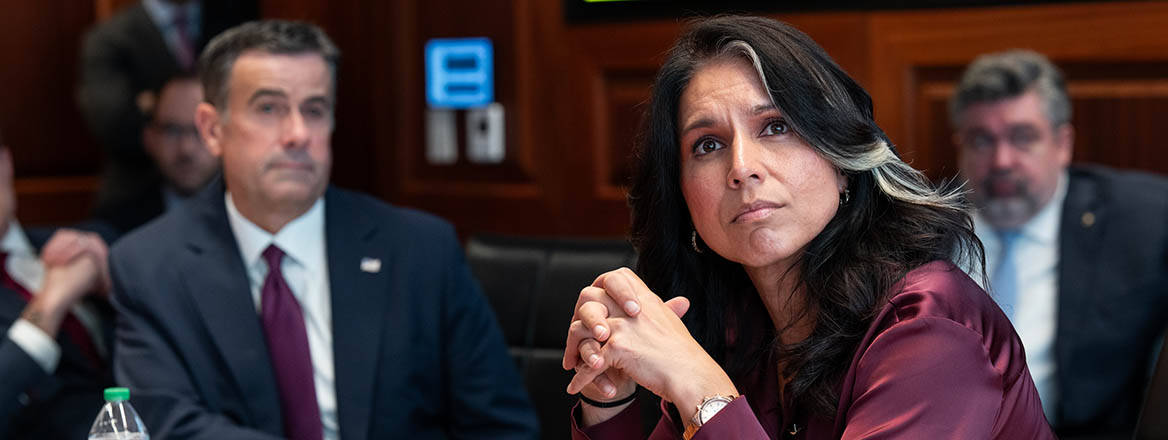
Indeed, the level of dysfunction in the US system can be seen in reporting that consistently highlights the absence of the Director of National Intelligence (DNI), Tulsi Gabbard, from much of the debate, presumably because of differences in opinion. The DNI instead has spent recent weeks continuing to pursue conspiracy theories linked to the first Trump Administration, probably to stave off threats to replace Gabbard. And while the Director of the CIA has been present, his advice, such as it is, does not seem to have been heeded before the war, while President Trump’s recent praise for the CIA has been heaped upon its covert action capabilities, not its analysis.
Intelligence was the bedrock of Epic Fury’s short-term success, yet the impact of intelligence on US policy appears to remain limited. It is true to say, as suggested elsewhere, that Israel and the US have ‘a kind of intelligence superiority’ over their rivals. Intelligence, however, only gives ‘decision advantage’ if policymakers use it wisely. Whilst they often draw on other sources for information, intelligence forms part of the wider information environment available. Events in the Middle East – and the daily leaks from US insiders – draw attention to the lack of intelligence’s influence on policy. That trend remains likely to continue, and US national security will suffer longer term.
© RUSI, 2026.
The views expressed in this Commentary are the authors', and do not represent those of RUSI or any other institution.
For terms of use, see Website Terms and Conditions of Use.
Have an idea for a Commentary you'd like to write for us? Send a short pitch to commentaries@rusi.org and we'll get back to you if it fits into our research interests. View full guidelines for contributors.
WRITTEN BY
Dan Lomas


Matthew Savill
Director of Military Sciences
Military Sciences

- Jim McLeanMedia Relations Manager+44 (0)7917 373 069JimMc@rusi.org