

Macron Offers a Promising Vision for Nuclear Deterrence in Europe

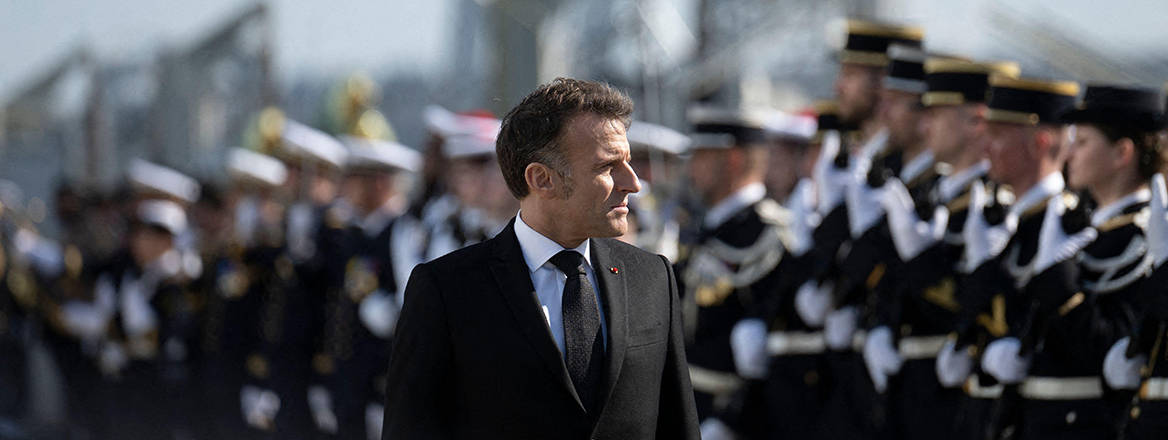
Macron’s concept of ‘forward deterrence’ offers a distinctly European approach to nuclear deterrence.
Standing in front of the imposing figure of Le Téméraire – one of France’s four nuclear-powered, nuclear-capable ballistic missile submarines – French President Emmanuel Macron, on 2 March, laid out his vision for the role of French nuclear weapons in the future of European security. Macron introduced the concept of dissuasion avancée (forward deterrence), which will – inter alia – build on and formalise ongoing French engagement with allies on nuclear issues, open up new options for nuclear coordination and signalling in Europe, and strengthen the French nuclear deterrent through an increase in warhead numbers.
The speech was eagerly anticipated by allies. Growing concerns over the potential for further Russian aggression in Europe, paired with anxieties over the credibility of the US nuclear umbrella, have led to increasingly louder demand signals across Europe for France and the UK to strengthen the role their nuclear weapons play in European security.
The French and UK nuclear deterrents cannot replace the US nuclear umbrella. However, Macron’s speech has clearly demonstrated even a limited nuclear arsenal can adapt to meet the changing deterrence challenges Europe is facing. It has highlighted a uniquely European approach to nuclear deterrence and security on the continent is possible, all-the-while preserving an important role for US engagement.
New and Persistent Challenges
Russia’s full-scale invasion of Ukraine, backed by Russian nuclear threats, has forced European states to rethink whether their defence postures are sufficient to deter and defend against possible future Russian aggression – including nuclear strikes – against their own territories. Unlike Europe’s two nuclear powers – France and the UK – Russian escalatory strategy envisions the use of limited nuclear strikes to backstop critical losses to Russian conventional forces and to prevent the expansion of an armed conflict. Should Russia decide to undertake a ground incursion into NATO territory, a limited Russian nuclear strike on NATO territory may be conceivable in a situation in which Russia is trying to prevent the overrun of its conventional forces, to deter US entry into the conflict or to coerce its adversaries into a settlement of the conflict on terms acceptable to Moscow.
In theory, the threat of nuclear counterstrike against its own territory should be sufficient to deter Russia from escalating the conflict to a nuclear exchange. In practice, the effectiveness of that deterrent effect depends on Russia believing that the adversary is, indeed, willing to escalate to a nuclear exchange. And while it is easy for the US, the UK and France to make credible the threat of nuclear counterstrike in instances where their own territories are at risk of nuclear attack, convincing allies that one is ready to escalate to a nuclear exchange on their behalf is much more challenging.
The French President announced a number of key developments in France’s nuclear posture which will have direct relevance to clarifying and strengthening the role that the French nuclear deterrent plays in the security of European allies
While Europe has always harboured anxieties over the credibility of US extended deterrence, the extensive size and diversity (in terms of yield and types of delivery systems) of the US nuclear arsenal, as well as US missile and defence capabilities, have – broadly speaking – historically helped reassure allies. And while the US has made clear its continued commitment to extending its nuclear umbrella over Europe, plans for conventional US retrenchment from the continent and outright threats against the sovereignty of European allies, have undermined the all-important political foundations on which credible extended deterrence relies.
The limited size and flexibility of the British and French nuclear arsenals – both of which are designed around a policy of strict sufficiency – greatly limit their ability to extend deterrence to allies and to make credible that London or Paris would be willing to risk nuclear escalation in the face of anything but an existential threat to their survival or way of life. Yet, with storm clouds continuing to gather over Europe and the American nuclear umbrella seeming increasingly unreliable, European states have turned to the UK and to France for cover and are expecting them to rise to the challenge. At the same time, London and Paris are looking for ways to more effectively reassure allies of the critical link between their security and that of the rest of Europe.
The UK and French arsenals will never resemble those of either the US or Russia – in numbers or in posture. However, as Macron’s speech has made clear – when it comes to extending deterrence, it’s not the size of the nuclear arsenal that matters but how you use it. While there is need for serious conversations in London and Paris over the longer-term future of their nuclear deterrents, adjustments in the posture of their existing arsenals and a better distribution of deterrence responsibilities across nuclear and non-nuclear European allies can be sufficient to meet emerging challenges in the meantime.
Forward Deterrence: A Long-Awaited Doctrinal Evolution
While Macron’s speech did not introduce any fundamental changes to French nuclear policy, the French President announced a number of key developments in France’s nuclear posture which will have direct relevance to clarifying and strengthening the role that the French nuclear deterrent plays in the security of European allies. This, despite the need to balance domestic political considerations – in particular, strong pressure from both far right and far left parties to avoid anything that even remotely hinted at the sharing of nuclear decision-making with allies.

Under the new concept of forward deterrence, non-nuclear allies will take part in future French exercises of its nuclear forces (such as the quarterly Operation Poker), which could also take place beyond the French airspace. France will maintain full autonomy in its nuclear decision-making; however, Paris will engage in coordination with a number of non-nuclear allies (namely, Germany, Poland, The Netherlands, Belgium, Greece, Sweden and Denmark) on nuclear deterrence issues, including through a newly-announced Franco-German nuclear steering group. This new bilateral arrangement follows the establishment last summer of the Franco-British nuclear steering group, which was announced as part of the Northwood Declaration and will see France and the UK more closely cooperate on nuclear issues. Perhaps most significantly, Macron announced that France, in times of crisis, deploy its Forces aériennes stratégiques (FAS) – on a temporary basis and with or without nuclear weapons – to the territory of other European states.
These initiatives represent an impressively forward-leaning operationalization of the long-standing ‘European dimension’ of French ‘vital interests’, which are meant to drive French decision-making on the use of nuclear weapons in a crisis but have historically been difficult to make credible. French nuclear strategists have argued that the sheer geographic realities of the European continent shrink the asymmetry of stakes that exists in the US-Europe extended deterrence relationship. The fact that France’s interests are intimately intertwined with those of their European neighbours should be evident from simply looking at a map; as such, the idea of ‘extended deterrence’ as it exists in US strategic thinking is ill-suited for the European context – goes the argument. This logic, however, becomes much more difficult to make convincing the further one moves away from French territory.
Closer integration of allies into French nuclear exercises and planning, and any future stationing of the FAS on allies’ territory, makes that logic manifest. In case of an outbreak of armed conflict with Russia, forward-deployed French strategic assets – particularly those capable of delivering or armed with nuclear weapons – would likely be targeted early by Moscow and would justify a commensurate French response against Russian capabilities, though early warning of attack should allow for the survivability of aircraft through dispersal.
As such, French willingness to forward-deploy its nuclear capable aircraft serves not only to send a strong signal to Russia that European allies are included in the French vital interests, but would also act as trip-wires, greatly increasing the likelihood and credibility of early and meaningful French involvement in a European armed conflict with Russia.
French nuclear weapons would – as has always been the case – be used only if an attack on a European ally were to have strategic consequences on French vital interests. However, Macron’s approach to operationalizing this ‘European dimension’ of its deterrent has made more credible the fact that these vital interests are not limited to French territory. Meanwhile, bilateral cooperation and joint exercises with non-nuclear allies will, to this end, serve to more firmly establish shared values and interests, while reassuring allies of the effectiveness of the French nuclear deterrent.
The Need for Conventional-Nuclear Integration
However, the deterrent value provided by such trip-wires and signalling only truly becomes credible if the adversary believes that Paris is able to moderate escalation at an appropriate level and that France is willing and able to absorb whatever follows from Russia. As touched on earlier, the US has historically been able to make such claims credibly through the fielding of non-strategic (in other words, smaller yield and more easily intercepted) nuclear weapons, as well as a robust air and missile defence system. France and the UK do not field non-strategic nuclear weapons; meanwhile, European air and missile defence faces significant challenges in the absence of key US enablers.
This is where the value of effective cross-European collaboration – if it can be achieved – can really shine. Non-nuclear allies can and must play a critical role in supplementing and bolstering the nuclear deterrence provided by the French and British nuclear arsenals, something Macron made clear in his speech. Through investments in advanced conventional capabilities – namely, advance warning, deep precision-strike and integrated air and missile defence systems – non-nuclear European allies can help address some of the credibility challenges that the French and British nuclear deterrents inherently face due to their limited size and diversity.
Investments into deep precision strike systems will allow Europe to convincingly field escalatory options at the higher end of the conventional escalation ladder but below the use of high-yield French or British strategic nuclear weapons, which may not be seen as credible in response to limited Russian nuclear strikes. Meanwhile, investments into early warning and defensive systems across Europe will help make credible British, French and broader European ability to absorb Russian retaliatory strikes. Such systems will also complicate Russian decision-making in any future decision to resort to nuclear weapons by making it more difficult for Moscow to gauge precisely how many missiles are enough to penetrate defences while avoiding the risk of inadvertent escalation.
‘Forward deterrence’ is not intended to replicate extended deterrence à la NATO. Instead, it offers a uniquely European approach to nuclear deterrence
For the moment, existing European projects along these lines are still early in their development (in the case of the Joint Early Warning for a European Lookout (JEWEL) program) or facing delays and other complications (in the case of the European Long-Range Strike Approach (ELSA), the Future Combat Aircraft System (FCAS) and Main Ground Combat System (MGCS) projects). As such, significant work lies ahead for the development of reliable strategic conventional systems and support capabilities that will be needed to serve as a key pillar of the ‘forward deterrence’ strategy.
A European Deterrent for Europe
French and British nuclear weapons cannot replace US extended deterrence. ‘Forward deterrence’ is not intended to replicate extended deterrence à la NATO. Instead, it offers a uniquely European approach to nuclear deterrence – reflecting both the constraints and opportunities that European defence posture and geography present.
It has proposed to do so by reinforcing shared values and interests with European allies, strengthening allies’ ownership in French nuclear deterrence (while clearly preserving the independence of French nuclear decision making), and taking practical steps to directly link French strategic interests with those of its European allies through the option of forward-deploying strategic assets. Macron’s speech has received broadly positive responses from NATO as well as from individual European states, confirming its potential to make a meaningful difference to European security.
Macron’s speech is a heartening reminder of both the initiative and potential that exist in Europe to provide for its own security by maximizing individual strengths for joint security dividends that are greater than their individual parts, and by providing a pathway towards a genuine European deterrence, without a need to mimic the US nuclear posture in composition, size or strategic culture.
© RUSI, 2026.
The views expressed in this Commentary are the authors', and do not represent those of RUSI or any other institution.
For terms of use, see Website Terms and Conditions of Use.
Have an idea for a Commentary you'd like to write for us? Send a short pitch to commentaries@rusi.org and we'll get back to you if it fits into our research interests. View full guidelines for contributors.
WRITTEN BY
Darya Dolzikova
Senior Research Fellow
Proliferation and Nuclear Policy


Héloïse Fayet
Guest Contributor

- Jim McLeanMedia Relations Manager+44 (0)7917 373 069JimMc@rusi.org