

The Limits of Decapitation: Mexico's Security Outlook After El Mencho

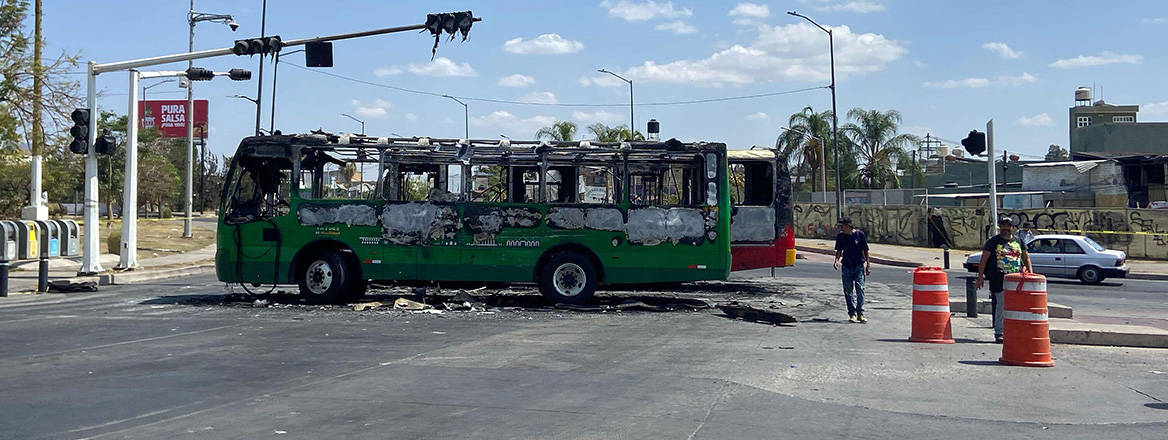
After the takedown of the head of the organised crime group Cartel Jalisco Nueva Generación (CJNG), one thing is certain: ordinary Mexicans are set to pay the price as violence escalates.
On 22 February, Mexico’s federal security forces killed Nemesio Rubén Oseguera Cervantes (alias El Mencho), the leader of the Cartel Jalisco Nueva Generación (CJNG) – one of Mexico’s most powerful and violent criminal groups – after locating and targeting his hideout in an ecotourism resort in Tapalpa, Jalisco state.
The operation was supported by intelligence provided by the US authorities, which had previously offered a $15 million bounty for Oseguera Cervantes’ capture. Despite the lack of direct participation of the US on the ground, President Donald Trump has claimed credit for the takedown.
The ‘kingpin’ strategy of targeting cartel leaders has been a long-favoured approach by the US to ‘weaken, dismantle and destroy’ drug trafficking organisations, as part of its ‘War on Drugs’. However, such methods have a poor track record in Latin America, tending to drive fragmentation, competition and violence while illicit markets themselves remain intact.
Indeed, what comes next – both for the CJNG, and for Mexico’s criminal ecosystem more broadly – beyond the initial wave of retaliatory violence is far from clear.
What’s Next for the CJNG?
For fifteen years, the CJNG remained united. Where older organisations like the Gulf Cartel and even the Sinaloa Cartel fractured as they expanded, or after key arrests and deaths, the CJNG grew into a conglomerate spanning fentanyl and methamphetamine production, a cocaine pipeline from Colombia and Ecuador, industrial-scale fuel theft, illegal mining, illegal fishing, migrant smuggling and a vast money laundering infrastructure.
That cohesion rested on several reinforcing pillars: a constant use of implacable violence enforced by its armed wings, Delta and Elite, and a transcontinental illicit financial architecture.
But perhaps its most defining feature was the cult of personality surrounding El Mencho himself.
This was at once a distinctive feature of the CJNG and a great vulnerability. Oseguera Cervantes spent much of his leadership living reclusively in rural Jalisco, where he was ultimately killed, and the vast majority of CJNG members almost certainly never met him. Yet the battle cry of ‘Somos la pura gente del Sr. Mencho’ appeared on every narco-banner, in every propaganda video, across every territory the cartel touched. It was almost devotional.
Without systemic change to the incentive structures behind illegal markets, the removal of kingpins does little to alter criminal economies and stem illicit commodity flows
The CJNG also distinguished itself through its distinctive relationship with violence. While the Sinaloa Cartel has used violence broadly, it has generally preferred a stable operating environment for business. By contrast, the CJNG has deployed brutality as a continuous instrument of territorial control. It normalised what had been the most extreme excesses of the cartel wars, with bodies suspended from bridges and severed heads left at roadsides.
The question of who succeeds El Mencho may therefore not be about who is the strongest commander, but if his authority can be replicated. The name that has emerged most prominently is Juan Carlos Valencia González, El Mencho's stepson and operational commander of Grupo Elite.
His claim carries genuine weight. He is the last scion of the Valencia clan. His father, Armando Cornelio Valencia, founded the Milenio Cartel, the CJNG's direct institutional precursor, and the Valencia name carries a founding legend within the organisation's internal history. Whether that legend still resonates across the nationwide apparatus of 2026, whose members are far removed from these regional origins, is tough to answer.
Other senior commanders control sufficient territory, finances, manpower and weaponry to construct autonomous fiefdoms should they conclude that fragmentation serves their interests better than loyalty. But they may be persuaded that backing Valencia González is best for business.
Surface calm in the coming weeks does not equate to long-term stability. The civil war between the Chapitos and Zambada factions in the Sinaloa Cartel brewed quietly for years before it detonated, accelerating rapidly in 2024.
The CJNG's territorial presence, for all its scale, relies on a projection of force rather than the deep social integration that other criminal groups have cultivated in their home state.
How brittle that control turns out to be will prove crucial to Mexico’s immediate future.
Implications for the Wider Criminal Ecosystem
The succession question and the criminal economy question are not the same issue. Even a CJNG that holds together under González Valencia inherits a map of regional battlefields, each with its own rivals, its own illicit economy, and its own internal logic.

In Michoacán, the most immediate pressure comes from the Cárteles Unidos coalition, an alliance of smaller groups including the Cartel del Abuelo, Los Viagras, and remnants of La Familia Michoacana, which has contained CJNG expansion into the Tierra Caliente region for years.
While the Valencia family came from Michoacán, the CJNG is seen as a different beast. It has not been able to cultivate the local intelligence networks and community relationships needed to thrive. The economies at stake are substantial: avocado and lime extortion networks and the Port of Lázaro Cárdenas, where the cartel receives tons of chemical precursors used to make fentanyl and methamphetamine.
In the industrial heartland of Guanajuato, north of the capital, fuel theft is a billion-dollar business. Local rivals like the Cártel de Santa Rosa de Lima have been systematically weakened by the CJNG but never finished off. The prize is control of the Pemex pipeline network around the Salamanca refinery, a sufficiently lucrative and bloody contest that Guanajuato has recorded Mexico's highest homicide rates for years.
Further south, Chiapas presents a different but equally combustible picture. The state's border with Guatemala has become one of Mexico's most violent corridors, contested for both drug trafficking routes and human smuggling networks.
The CJNG has a resource allocation problem. The CJNG cannot afford to ignore these theatres, but it may struggle to reinforce them if managing a succession crisis in Jalisco.
The Sinaloa dimension adds a further layer of complexity. The CJNG's controversial alliance with Los Chapitos was, at its core, an arrangement brokered under El Mencho's authority. This alliance may not survive.

The cumulative picture is one of overlapping, mutually reinforcing conflicts across much of the country. Smaller, locally embedded rivals can exploit its distraction long enough to reclaim the specific economies they lost.
The Limits of Decapitation
The looming prospect of violence and instability underscores the core limitations of ‘decapitation’ strategies. Without systemic change to the incentive structures behind illegal markets, the removal of kingpins does little to alter criminal economies and stem illicit commodity flows. Instead, it drives a violent recalibration of internal group hierarchies and localised competition over trafficking routes, production hubs and extortion rackets, fragmenting groups rather than fully dismantling them. If one group collapses, another will quickly emerge to fill its place.
As shown, the revenue-generating opportunities in each strategic node have now extended far beyond drugs to encompass a broad array of commodities and activities, significantly raising the stakes.
Ultimately, it is local communities that have the most to lose from the fallout of Oseguera Cervantes’ death, either as collateral damage from factional feuds or as victims of extortion and coercion deployed by cartels to establish territorial control – as seen in the fisheries sector.
The immediate aftermath of the takedown – with roadblocks erected and arson attacks conducted across at least 20 states in Mexico – demonstrates the breath of CJNG influence and the potential scale of harm to Mexican civilians and businesses that could be caused by further confrontations with the state or inter-cartel violence.
Mexico’s President Claudia Sheinbaum has herself questioned the logic of traditional ‘War on Drugs’ approaches for precisely this reason. However, successive governments have struggled to move past such strategies, largely due to US pressure.
These pressures have intensified under US President Donald Trump, who has called for more decisive action against Mexican cartels to disrupt drug flows into the US. Last February, Trump designated a number of these groups as foreign terrorist organisations, and he has repeatedly threatened to take unilateral military action in Mexico if the Mexican government fails to show results.
In this scenario, Sheinbaum faces pressure to take bold military action against cartels that results in short-term tactical wins that are celebrated in Washington but have limited strategic impact on criminal disruption and incur a heavy cost for ordinary Mexicans in the long term.
© RUSI, 2026.
The views expressed in this Commentary are the authors', and do not represent those of RUSI or any other institution.
For terms of use, see Website Terms and Conditions of Use.
Have an idea for a Commentary you'd like to write for us? Send a short pitch to commentaries@rusi.org and we'll get back to you if it fits into our research interests. View full guidelines for contributors.
WRITTEN BY
Chris Dalby
RUSI Associate Fellow, Organised Crime and Policing


Jennifer Scotland
Research Fellow
Organised Crime and Policing

- Jim McLeanMedia Relations Manager+44 (0)7917 373 069JimMc@rusi.org