

Kerch Bridge Destruction: Politically Embarrassing, Logistically Contained

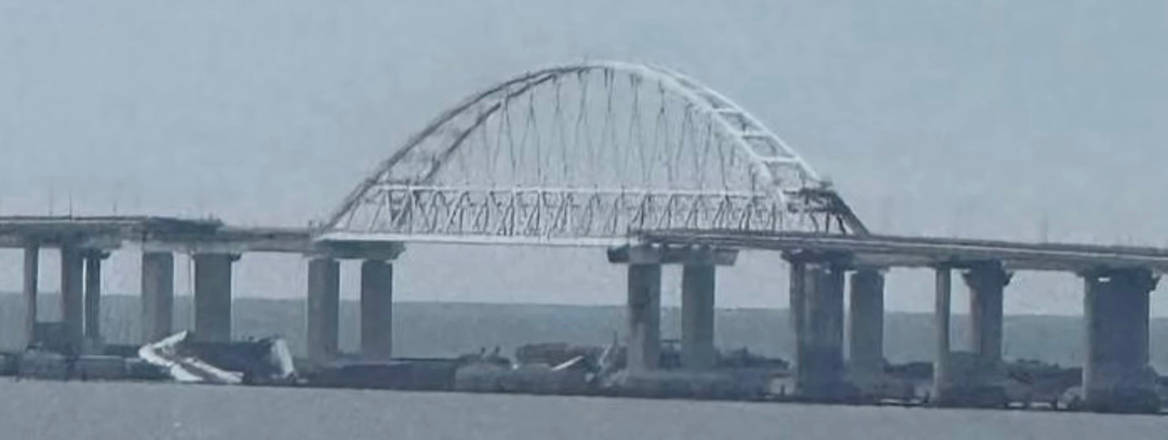
Ukraine’s destruction of the Kerch Road bridge has embarrassed Moscow, but Russia’s adapted southern supply chains mean the military impact will probably stay localised.
Ukraine’s successful destruction of the road bridge connecting the Crimean Peninsula to Russia has been hailed as an operational triumph.
Symbolically, it dramatically collapsed part of a much-reviled and contentious piece of infrastructure that was designed to cement Russia’s physical and political control over Crimea upon its completion in 2018. Politically, it was timed to cause maximum embarrassment to President Putin, on the eve of his arrival in China for a highly publicised trilateral with Presidents Trump and Xi. Tactically, Ukraine was responding to an earlier Russian attack on the North and South bridges in Kyiv that night. And strategically, the attack raises important questions about Russia’s ability – or not – to regroup its southern supply chains under pressure.
This is not the first time the bridge has been attacked, but it is the first time it has sustained such persistent damage. While the piers of the bridge appear largely intact, if cracked, replacing the destroyed steel arch is difficult – the original was constructed on land and floated into place, and there is little to prevent Ukrainian drone attacks from continuing to block attempts to repair it. There might be little utility in repairing the bridge at all, although the Kremlin has already pledged to rebuild it.
Displacement and Containment
All of Russia’s road, rail and river systems are interdependent, and obstructions to one part of the network naturally have consequences for others. There are probably two different ways of looking at the consequences of this attack for Russia’s southern logistics and military sustainment.
First, displacement. In the short term, if the road bridge remains out of commission for several months or even a year, traffic into and out of Crimea will be displaced onto its remaining rail link. That rail bridge itself has come under additional attack since the road bridge was destroyed, further disrupting traffic. Ferries to Crimea were already mostly out of commission anyway, even though Putin claimed to be restarting that service swiftly. That rail bridge is by design restricted in its load-bearing capacity over the Kerch Strait, and cannot accept a sudden significant increase in cargo, meaning it cannot account for the traffic in its entirety required to support the peninsula. Any supplies into and out of Crimea will be reduced.
Offloading traffic instead onto the more circuitous overland route of the R-280 – the so-called Novorossiya Highway – presents an additional difficulty for Russia. That motorway, although more than 100 km from the frontline, has been consistently targeted by Ukrainian drones this year, causing a backlog of traffic and raising costs for logistics carriers unwilling to make the journey. Ukraine as of the time of writing continues to target that motorway, putting greater pressure on Russia’s land routes. Overuse of that highway – which already requires repairs due to drone attacks – will create traffic bottlenecks, increasing vehicles’ vulnerability to aerial attack.
There is no doubt that Crimea is an important military and political base for Russia, but its military significance has had to shift, due to Ukraine’s sustained infrastructure attacks over the past year
The collapsed bridge and debris in the shallow waters of the Strait are currently obstructing the movement of larger vessels, for now cutting off Russia’s ability to exploit the grain terminals within the occupied territories of Berdyansk and Mariupol via the Sea of Azov and into the Black Sea. The Kremlin had been attempting to turn these ports into a financially profitable enterprise. Naturally, there are important short-term economic implications here too for Russia’s ability to export its grain, which are beyond the immediate scope of this article. This particular problem is probably temporary.
Second, containment. Because of how Russia’s logistics are organised, the actual damage to Russia’s military sustainment is probably limited to the south of Ukraine.
There is no doubt that Crimea is an important military and political base for Russia, but its military significance has had to shift, due to Ukraine’s sustained infrastructure attacks over the past year. Its naval role changed most substantively; it originally housed the Black Sea Fleet, but Ukraine’s attacks obliged their relocation to Novorossiysk on the mainland, restricting Russia’s operational abilities in the Black Sea.
Russia had largely stopped relying on the Kerch Bridge for military logistics in the earlier years of the war, and most military cargo had halted by 2024. Russia’s resupply in the occupied territories of Ukraine is mostly reliant on rail transport rather than sea or road. In Donetsk and Luhansk, resupply is mostly by rail from within Russia itself. The impact is likely to be most keenly felt in Kherson and Zaporizhzhia, whose forces were supplied with sustenance from Crimea by train, but whose rail link is – for now – still functioning. Russia’s centralised strategy of resource allocation means that it will probably allow its forces in those regions to be run down temporarily and only latterly decide whether to reallocate or redistribute them if those formations become damaged by a lack of resupply.
This does not make the loss of part of the Kerch Bridge connection less significant politically. But Crimea’s changing role as part of Russia’s supply chain over the past year, the fact that the rail link is still functioning, coupled with its strategy of allowing a certain amount of force attrition before redistributing, means that the overall impact on Russia’s logistics will be more localised.
Military Supplies in the South
To understand the full implications, it is worth examining Russia’s southern logistical supply chains as a whole.

Since it invaded Ukraine, Russia has been busy investing in roads and railway connections in the territories it occupies, mostly for military purposes. Data is patchy, but a Reuters investigation put Russia’s allocation of funds for the development of the four occupied regions of Ukraine at $12 billion in 2024–26, the majority of which has been spent on transport infrastructure. The spending on these dwarfs the investments Russia has made in occupied Crimea since 2014. The swift progress Russia made on the actual construction of this infrastructure, despite aerial bombardments, indicates the serious priority this project has been given.
While many of Russia’s other investment programmes have been cut since the war over budget constraints, Rosavtodor – the Federal Road Agency – had by July this year been given a boost of an extra ₽81.2 billion in comparison with last year. Rosavtodor plays a key role in constructing road networks in the occupied Ukrainian territories to cement Russia’s control over the regions, as well as facilitating military transport. Since 2024, Russian state-controlled companies have been overhauling the Chaplynka–Novotroitske road, running parallel to the frontline very close to Crimea, and linking up other southern highways, in response to Russia’s understanding that bridges linking the peninsula to the mainland such as the Chonhar Bridge could be destroyed – it has been attacked multiple times.
One of Russia’s first major acts upon occupying Kherson in March 2022 was to repair the Kherson–Melitopol motorway, which links up Kherson and Zaporizhzhia from west to east. Melitopol is an important transport hub. It sits at the junction of routes that link up Crimea, the Azov coast and Zaporizhzhia into the Donbas, with three different road and rail systems converging around the city. Now, Melitopol serves as the main link between the east and west sections of the land corridor, and it has come under repeat attack as Russia adjusts its routes, as well as at crossings like Henichesk.
The crown jewel in the Kremlin’s construction plans for southern Ukraine is epitomised by the Azov Transport Ring, a project that Putin announced amid much fanfare in his end-of-year address in December 2024. A massive undertaking that links Russia’s Rostov region with occupied Ukrainian cities including Mariupol and Berdyansk, extending out to Crimea, it uses pre-existing Ukrainian transport corridors and upgrades local railways and ports all along the Sea of Azov. Reduced resupply lines around Crimea will restrict some of Russia’s operational reach in the south, and force increased reliance on the Azov Ring, thereby increasing its attractiveness as a target for Ukraine’s aerial strikes.
Geographical Constraints
All of this raises some new questions and emphasises some old truisms.

Get a weekly round-up of the latest commentary and research straight into your inbox.

The first is that the advent of drone technology has eroded Russia’s traditional military advantage of using its vast geographical expanse to retreat its forces into during campaigns.
In this war so far, Ukraine’s cumulative drone attacks – rather than one specific event – have convincingly revealed some of the weaknesses in the rear (tyl), which the Kremlin previously believed to be impervious to attack. Ukraine’s strategy to degrade Russia’s operational rear through destroying its transport network was clearly laid out earlier this year by Robert Brovdi, commander of Ukraine’s Unmanned Systems Forces.
One of the interesting points about this situation is the age-old problem of how Russia confronts its own geographical limitations, and how access to supply routes increasingly far from its home military bases is vulnerable. In many ways, the Kerch Bridge attack demonstrates that for Russia, the relationship between geography and military power remains unchanged and constant. Operating far from their home bases, even with forward supply points close to the front lines, Russian forces are stationed in occupied regions whose infrastructure has been largely destroyed after years of fighting. This is compounded by a local population attempting to sabotage Russia’s commandeering of its rail systems from the ground, to disrupt its military logistics.
Politically, Russia’s land corridor to Crimea was supposed to be one of the Kremlin’s symbolic achievements in this war, consolidating its control over the peninsula, the Sea of Azov and the Black Sea. Ukraine’s naval blockade of the peninsula denied Russia this political success. While this has indubitably identified weaknesses in Russia’s supply chains, it also shows what disruption Russia can technically tolerate. Its armed forces do not necessarily require the Kerch Bridge to be operating normally for military sustainment in the south, and there is not yet substantive evidence suggesting that Ukraine has managed to systematically decouple Russia’s supply chains in occupied Ukraine.
Most disconcertingly, Russia’s long-term strategy for construction work, and attempts to financially enmesh the occupied territories into its own, spell low prospects for Moscow’s willingness to concede their return to Ukraine under any of the ongoing political negotiations.
© RUSI, 2026.
The views expressed in this Commentary are the author's, and do not represent those of RUSI or any other institution.
For terms of use, see Website Terms and Conditions of Use.
Have an idea for a Commentary you'd like to write for us? Send a short pitch to commentaries@rusi.org and we'll get back to you if it fits into our research interests. View full guidelines for contributors.
WRITTEN BY
Emily Ferris
RUSI Senior Associate Fellow, International Security


- Jim McLeanMedia Relations Manager+44 (0)7917 373 069JimMc@rusi.org