

Ukraine’s Logistics Targeting Raises Questions for Russia’s Rear Defences

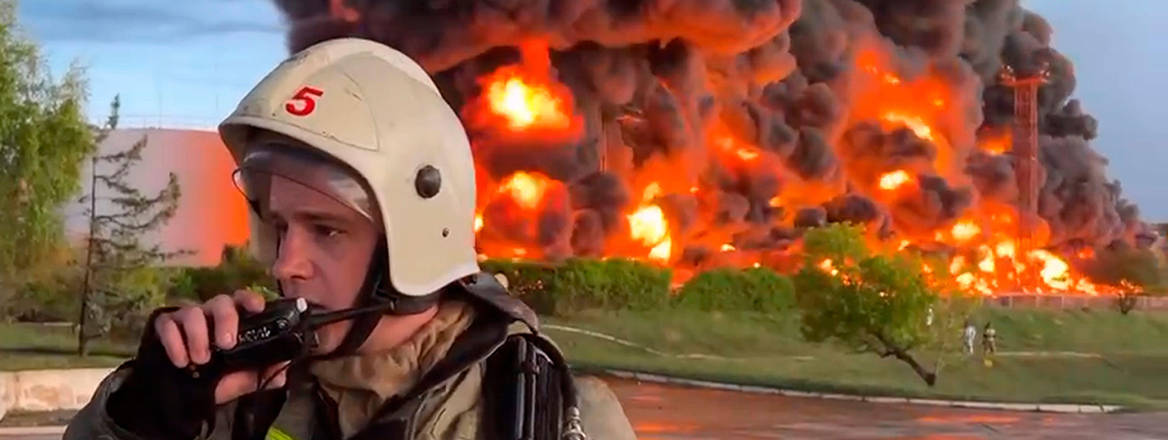
Ukraine’s use of drone warfare has serious implications for Russian lines of communication.
Ukraine’s ‘logistical lockdown’ programme has unleashed a sustained and coordinated series of attacks on Russia’s military supply chains in recent weeks. If previous salvos targeting Russia’s infrastructure had demonstrated what Ukraine’s evolving drone capabilities were able to do, the latest campaign represented a concerned and coordinated effort to shut down Russia’s military supply chains and fuel supplies, revealing serious weaknesses in Russia’s rear defences. But the campaign also demonstrated some of the practical and political limitations of attacking infrastructure in this way.
In the latest campaign, Ukraine has zeroed in on Russia’s logistical supply chains around Crimea, particularly localised around the R-280 Novorossiya highway, which runs from Russia’s Rostov region to Crimea via the occupied territories. It is an alternative route to the Kerch Bridge, which itself has come under attack numerous times since the invasion. While an integral part of the tyl (rear), these logistics routes were believed by Russia to be deep behind the frontlines and therefore relatively immune from attack. These latest sustained attacks have proven how vulnerable Russia’s tyl can be.
Delivery routes to Crimea have been blocked – no heavy duty trucks are able to cross the Kerch Bridge, and private logistics carriers are struggling to get insurance for vehicles. The land corridor is the only route to supply the occupied territories of the south and east. As a result, truck freight is being moved in long vulnerable convoys to Crimea, with trucks rerouted onto secondary roads and protected by soldiers. Ferries across the Kerch Strait have been struck by the Ukrainian Armed Forces since 2024, rendering all three vessels out of service. Fuel storage in warehouses on the peninsula is problematic, risking explosions if sites are attacked. The problem extends not only to Crimea but also the Russian occupied parts of Donetsk and Luhansk, as well as parts of Russia’s south such as Belgorod. Trucks appear to be locked in traffic jams attempting to cross the pontoon bridge by the damaged Chongar bridge, easy prey for drones. Bridges such as the Genichesk, Chongar and Armyansk rail and road passages have been hit – while pontoon bridges remain operational, they are a temporary emergency measure, and cannot support large axle loads nor be adequately defended by Russian air defences.
As Ukraine has evolved its attacks on logistics, simultaneous and prolonged attacks have had a more sustained effect, creating long delays in both civilian and military cargo deliveries.
These waves of drone attacks were timed to accompany high-profile political events in Russia, causing some embarrassment. The attack on the Kronstadt naval base and oil refineries around St Petersburg coincided with Russia’s SPIEF economic forum, considered by Russian officials to be the capstone investment event of the year but which is increasingly descending into farce as obvious economic pressures mount. In a choreographed refusal to acknowledge the issue, President Putin then chose to publicly ignore a major Ukrainian drone attack on Moscow, while instead hosting the Russia Association of Southeast Asian Nations (ASEAN) summit in Kazan, another investment forum scheduled around the same time as the G7.
Russia’s CNI Weaknesses
All of these issues in concert highlight two things about Russia’s ability to protect its infrastructure.
The first is Russia’s geographic loss of strength gradient – the idea that military force loses combat power per unit of reach from its bases. This affects Russia’s ability to move its forces around and project power significantly further from its home territory. These attacks on infrastructure around Crimea in particular reveal the substantive problems that Russia is encountering in protecting and maintaining the connectivity of its long and vulnerable supply chains across large geographic distances far from its Rostov bases in the south.
Second, this raises important questions about how Russia can protect its critical national infrastructure deep behind the front line, as the geographic range, stealth and altitude of Ukraine’s drones shifts and Russia’s manpower is preoccupied in a different direction. This includes how Russia will be able to defend its ports, railway systems, and oil refineries, not just in the European part of Russia but also in Siberia and the Far East. In many areas of the Far East, the Trans-Siberian is a long and vulnerable single track. Previous physical sabotage attacks on Russia’s rail systems, junction boxes, locomotives and bridges temporarily knocked trains out of service and slowed down the network without halting it entirely. But as Ukraine has evolved its attacks on logistics, simultaneous and prolonged attacks have had a more sustained effect, creating long delays in both civilian and military cargo deliveries.
Patchy air defences that are mostly located around large cities and a lack of drone-intercept weapons are only part of the problem.
Russia has been relatively slow to respond and adapt to the question of rear defence. To protect its rail network from drone attacks, Russia reintroduced Soviet-era armoured trains to resupply the frontline and protect the Railway Troops repairing damaged sections of track and bridges, although these trains have been targeted by drones that have destroyed locomotives and immobilised them.

Help your search results show more from RUSI. Adding RUSI as a preferred source on Google means our analysis appears more prominently.

Since 2025, Russia has established new combat reserve units – BARS – as mobile fire teams, specifically with the aim of protecting civilian and industrial infrastructure. The BARS were set up in 2015 but were only actively deployed in combat since the invasion. These formations have been reorientated specifically to protect infrastructure from drones – units such as BARS-32 were in 2025 withdrawn from the contact line and tasked with protecting railways in Zaporizhzhia, where they claim to have shot down UAVs designed to destroy Russia’s trains and power grids. It remains to be seen whether these teams will be able to shoot down the stealthier drones that Ukraine has adapted since the war began – so far, mobile fire counter-operations along the Novorossiya Highway do not appear to be particularly effective.
A longer-term option for the Kerch fuel issue would be to move infrastructure underground. Russia already has a gas pipeline to Crimea, but constructing an underground oil pipeline would take the pressure off the overground transport network. However, this would be a costly project, requiring investment in transfer stations, as well as technically creating a new target for attacks, as pipelines require fuel trucks to transport oil on the other side, including static storage sites that could be vulnerable to drone strikes.
Limitations to Attacks
Technically, Ukraine could probably disable the Kerch Bridge and sever its links to the Russian mainland, even though it is well-enforced. The bridge has been attacked before – most successfully early in the war in 2022, where a truck bomb was detonated between reinforced concrete supports, although it was relatively swiftly repaired and traffic resumed shortly after. Constructed in 2018 as a sign of Russia’s political and practical control over the peninsula, cutting off the bridge connection would be a symbolic coup for Ukraine.
But, politically, there is a risk that such a move would be met with disapproval by Ukraine’s allies in Europe and the US, and jeopardise their support. Any moves to disable the bridge entirely would prompt a serious escalatory move from Russia. Ukraine over the past 18 months has had to consider the strategic calculus of how to frustrate Russia’s military supply chains while avoiding dense civilian areas, and maintaining pressure on Moscow without inducing significant escalation. Thus far, it does not appear that the strategy is sufficient to bring Moscow to the negotiating table.
© RUSI, 2026.
The views expressed in this Commentary are the author's, and do not represent those of RUSI or any other institution.
For terms of use, see Website Terms and Conditions of Use.
Have an idea for a Commentary you'd like to write for us? Send a short pitch to commentaries@rusi.org and we'll get back to you if it fits into our research interests. View full guidelines for contributors.
WRITTEN BY
Emily Ferris
RUSI Senior Associate Fellow, International Security


- Jim McLeanMedia Relations Manager+44 (0)7917 373 069JimMc@rusi.org