

Iraq's Top Shia Cleric Denounces the War Against Iran, But Implies Moderation

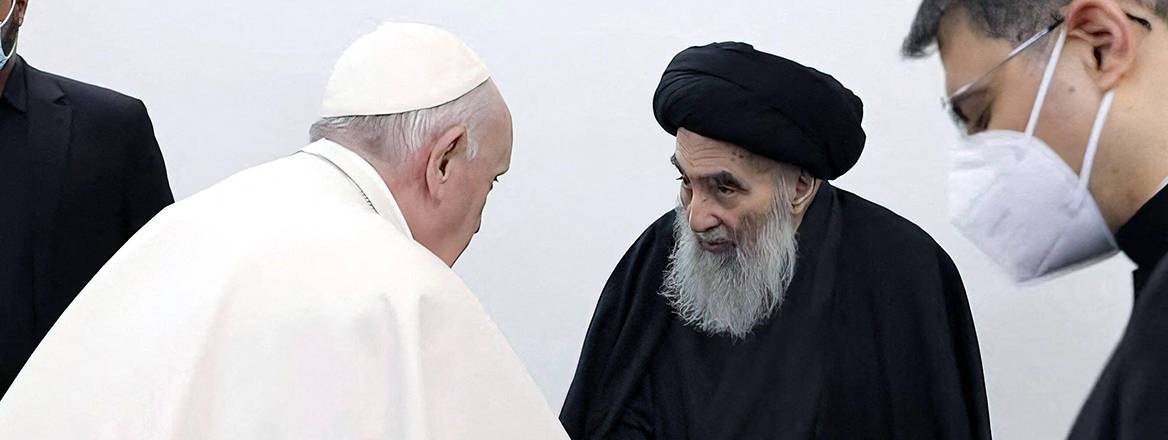
Sistani has issued a layered statement addressing the war against Iran.
The recent statement issued by the office of Ali al-Sistani, the leading cleric of Iraq’s Najaf religious establishment, condemning the ongoing military attacks on Iran, carries significance that extends beyond its immediate wording. Public interventions by Sistani on interstate conflicts are rare and, when they occur, they typically signal deeper concerns about regional stability, international order and Iraq’s own position within unfolding crises.
In this case, the statement offers more than a moral condemnation of war. It reflects Najaf’s longstanding political doctrine, sends signals to regional and international actors, and may also serve as a message directed inward toward Iraqi political and armed groups.
A Rare Intervention from Najaf
The clerical establishment in Najaf has historically maintained a posture of relative restraint in direct political intervention, particularly regarding interstate conflicts. Unlike other religious authorities in the region, Najaf’s tradition, often described as ‘quietist,’ generally avoids sustained involvement in day-to-day political affairs.
Statements from Sistani’s office therefore tend to appear primarily during moments of profound crisis. During the war against ISIS in Iraq, for example, Sistani issued the well-known al-jihad al-kifai mobilisation call that helped organise the defence of Iraq against the advance of ISIS. Outside such exceptional moments, however, the Najaf establishment usually adopts a more cautious and restrained tone.
The latest statement thus stands out precisely because of its timing. By addressing an ongoing regional war, Najaf signals that the conflict carries consequences that extend well beyond the immediate battlefield.
Framing the War as ‘Military Aggression’
One of the most notable elements of the statement is its explicit description of the conflict as a ‘military aggression against Iran.’ Such wording clearly conveys condemnation of the attack itself and emphasises the human costs of the war, particularly the deaths of civilians and the destruction of public and private property.
At the same time, the language used does not amount to an endorsement of Iran’s political system or governing structure. The statement instead focuses primarily on the suffering of the Iranian population and the broader destabilising effects of the conflict. This distinction reflects a pattern that has characterised Najaf’s approach to regional crises: solidarity with populations affected by war without necessarily aligning with specific governments or political agendas.
Notably, the Najaf statement moves in the opposite direction. Rather than calling for armed mobilisation, it emphasises condemnation, solidarity and diplomatic engagement
The reference to those killed defending their country as ‘martyrs’ and ‘heroes’ also carries symbolic weight. Sistani remains one of the most influential Shia religious authorities globally, with a wide transnational following that extends beyond Iraq. As a result, statements from Najaf resonate across Shia communities throughout the region.
Warning Against Regional Escalation
Beyond condemning the attack itself, the statement highlights the widening scope of the conflict and the damage already inflicted across several countries in the region. By emphasising that military operations and retaliatory strikes are affecting multiple states, the text frames the war not merely as a bilateral confrontation but as a crisis with potentially broader regional implications.
Such framing serves to underscore the dangers of escalation. The statement describes the unfolding situation as an unusual and alarming development for the region, one that could produce prolonged instability and widespread suffering if left unchecked.
In doing so, Najaf’s message shifts the focus from the immediate military confrontation toward the larger risks posed to regional order.
Emphasising International Law
Another central theme of the statement is its reliance on the language of international law and global governance. The text criticises the decision to launch a comprehensive war against another state outside the framework of the United Nations Security Council, describing such unilateral action as a dangerous precedent.
This legal framing is notable. Rather than employing sectarian rhetoric or ideological language, the statement grounds its argument in principles associated with the international system: respect for sovereignty, adherence to international law and the authority of multilateral institutions.
Such language aligns with Najaf’s broader political outlook, which has often emphasised stability, institutional legitimacy and the avoidance of large-scale conflict.
A Message Directed at Iraq
While the statement addresses an international crisis, it may also contain an indirect message aimed at Iraq itself. In recent years, Iraq has repeatedly found itself caught between regional rivalries and great-power competition, particularly in confrontations involving the US and Iran.
Against this backdrop, the emphasis on international law, restraint and diplomatic resolution can be interpreted as a signal encouraging Iraqi actors to avoid further escalation. In particular, the message may resonate with Iraqi armed groups whose actions could potentially draw the country more directly into the conflict.
By framing the war primarily as a threat to regional stability, Najaf appears to reinforce the idea that Iraq should avoid becoming another battlefield in an expanding confrontation.
Rejecting Calls for Religious Mobilisation
The timing of the statement is also significant in light of calls circulating among some commentators and political actors urging a broader religious mobilisation in response to the war. In Shia political discourse, such appeals sometimes take the form of demands for a clerical declaration of jihad.

Help your search results show more from RUSI. Adding RUSI as a preferred source on Google means our analysis appears more prominently.

Notably, the Najaf statement moves in the opposite direction. Rather than calling for armed mobilisation, it emphasises condemnation, solidarity and diplomatic engagement. The absence of any religious mobilisation language is striking, particularly given Sistani’s demonstrated ability to mobilise followers when he considers it necessary.
By refraining from such a step, the statement appears to discourage the transformation of the conflict into a wider transnational religious confrontation.
Diplomacy and the Nuclear Question
The final section of the statement calls for what it describes as a ‘just and peaceful solution’ to the Iranian nuclear issue in accordance with international law. This explicit reference to the nuclear file is noteworthy. Public statements from Najaf rarely engage directly with such specific geopolitical disputes.
By invoking the nuclear issue in this context, the statement suggests that the current conflict cannot be separated from the broader diplomatic deadlock surrounding Iran’s nuclear programme. The emphasis on a peaceful resolution indicates a preference for renewed negotiation rather than continued military escalation.
Najaf’s Broader Message
Taken together, the statement reflects a broader effort by Najaf to frame the unfolding conflict within a narrative centred on restraint, legality and diplomatic resolution. The intervention condemns the war, expresses solidarity with those affected and warns of the dangers of regional escalation.
At the same time, it avoids endorsing military mobilisation or aligning the clerical establishment with any particular political project. Instead, the message emphasises international norms and the need for a peaceful solution to the underlying disputes.
In this sense, the statement can be understood as part of Najaf’s long-standing effort to promote stability during periods of regional turbulence. As tensions continue to spread across the Middle East, the voice of Najaf appears to be urging both regional actors and the wider international community to prioritise de-escalation before the conflict expands further.
© Alabbas F. Alsudani, 2026, published by RUSI with permission of the author.
The views expressed in this Commentary are the author's, and do not represent those of RUSI or any other institution.
For terms of use, see Website Terms and Conditions of Use.
Have an idea for a Commentary you'd like to write for us? Send a short pitch to commentaries@rusi.org and we'll get back to you if it fits into our research interests. View full guidelines for contributors.
WRITTEN BY
Alabbas F. Alsudani
Guest Contributor


- Jim McLeanMedia Relations Manager+44 (0)7917 373 069JimMc@rusi.org