

How North Korea is Modernising its Defence

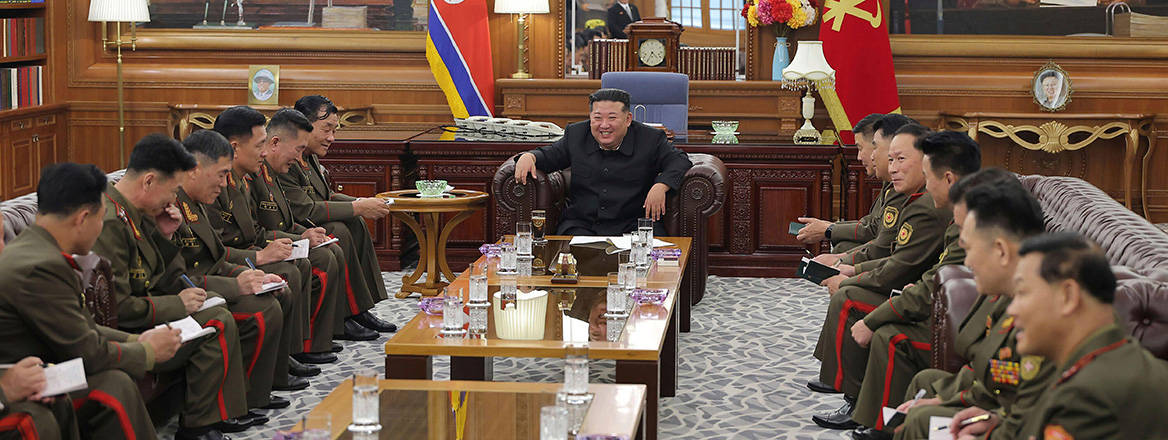
Stirred on by engagement in the War in Ukraine – and buoyed by resources through reciprocal arrangements with Russia – North Korea is seeing rapid development in modernising its military.
It is well known that there are 12,000 North Korean military personnel in the Kursk part of Ukraine who have been supporting Russian troops since October 2024. The combat experience of the Korean People’s Army (KPA) and what they have learned from on-the-ground experience has also been discussed in the Wall Street Journal and other publications, with Ukrainian military intelligence initially criticising KPA infantry tactics as ‘cannon fodder’, emphasising direct charges on Ukrainian positions. Over time, however, KPA units have adapted and adjusted to the new style of warfare in Ukraine and begun integrating reconnaissance drone intelligence directly into artillery and MLRS fire-control loops, compressing the sensor-to-shooter cycle from hours to minutes. In addition to processing this tactical battlefield experience, it is clear that the North Korean military is making systematic and long-term changes to KPA equipment, doctrine and building a defence industrial eco-system to support those changes.
This is significant because for the past 30 years, North Korea’s military – while larger than that of the South – has been built on a foundation of a mixture of modern and out-of-date, Soviet-era equipment and doctrine. Remarkably, the KPA still fields many systems considered obsolete by other nations. For example, the KPA Ground Force still fields indigenous versions of Russian tanks like the T-54 and T-62 from the 1950s and 60s, and while the Korean People’s Army Air Force (KPAF) they still maintain MiG-15s, 16s and 19s, from the 1950s, though they do some modern capabilities such as the MiG-29 and Su-25 ground attack aircraft. This mixture of aged and recent equipment brings with it sustainment and production challenges.
North Korean Doctrine
When it comes to doctrine, the KPA has long adhered to the tactics employed by Chinese troops in the Korean War, mixed with lessons derived from US battlefield experiences. According to a US Training and Doctrine Command G-2 study from 2015, KPA doctrine focuses on five fundamental principles of war: surprise attack, mass and dispersion, increased manoeuvrability, ‘cunning and personified tactics’ and secure secrets manoeuvre. According to James Minnich’s seminal 2005 study, the KPA Ground Forces train in seven forms of offensive manoeuvres, two forms of defensive manoeuvres and employ various tactical artillery groupings. According to South Korean intelligence reports, North Korean tactics were ill-fitted to conditions in Ukraine, with its forces suffering 3,000 casualties (300 of them fatal) by February 2025.
Critically, Pyongyang is encouraging the KPA to institutionalise these lessons back on the Peninsula. New training has incorporated lessons-learned from Kursk, to include incidence footage; KPA combat manuals have also been rewritten. The KPA's foundational emphasis on offensive manoeuvre and asymmetric capabilities remains intact – but it is now scaffolded onto low-signature, networked, small-unit operations that differ from the mass manoeuvre tactics absorbed from Chinese in the Korean War. The importance to which Pyongyang has attached to systemic military modernisation was evident last month at the 9th Party Congress where ‘special strategic assets’ were mentioned, listing AI, anti-satellite weapons and electronic warfare systems.
Technology Transfer with Russia
The technology transfer dimension is equally consequential. The Russian-DPRK defence deal inked in 2024 saw the modernisation of North Korea’s defence industrial base, to include the adoption of newer computer numerical control (CNC) machinery, critical for automated missile production in Jajang Province and the building of modern machine tool capabilities at Kim Chaek University’s Automation Institute. The country is also determined to build a research and manufacturing base for different types of AI-powered drones. According to CSIS research relying on open-source satellite data, North Korea has been developing Panghyon Airbase as a ‘motherland for large UAVs’, with production and assembly occurring at the 6 January Factory 5.2 km south of the airbase.
According to 38 North, Kim Jong-un observed lives tests of newly-created ‘x-wing’ suicide drones and quadcopters in 2025 at Panghyon. Russia is actively supporting domestic North Korean production of Shahed/Geran-class attack drones and has supplied advanced electronic warfare systems. Kim Jong-un's 2025 inspection at Panghyon Airbase and his personal directive calling AI drone integration a ‘top-priority task’ signalling institutional commitment to AI more broadly. Pyongyang is now pursuing AI-assisted targeting, autonomy layers and jam-and-capture techniques proven effective against Ukrainian systems. In addition, North Korean has made progress on satellite launching technology. Such was Kim Jung Un’s interest in the sector, that Putin provided him with a tour of a Russian space satellite launching facility on the former’s visit to Russia in September 2023.

Help your search results show more from RUSI. Adding RUSI as a preferred source on Google means our analysis appears more prominently.

For peninsula contingency planners, the implications are clear: the force that sits across from US and ROK Forces today is significantly more dangerous than the one that existed just two years ago. It has taken hard lessons from its initial setbacks in Ukraine and adapted its infantry tactics, reducing from large scale battalion manoeuvres to small fire-team tactics, offset and combined with drone-assisted artillery. North Korea retains – and is building upon – the ability to produce munitions at speed and scale; the DPRK munitions supply is now running at full tilt to help replenish Russian stocks and has had the wheels greased by Russian fuel and funding. Furthermore, it is creating a drone manufacturing capability for quadcopters, gliders and large-scale surveillance systems that can be replicated across the defence industrial base. Finally, it has realised the importance of new technologies in updated command-and-control. While the KPA is most likely far from having the joint all-domain command-and-control (JADC2) strategy of the US Department of War, it is now working hard to develop its AI, space and integrated technologies.
The KPA seems to have quickly adapted to real war-time conditions in Ukraine. The US and ROK militaries must now begin adapting their own plans on the DMZ.
© John Hemmings, 2026, published by RUSI with permission of the author.
The views expressed in this Commentary are the author's, and do not represent those of RUSI or any other institution.
For terms of use, see Website Terms and Conditions of Use.
Have an idea for a Commentary you'd like to write for us? Send a short pitch to commentaries@rusi.org and we'll get back to you if it fits into our research interests. View full guidelines for contributors.
WRITTEN BY
Dr John Hemmings
Guest Contributor


- Jim McLeanMedia Relations Manager+44 (0)7917 373 069JimMc@rusi.org