

The Hour That Worked: What Midnight Hammer Teaches About AI-Era Command

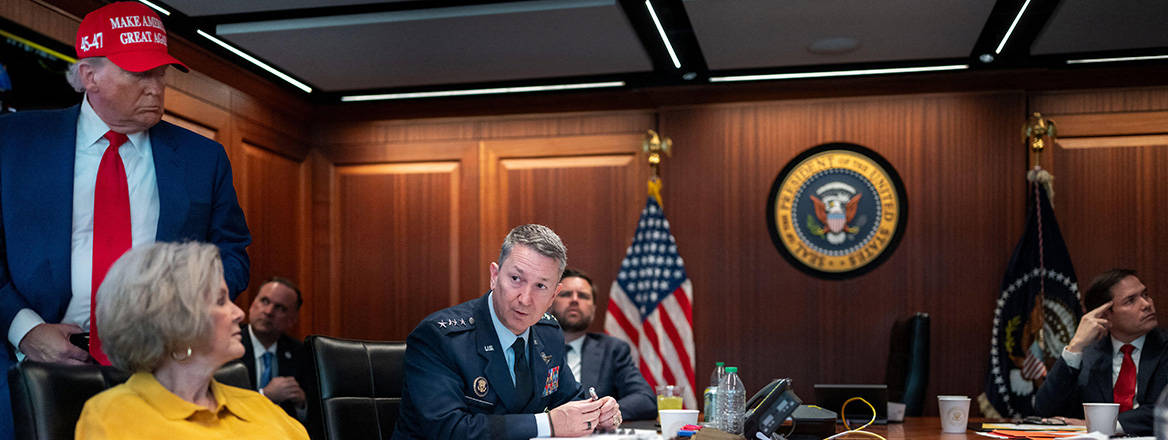
Two US operations against Iran, nine months apart, offer NATO opposite models of command at machine speed and a clear lesson about which to adopt.
On the night of 21 June 2025, seven B-2 Spirit bombers flew eastward from Missouri towards Iran while a second group of bombers flew west into the Pacific, towards Guam, as a decoy. The deception held: as General Dan Caine, Chairman of the US Joint Chiefs of Staff, later told reporters, 'Iran's fighters did not fly, and it appears that Iran's surface-to-air missile systems did not see us throughout the mission.' Over roughly 25 minutes, the strike package dropped 14 30,000-pound bunker-busters on the Fordow and Natanz nuclear sites, while a submarine launched Tomahawk cruise missiles at Isfahan.
Operation Midnight Hammer has been analysed largely as a feat of tactical execution, and it was. But its most instructive feature for the alliance is quieter, and concerns the architecture of command rather than the skill of the aircrew. The decisive choices in Midnight Hammer were not made in the cockpit, nor improvised in the operations centre under time pressure. They were made years in advance, embedded in the design of the weapon and the structure of the mission. That is a model of disciplined command for an age in which machines compute faster than humans can deliberate, and the contrast with what came nine months later, the much larger, AI-accelerated Operation Epic Fury, should concentrate allied minds, British and European ones included.
Authority Built in Advance
Consider what the lead B-2 pilot over Fordow actually decided. Not whether to strike Iran’s most heavily protected nuclear facility; not which weapon to use; not how many to drop. Those choices had been settled over the preceding years, through the development and testing of the GBU-57 Massive Ordnance Penetrator, a weapon engineered specifically to defeat hardened, deeply buried targets and validated through repeated test drops before it was ever used in combat. The weapon-to-target match, the number of penetrators for Fordow’s mountain versus Natanz’s shallower bunkers, the reservation of submarine-launched Tomahawks for the targets at Isfahan: these were engineering and planning judgements, made deliberately and in advance. The development and testing of the GBU-57 Massive Ordnance Penetrator's depth exceeded even the GBU-57's reach.
The point is not to remove human judgement from the use of force. It is to relocate that judgement to the point where it can be exercised properly
It is worth being precise about what this is, and what it is not. In the strict doctrinal sense, pre-delegated authority describes something narrower: a commander on the spot being granted, in advance, the discretion to employ capabilities under his control within predefined rules and parameters. Midnight Hammer was not principally that. It was a centrally scripted strike: the substantive choices about what force would be applied, against what, and validated against what intelligence, were resolved in advance by planners with the time and expertise to weigh them, and the crew executed a plan whose hardest choices had already been made and tested. What the two have in common, and what matters for the argument here, is the location of human judgement in time: it is exercised deliberately, before the operation, rather than improvised within it. The result was an operation whose kinetic phase lasted under an hour and produced no recorded governance failures. The kinetic phase lasted under an hour.
Whatever label one prefers, the point is not to remove human judgement from the use of force. It is to relocate that judgement to the point where it can be exercised properly, deliberately, with full information, under no time pressure rather than demanding it in the compressed seconds of a live: machine-speed engagement. In an era in which machines compute faster than humans can deliberate, where that judgement sits in time is becoming the central question of command.
What Happens When Authority Is Improvised
Nine months later, the same military fought a very different kind of campaign. Operation Epic Fury, launched against Iran in late February 2026, was an AI-accelerated operation of unprecedented tempo. By its own commander's account, the campaign hit more than 1,000 targets in its first twenty-four hours. Admiral Brad Cooper, the head of US Central Command, described how AI tools turn 'processes that used to take hours and sometimes even days into seconds'. He was right that this delivered a tempo advantage. He was also describing a system in which the human deliberation that pre-delegation protects had been compressed to the vanishing point.

The cost of that compression appeared on the first day. A US Tomahawk struck the Shajareh Tayyebeh elementary school in Minab, killing at least 156 people, most of them children. Preliminary findings from the US military’s own investigation, as reflected in the public record, indicate the strike rested on targeting data roughly nine years out of date: the building had once formed part of an adjacent military compound and had since become a school. Strikes on stale or mistaken information are not unique to AI-accelerated operations; the 1999 Belgrade embassy strike and others long predate them. The relevant question is not whether error is possible, which it always is, but whether the architecture preserves the point at which the currency of the underpinning data is forced to be checked. In a scripted operation such as Midnight Hammer, every weapon-target pairing was confirmed beforehand; in Epic Fury’s high-tempo pipeline, the compression of the targeting cycle to seconds is precisely what removed the interval in which such a check would have occurred.
Two objections must be met head-on. The first is that Midnight Hammer was simply an easier problem: a small, fixed set of high-value nuclear sites, watched for years, is inherently easier to strike accurately than a sprawling target list generated in days. That is true, and scale and target type account for part of the difference. But it does not account for the mechanism of the Minab failure, which was not that the target was hard to find but that no step in the pipeline was obliged to ask whether nine-year-old data still held. The second objection is that no military can script every operation in advance; most combat is not a handful of pre-surveilled bunkers. That too is correct, and the argument here is not that every operation can or should look like Midnight Hammer. It is narrower; whatever the tempo, the architecture should preserve an inspectable point at which substantive authority was exercised and the underlying data validated. Midnight Hammer had such a point by design; Epic Fury, by compressing the cycle, did not.
Why This Matters for the Alliance
For British and European defence planners, this is not simply an American problem to observe from a distance. NATO's operational future is built on interoperability the premise that allied forces can plug into one another's systems, share targeting data, and act as a coherent whole. As AI-enabled targeting tools spread through allied arsenals, interoperability will increasingly mean connecting to systems whose command architecture one's own forces did not design and cannot fully see.
There is a practical mechanism at stake here. Allied command arrangements have long relied on national ‘red cards’ the right of a contributing nation’s commander to refuse participation in a strike that breaches national rules of engagement. A red card presupposes a reviewable interval: a moment at which a human can see the proposed target, the supporting intelligence, and the legal basis, and withhold consent. An AI-accelerated targeting cycle that collapses that interval to seconds does not merely speed the process; it threatens to engineer the red card out of existence, because there is no longer a point at which a national representative can meaningfully interpose. How red-card authority is to function inside a machine-tempo pipeline is, for a multinational alliance, not a peripheral question but a central one, and it is unanswered in NATO’s current standards.
That raises a question the alliance has barely begun to address. If a British or French or German formation contributes to, or relies upon, an AI-accelerated targeting pipeline, whose pre-delegation governs the strike? Under whose validation standard was the underlying data confirmed current? Midnight Hammer's model authority engineered and validated in advance is exportable and auditable; an ally can, in principle, inspect and trust a weapon-target validation process completed before an operation. Epic Fury's model authority improvised at machine tempo is far harder to share responsibly, because there is no fixed, inspectable point at which the human judgement was exercised.
The implication for allied policy is concrete. As NATO develops common standards for AI-enabled military systems, those standards should privilege the Midnight Hammer architecture over the Epic Fury one: they should require that the substantive authority to apply force, and the validation of the data on which that authority rests, be established and inspectable before deployment, not generated in the unreviewable instant of a machine-speed engagement. This is not a constraint on operational tempo for its own sake. It is the condition under which allies can trust one another's systems and under which the law of armed conflict, which assumes a deliberating human somewhere in the chain, can continue to mean something.
The Hour Worth Studying
The most important hour of the past year of Western military operations may be the one over Fordow. Not for what it destroyed, but for how the decision to destroy it was structured. The claim is not that every operation can be scripted in advance; most cannot. The discipline Midnight Hammer embodied – substantive authority and data validation fixed at an inspectable point before action – is the property NATO’s emerging standards for AI-enabled force should require, whatever the tempo at which force is finally applied. Epic Fury showed what is lost when that point disappears. The alliance now has two models before it, drawn from the same military within a single year; choosing deliberately between them is among the more consequential tasks of the next few years.
© Burak Oktenli, 2026, published by RUSI with permission of the author.
The views expressed in this Commentary are the author's, and do not represent those of RUSI or any other institution.
For terms of use, see Website Terms and Conditions of Use.
Have an idea for a Commentary you'd like to write for us? Send a short pitch to commentaries@rusi.org and we'll get back to you if it fits into our research interests. View full guidelines for contributors.
WRITTEN BY
Burak Oktenli
Guest Contributor


- Jim McLeanMedia Relations Manager+44 (0)7917 373 069JimMc@rusi.org