

The Gloves Come Off as Zelensky Gives Up on Trump. What Should Europe Do?

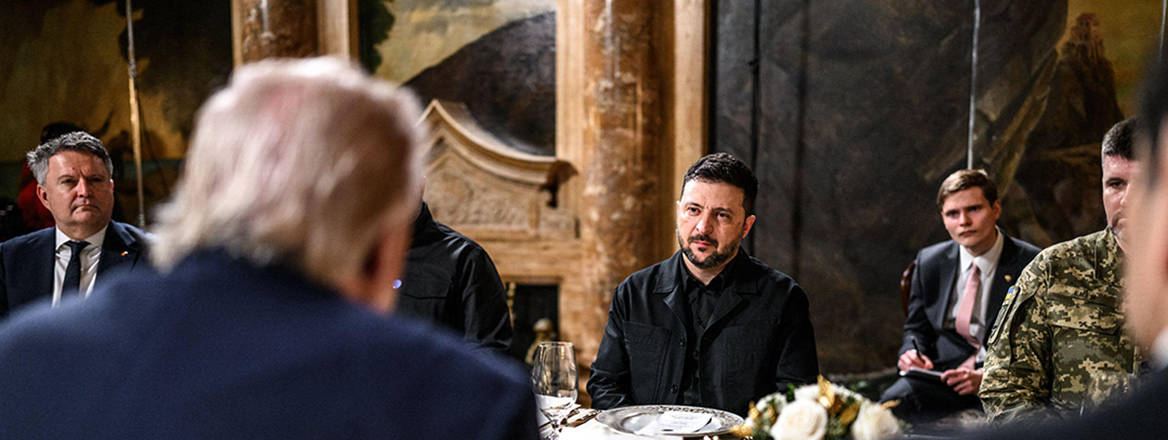
Should Europe go along with Trump’s trajectory towards a flawed peace agreement or follow Zelensky’s decision to defy the US president?
President Volodymyr Zelensky has always known that President Trump favours Russia. He did not need that bizarre trilateral in Shenzhen to remind him. The mugging in the Oval Office in February 2025 is not something he was ever going to forget. On his arrival in London the following day, the sensible advice from his British ally was to patch up relations with Washington and bend over backwards to humour the US president.
The arguments were convincing at the time. Biden-era support for Ukraine was still flowing and, even when it stopped, a great deal of US assistance carried on at official level beneath the radar of Trump and his circle.
Meanwhile European nations abased themselves at the court of Trump. There were some truly toe-curling moments. Prime Minister Starmer’s obsequious deployment of the letter from King Charles was one. Another was in August of the same year when eight European leaders gathered around the Resolute Desk like children listening to pearls of wisdom from a much-respected elder.
The Mood Shifts
Then things began to change. Italian Prime Minister Meloni bit back when Trump alleged she had ‘begged’ for a photograph with him.
And Defence Secretary Pete Hegseth began to clamp down on any streams of informal support for Kyiv. A middle-ranking Pentagon official told me in April 2026 that it was now increasingly dangerous to take any action contrary to the administration’s wishes. The sackings of State Department and Pentagon officials were having a sobering effect. People had families to support and bills to pay.
Then there was Canadian Prime Minister Mark Carney’s inspirational speech at Davos in January 2026, ‘The powerful have their power. But we have something too – the capacity to stop pretending, to name reality, to build our strength at home and to act together.’
At the end of February, most of Europe did little to support the US attack on Iran.
Zelensky Raises the Stakes
At the beginning of October, Zelensky took a big risk. He bet on a Democratic Party victory in the US mid-term elections. In mid-October, he directly criticised both Trump and Elon Musk for the reduction in Starlink/Starshield functionality. Following Trump’s agreement to buy Russian diesel and demand that Ukraine stop targeting Russian fuel production, he approved further strikes against the Kstovo refinery in Nizhny Novgorod region following a separate attack against a refinery in Samara.
Ukraine is reacting in the only way it can. It is removing any self- and externally imposed restrictions
Then the day before Trump’s appearance at the Shenzhen APEC (Asia-Pacific Economic Cooperation) Summit on 18 November, Zelensky approved the strike against the Kerch Bridge. The attack has correctly been described as an attempt to humiliate Putin but it was also a deliberate affront to the US president. There should be no doubt that the gloves are off. The antagonism between the two men is now out in the open.
A driving factor is that Ukraine is in deep trouble. The expenditure of over a thousand Patriot interceptors in the Arabian/Persian Gulf has left Kyiv and other Ukrainian cities indefensible. Even before the onset of the really cold winter weather it is becoming increasingly hard for Kyiv to function as a capital city. A Ukrainian official told me last week that there is discussion of evacuating schools towards the west of the country. Other functions may have to follow.
Ukraine is reacting in the only way it can. It is removing any self- and externally imposed restrictions. In recent days, there has been a Russian cargo ship hit in the Gulf of Finland and a warship destroyed at Benghazi.
Another reason for escalating is to improve its position in case of a peace negotiation. Isolating Crimea from Russia has been a strategy throughout 2026 and has been one of two areas of success, the other being the deep strikes against Russian refineries and logistics hubs.

To their credit there has been no open criticism of Zelensky from European leaders although there will be internal anxiety. There is still a view in Europe that it might be possible to ‘manage’ the Trump problem for another two years, even though he will increasingly focus on foreign policy now that a Democrat-controlled Congress will contest his domestic agenda.
That hope may be illusory, given that Trump is likely to be even more erratic as his term draws to a close. But the overriding European objective is to keep the US in NATO at a time when Putin is already beginning to test whether Article 5 really exists in practice.
Europe’s Missing Resolve
Meanwhile Europe continues to show weakness. The refusal to seize Russian frozen assets; the failure to seize more than a handful of the 632 sanctioned shadow tankers; the request by four members to opt out of the latest €45-billion loan package; and Germany’s persistent reluctance to supply the Taurus missile all testify to this.
A Ukrainian speaker at a London conference last week alleged that every European weapons delivery comes with much of its functionality disabled. Beyond the robust talk Europe has still not woken up to what lies ahead.
And what lies ahead is an attempt to bully Ukraine into an unsatisfactory peace agreement. This is why Trump wants to complete it before 3 January, when the new Congress takes office. The G20 meeting on 14 December will doubtless play a part in this aspiration and Putin may even risk appearing in person despite his fears for his personal security. Putin knows he has two years to maximise the gains from having a pro-Russian president in the White House. It may never happen again.
Even Putin must have been amazed when Jared Kushner and Steve Witkoff relayed the contents of Moscow’s 10 November ‘non-paper’ from their Abu Dhabi meeting to European leaders. It could be portrayed as naivety but it is more likely the tactics of the New York property market. By not rejecting Russia’s additional demands (which Putin reiterated during the pair’s stopover in Moscow) they have exerted additional pressure on both Europe and Zelensky.
The same is true of the false suggestion that Putin would consider a NATO Article 5-type guarantee for Ukraine if it gave up the Donbas. It is the same trick where you ask if someone will sell their house for an exorbitant price. Having established a willingness to sell you then offer a substantially lower sum.
The Lesson of Doha
What will Europe do? With the increasing likelihood of Marine Le Pen winning the presidential election in France, with Chancellor Merz under pressure from the AfD (Alternative for Germany) and with increasing anti-Ukrainian sentiments in Poland, some will argue that Zelensky would be wise to settle now. This feels reminiscent of the general weakening of European resolve which saw Trump negotiate the disastrous Doha Agreement with the Taliban in 2020. And it was the humiliation of the subsequent Afghan fiasco in August 2021 which is said to have encouraged Putin to attack Ukraine.
Doha was the biggest diplomatic disaster since Munich in 1938 and Yalta in 1945. This is something which European leaders, especially the waverers to the east, should ponder.
© RUSI, 2026.
The views expressed in this Commentary are the author's, and do not represent those of RUSI or any other institution.
For terms of use, see Website Terms and Conditions of Use.
Have an idea for a Commentary you'd like to write for us? Send a short pitch to commentaries@rusi.org and we'll get back to you if it fits into our research interests. View full guidelines for contributors.
WRITTEN BY
Tim Willasey-Wilsey CMG
RUSI Senior Associate Fellow, RUSI International


- Jim McLeanMedia Relations Manager+44 (0)7917 373 069JimMc@rusi.org