


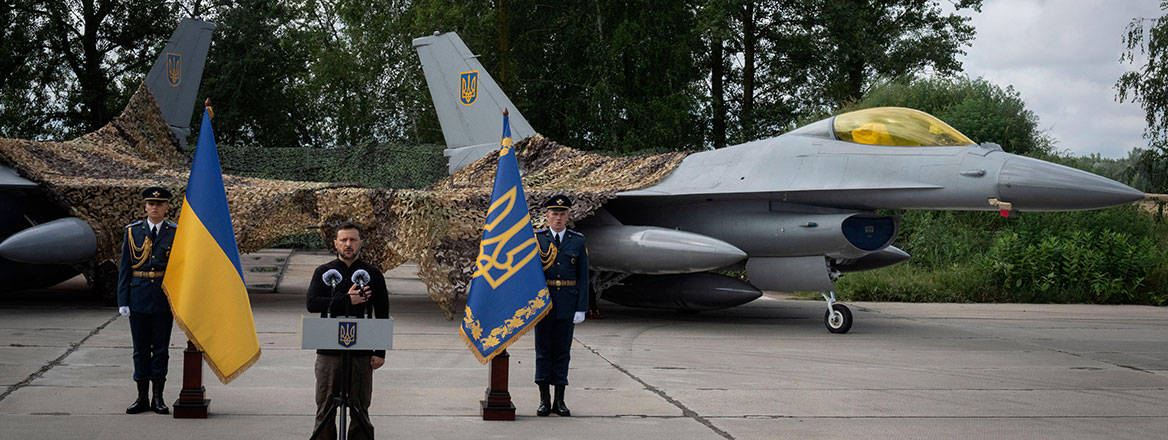
An established Ukrainian F-16 Fighter Wing and the overstretch of fighters and air defences on both sides by sustained long-range strike campaigns have changed the nature of the air war.
The first phase of the air war during Russia’s full-scale invasion of Ukraine was characterised by the failure of the Russian Aerospace Forces (VKS) to successfully complete a suppression and destruction of enemy air defences (SEAD/DEAD) campaign against Ukraine’s extensive ground-based air defence (GBAD) network. This left the bulk of the VKS tactical fighter fleets unable to meaningfully effect the direction of the war on the ground. Instead, the bulk of Russia’s air campaign in the first two years consisted of long-range strikes using cruise and ballistic missiles to try to degrade Ukrainian communications, defence industry and transport and energy infrastructure. Likewise, the impact that badly outmatched Soviet-legacy Ukrainian fighters and ground attack aircraft could have on the frontline situation was limited by a formidable Russian GBAD threat and VKS fighters on combat air patrol fairly near the frontlines.
In summer 2026, the nature of the air war is radically different. Western fighters now form the core of the Ukrainian Air Force in the shape of the 107th Wing, equipped with F-16, and a smaller force of Mirage 2000-5s. The F-16s are by some margin the most flexible and effective fighters available, across all mission types. Ukraine also still operates some MiG-29s and a few Su-27s for air defence missions, firing AGM-88 HARM missiles to suppress Russian GBAD systems and conducting glide bomb attacks. Air defence sorties make up the most common mission type, which is understandable given that throughout most of 2025 and 2026, Russia has launched several massed long-range strike waves per week. These strikes generally begin with waves of many hundreds of one-way attack (OWA) drones such as the propellor powered Geran-2 and jet-powered Geran-3, as well as decoy drones such as the Gerbera to probe and saturate Ukrainian air defences. The drones are followed closely by tens of cruise missiles such as the Kh-101 launched from Russian bombers and 9M728 from the ground-based Iskander-K; and around half-to-one-third that number of ballistic missiles such as 9M723 from the Iskander-M and the air-launched Kh-47M2 Kinzhal.
As a first line of defence against these complex massed attacks, Ukrainian forces deploy deep belts of cheap short-ranged air defence (SHORAD) systems manned by mobile air defence teams. These SHORAD defences include anti-aircraft artillery (AAA) from manually aimed vehicle mounted machine guns, automated and crewed turret emplacements and self-propelled anti-aircraft guns like the Gepard and Shilka. Air defence teams also use man-portable air defence systems (MANPADS) like Stinger and Igla, and many thousands of drone interceptors. The latter are essentially cheap propellor powered missiles and come in a very wide variety of forms, many of which are increasingly effective against multiple classes of Russian OWA and battlefield reconnaissance UAVs.
Ammunition resupply is the primary challenge for Ukrainian surface-to-air missile coverage
What unites all these mobile air defence teams and counter-drone teams is that their equipment and ammunition is relatively cheap and thus their operations are sustainable. However, they are relatively personnel intensive to deploy at scale and require both force density and geographical depth to be effective. This is because such SHORAD systems can only cover a small area individually, and so the odds of a given Russian Geran-2 or Gerbera OWA coming within their effective range on their way to targets deeper inside Ukraine is very low. However, since Ukraine has massed air defence teams behind the borders/frontlines in significant depth, these SHORAD systems now destroy a majority of the Russian Geran and Gerbera OWA drones shot down. The AAA guns and MANPADS also sometimes intercept a few faster and much more lethal cruise missiles. The development of these deep and widely deployed SHORAD defences has been critical in helping Ukraine offset serious shortages of surface-to-air missile (SAM) and air-to-air missile ammunition, which are desperately needed for intercepting the Russian cruise and ballistic missiles that the SHORAD systems cannot reliably shoot down.
Ukrainian SAM systems are now primarily Western, as most of the pre-war Soviet-era SAMs have long since run out of ammunition. The main systems used in 2026 are the medium range NASAMS and IRIS-T SLS/SLM, which are highly effective as point defence assets against cruise missiles; and longer-range SAMP/T and Patriot, which provide Ukraine’s only effective defence against Russia’s heavy use of ballistic missiles against infrastructure and military facilities throughout the country. Ammunition resupply is the primary challenge for Ukrainian SAM coverage – with PAC-2 GEM-T and PAC-3 MSE interceptor missiles being particularly sought after for long-range anti-aircraft and anti-ballistic missile interception respectively. These are in short supply globally following very large-scale expenditure of both PAC-2 and PAC-3 missiles by the Gulf States and US forces against Iranian ballistic and cruise missile attacks, and often OWA drone attacks during Operation Epic Fury.
Ukraine’s F-16 and Mirage 2000-5 fighters have had significant successes in shooting down Russian cruise missile salvos since early 2025, and the F-16s alone have destroyed well over 2,500 Geran and Gerbera OWA drones. However, the use of fighters against such drones has consumed an unsustainable number of airframe flying hours and air-to-air missiles such as AIM-9M/L Sidewinder and Magic 2 since mid-2024 when the Ukrainian Air Force received its first Western aircraft and trained crews. With unmatched combat experience against OWA drones, Ukrainian Air Force F-16 pilots now use the 20-mm cannon and US-supplied AGR-20 rockets (also known as APKWS II) to save missiles for more valuable targets like cruise missiles wherever possible. However, Ukraine’s belts of SHORAD systems near the border/frontline areas, and helicopters and volunteer-flown fixed-wing gunships with machine guns are much more efficient ways to intercept the Geran-2 and Gerberas than fighters. Russian industry produces more than 6,000 OWA drones per month, and fighter aircraft have only a finite number of airframe hours available before they need time consuming deep maintenance cycles to be performed at a factory by expert technicians.


Alongside their primary air defence duties, Ukrainian F-16s, Mirage-2000s and MiG-29s routinely launch precision stand-off attacks against battlefield targets with glide bombs like the American GBU-39 Small Diameter Bomb, GBU-62 JDAMs with glide kits, and French AASM Hammer. These theoretically allow the Ukrainian Air Force to strike a wide range of battlefield, logistics and industrial targets out to around 60 km behind Russian lines. Unfortunately, land-centric targeting and mission allocation processes have so far limited the effectiveness of Ukrainian fighters against time-sensitive targets in this role. However, there is a great deal of potential for improved results if the F-16 Wing is allowed to plan and execute missions in a more flexible way by the wider Ukrainian Air Force and Armed Forces of Ukraine command structure.
Russia’s own Su-34 Fullback fighter-bomber fleet pounds the Ukrainian frontline positions and cities near the frontline areas with hundreds of heavy UMPK and UMPB glide bombs per week. These weapons were introduced at scale from Autumn 2023, and have given Russia a cheap method of employing tactical airpower at scale to systematically demolish Ukrainian battlefield strongpoints and defensive positions, target concealed drone operator teams, and bombard cities near the frontlines. Countering them remains difficult as the AIM-120 AMRAAM missiles carried by F-16 cannot effectively reach the Su-34s releasing their weapons at high altitudes and speeds 70 km or so behind the Russian lines. The long-discussed arrival of Gripen C/D fighters from Sweden in early 2027, equipped with the long-range European Meteor missile offers hope that this will change in the not-too-distant future.
Russian air defence overstretch is also increasing the opportunities for Ukrainian fighters to conduct successful glide bomb and air-launched cruise missile attacks on larger, more hardened targets tens of kilometres behind the lines that cannot be destroyed with smaller OWA drone warheads
Meanwhile, Ukraine’s own long-range and mid-range strike UAVs such as the FP-2 are causing increasingly serious and politically embarrassing damage inside Russia. Ukrainian attacks – much like Russia’s own salvos of Geran-2 and Gerbera drones – consist of hundreds of OWA drones per wave and are launched several times per week. Most of the drones launched are shot down or defeated by electronic warfare on their way to targets by Russia’s extensive ground-based air defences, by helicopter gunships and increasingly regularly by VKS fighters. However, the targets that Ukraine is primarily attacking – oil and gas infrastructure – are widespread across Russia and are highly flammable and difficult to harden. This makes them almost ideal targets for causing major damage on a regular basis when only a handful of the hundreds of UAVs launched usually get through, and generally carry fairly lightweight warheads.
The result has been an increasing degree of strain on the Russian air defence system, as finite GBAD systems are redeployed ever deeper inside Russia to try to protect potential targets coming within range of Ukrainian drone strikes, and ammunition stocks are strained by constant attacks. This is particularly noticeable among the SHORAD systems Russia generally prefers for counter-UAV interceptions such as the SA-22 Pantsir and SA-15 Tor. The wider distribution of Russian GBAD, and increasing strain on fighter and attack helicopter fleets trying to conduct airborne interceptions outside the main GBAD concentration areas, has opened up more opportunities for mid-strike operations. With fewer Russian GBAD assets near the front and fewer fighter patrols, far more Ukrainian loitering munitions are getting through to harass resupply routes and battlefield logistics in the ‘deep’, especially in and around Crimea.
Russian air defence overstretch is also increasing the opportunities for Ukrainian fighters to conduct successful glide bomb and air-launched cruise missile attacks on larger, more hardened targets tens of kilometres behind the lines that cannot be destroyed with smaller OWA drone warheads. July 2026 also saw the first confirmed destruction of a Russian Su-35 fighter by a Ukrainian F-16, with the Russian pilot ejecting close to the frontlines. The shoot down was particularly impressive given the radar-performance and missile-range disparity between the two fighter types and the continued presence of Russian long-range GBAD threats near the frontlines. It is also a testimony to the increasing experience levels and potential within the F-16 Wing to deliver greater operational level effects than it has so far, if it can be correctly enabled and supplied with suitable weapons.
© RUSI, 2026.
The views expressed in this Commentary are the author's, and do not represent those of RUSI or any other institution.
For terms of use, see Website Terms and Conditions of Use.
Have an idea for a Commentary you'd like to write for us? Send a short pitch to commentaries@rusi.org and we'll get back to you if it fits into our research interests. View full guidelines for contributors.
WRITTEN BY
Justin Bronk
Senior Research Fellow, Airpower & Technology
Military Sciences


- Jim McLeanMedia Relations Manager+44 (0)7917 373 069JimMc@rusi.org