


The maturation of Chinese and US strategies to control strategic minerals supply chains echo Cold War structures. Fresh EU and UK plans are already behind the times.
The Cold War was a period of intense systemic competition between the US (and its allies) and the USSR. Competition was holistic, spanning geographies and sectors, and profoundly affected countries drawn into the orbit of these superpowers. This was not only a battle for influence and access to markets and resources, but an economic and industrial arms race, as blocs sought to protect vital supply chains and gain the technological edge.
As strategic rivalry between China and the US intensifies and both prepare for supply chain disruption, Europe and the UK struggle to pay their way and show little sign of treating the challenge with the urgency required by the geopolitical environment.
Both China and the US have accelerated efforts to secure strategic interests in critical supply chains, including minerals. This has produced strategies reminiscent of Cold War resource, technology and infrastructure competition, alongside a modern economic arsenal of controls, taxes and regulations. In Washington and Beijing, securing mineral supply chains is now seen as a prerequisite for strategic competition in the 21st century.
By contrast, the EU’s RESourceEU Action Plan, published in December, and the UK’s Vision 2035: Critical Minerals Strategy, published in November, set targets and signal more proactive pathways, but struggle with the immediacy and scale of the challenge.
China Instrumentalises the Minerals Industry
The past five years have seen a strategic evolution in Chinese government minerals strategy in line with changes to the country’s overarching security posture. Both central and provincial government, as well as corporate, policy through much of the 2010s was driven by the ‘go out’ strategy and the emergence of the ‘new’ industries. But China’s14th Five-Year Plan (FYP) for National Economic and Social Development (2021-25) incorporated rapidly maturing minerals supply chains into national security strategy. While the National Plan for Mineral Resources 2016–2020 establishes 24 ‘strategic’ minerals, the 14th FYP called for the government to ‘strengthen the planning and control of strategic mineral resources, improve reserve security capabilities, and implement a new round of . . . prospecting’, elevating minerals to a par with food and energy security.
The result is a quiet but seismic restructuring of government policy and, for minerals like rare earth elements, and the industry itself. With documents like the Mineral Resources Law and the 14th Five-Year Plan for Raw Materials Industry Development, the Chinese government established a strategy of resource conservation and supply security involving both the discovery and development of new domestic strategic mineral reserves and their ‘protective exploitation’. This approach protects reserves in the ground alongside conventional stockpiles for use in a crisis and to better manage the supply-demand balance within China and globally. The law instructs authorities to balance domestic and international resource exploitation in line with the overarching national security framework.
The 14th Five-Year Plan for Raw Materials Industry Development set the objective that by 2025 Chinese raw materials industries would be ‘secure and independently controllable’. Alongside more centralised control of resource management, this entails investment in exploration, substitution and recycling.
The [Trump] administration has built on Biden-era policies but with greater funding and a more confrontational approach based on ‘mineral dominance’, price floors, support for the defence industrial base, energy infrastructure and data centre deployment
Consolidation of the rare earths industry, with the formation of the China Rare Earth Group Co. Ltd in late 2021, has strengthened centralised control. The company joined the Northern Rare Earth Group to dominate a highly concentrated, state-backed industry. The process allowed the central government to bring divergent corporate and provincial government interests into better alignment with national security strategy.
In 2024 the Regulations on the Administration of Rare Earths introduced licensing, production quotas and traceability requirements across the supply chain. The regulations both enable ‘effective protection and rational development and utilisation of rare earth resources’ and underpin export controls by clamping down on illegal trade that might circumvent controls through a traceability framework.
These developments also supported a sophisticated system of controls over rare earth exports that ultimately enabled their deployment as a deterrent against US trade aggression in 2025, with major consequences for global industry and likely an important factor in the US backing down.
China’s strategy has echoes of US Cold War oil strategy. Between the 1940s and 1970s, the US encouraged development of Middle Eastern oil resources to conserve its own oil reserves to supply Europe in an emergency. The strategy was based on the premise that if war broke out with the Soviet Union, Europe might lose access to Middle Eastern supply and would have to fall back on the US. The strategy managed persistent concerns about forecasts of dwindling US reserves by managing extraction during peacetime. Chinese strategy has a comparable objective, with a resource management strategy that emphasises conservation of high-grade reserves and domestic surge capacity.
The US: ‘Nothing Realer’ Than Raw Materials
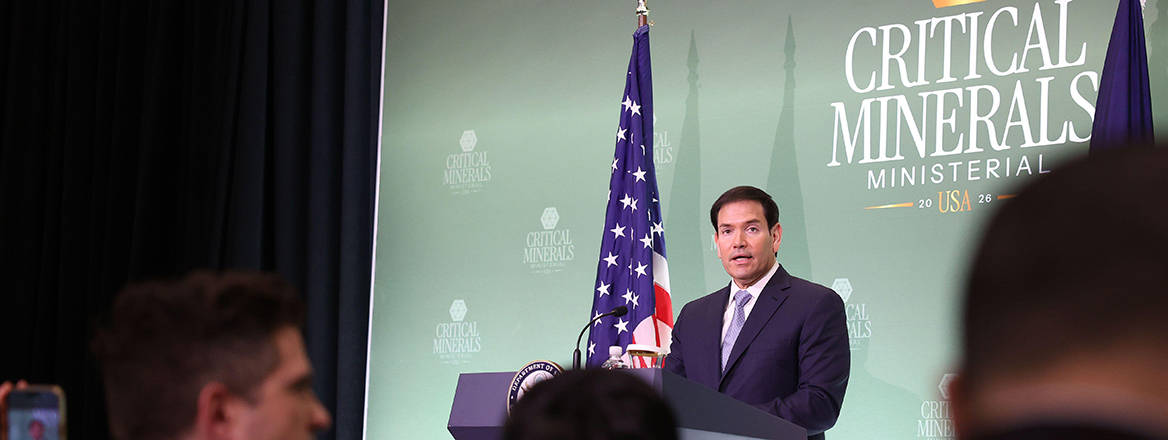
After a long period of neglect, the US has re-energised its raw materials strategy over the past decade, with efforts supercharged by the current administration of President Donald Trump. As US Vice President JD Vance said at the Critical Minerals Ministerial, convened by the US State Department in February in Washington DC: ‘the President said . . . fundamentally you still have an economy that runs on real things. And there is no realer thing than oil – and I would add to that there’s no realer thing than critical minerals.’ The administration has built on Biden-era policies but with greater funding and a more confrontational approach based on ‘mineral dominance’, price floors, support for the defence industrial base, energy infrastructure and data centre deployment.
While sometimes lacking coherence, the US strategy has financial weight. The US International Development Finance Corporation (DFC), alongside the Export-Import Bank of the US, has been reimagined in a more strategic role targeting projects in countries (such as the Democratic Republic of Congo [DRC] and Kazakhstan) and supply chains (such as cobalt, graphite and rare earths) with a strong Chinese presence. This has been accompanied by aggressive diplomacy and policies that, alongside public funding, leverage the corporate muscle of traders, private equity and miners.

These manoeuvres are already impacting markets. DFC announced plans to invest in a joint venture to market DRC’s royalty copper and cobalt, giving US buyers the right of first refusal. Glencore also signed an MoU in early February with the US-backed Orion Critical Mineral Consortium, which aims to acquire DRC-based mineral assets. In April 2025, US rare earth miner MP Materials ceased exports to China following US government investment. The cessation of exports hit China: the company had until then met as much as 7-9% of China’s demand for neodymium and praseodymium oxide (the key elements for permanent magnets).
Washington is also leveraging its stockpile ambitions. Project Vault – a stockpile initiative targeting industry and intended to complement the National Defense Stockpile – will be backed by a $10bn loan from the Export-Import Bank of the US and is seeking an additional $2bn in private sector investment. Glencore is expected to purchase around 2,000 tons of cobalt in 2026 as part of US stockpiling efforts and signed an MoU in early February with the US-backed Orion Critical Mineral Consortium, which aims to acquire DRC-based mineral assets.
Aggressive resource diplomacy has been another feature of the Trump administration. An unusual deal was shaken out of Ukraine, but 21 memorandums of understanding or framework agreements have been signed by the US and other countries since Trump’s second inauguration. With the Critical Minerals Ministerial in February, the administration attempted to push these efforts into a broader US-led alignment – the Agreement on Trade in Critical Minerals (ATCM) – which would set minimum prices for key mineralsestablished using tariffs, potentially set by AI. ATCM would prevent minerals being sold below the cost of production outside of China, helping to make mining and processing more financially viable. The ministerial also revamped the somewhat moribund Minerals Security Partnership, a Biden-era effort at multilateral coordination on minerals, relabelling it the Forum on Resource Geostrategic Engagement (FORGE).
With the ATCM, the US recognises the scale of the challenge. But major technical obstacles remain and many advanced economies are likely to decline to sign up by the US deadline in April. Unlike US leadership in 20th-century bloc building, such as the General Agreement on Tariffs and Trade (GATT) in 1947, the US has not worked with allies to design a stable and mutually beneficial arrangement. While US officials have said they are open to alternative proposals, they have not created channels for these to be explored. Furthermore, the complex administration of the ATCM would require institutional backing, which the US appears to intend to operate unilaterally.
The US has also become less cooperative in other multilateral forums, notably the G7, where France had intended minerals to be a central focus of its presidency, a US approach that risks slowing mineral supply chain diversification efforts outside the US.
Europe: Striving for Relevance
China and the US are accelerating strategies that manage and control critical supply chains, backed by tens of billions of dollars of public investment. This environment poses challenges to the EU and individual European countries, which have committed neither comparable funding or administrative zeal to the task.

Stay up to date with the latest publications and events as part of the UK National Security and the Net Zero Transition programme of work

With the RESourceEU Action Plan and the EU Stockpiling Strategy building on the 2024 Critical Raw Materials Act, the European Commission has moved from trade responses, diplomacy and industrial policy to a more security-centric approach. The strategy emphasises controls on secondary materials exports, joint purchasing, stockpiling and ‘strategic project’ designations intended to accelerate permitting and financing. A new European Critical Raw Materials Centre will provide intelligence and guidance for member states, as well as acting ‘as a portfolio manager’ and investor, operating both within the EU and abroad. This is a material change in EU strategy that begins to build the institutional architecture to manage critical supply chains.
However, implementation at scale and impact on the ground are not guaranteed. The strategy requires major operational capacity, but European Commission documents are vague on staffing levels, expertise and budget. The layering of EU-wide strategic projects, diversification targets, joint purchasing and stockpiling on top of national policy risks creating strategic uncertainty, coordination problems and lacklustre implementation.
The pace of implementation is also much too slow. Minerals supply chains were first identified as an economic challenge in the 2008 Raw Materials Initiative and a security challenge in a 2020 Critical Raw Materials Communication in the wake of the Covid-19 pandemic. Yet, in 2026, the European centre intended to monitor, invest in and guide stockpiling has not yet been set up.
Most telling, a European Court of Auditors (ECA) report earlier this year on EU minerals strategy was titled ‘Not a rock-solid policy’. The report concluded that the Critical Raw Materials Act targets ‘lack justification and underlying data is not robust’. Efforts to diversify imports have yet to produce tangible results and bottlenecks hamper progress in domestic production and recycling.
The ECA criticised diplomatic and trade activities, long a focus for the EU, arguing that ‘the extent to which they led to a strengthened supply is unclear.’ The Critical Minerals Ministerial may have been chaotic and tone deaf (Vance told the audience: ‘We’re all on the same team; we’re all rowing in the same direction’), but it set out ambitions at the scale required to move the needle on minerals market security, even if the US-led minerals bloc may ultimately lean more towards Board of Peace than Bretton Woods.
Conclusion
The global economy is being rewired to reflect a geopolitical environment where the largest economies are actively seeking control over their own supply chains and to undermine those of their adversaries. US and Chinese strategies are reshaping mineral markets, and most advanced economies are taking steps to secure supply chains. But the advanced economies that remain committed to rules-based trade are struggling to coordinate without US leadership and with China unwilling to open its own markets or reform anti-competitive industrial and trade practices.
Solving the minerals challenge will take many years and UK Minister for Industry Chris McDonald recently said that if it is a ten-year problem, one had better start immediately. But it is not clear whether the UK or Europe are at the races or stuck outside the stadium, or whether, in this geopolitical environment, they have ten years to solve the problem.
© RUSI, 2026.
The views expressed in this Commentary are the authors', and do not represent those of RUSI or any other institution.
AI was used in the translation of Chinese-language documents.
For terms of use, see Website Terms and Conditions of Use.
Have an idea for a Commentary you'd like to write for us? Send a short pitch to commentaries@rusi.org and we'll get back to you if it fits into our research interests. View full guidelines for contributors.
WRITTEN BY
Dan Marks
Research Fellow for Energy Security
International Security


- Jim McLeanMedia Relations Manager+44 (0)7917 373 069JimMc@rusi.org