

Clear Warning: The Iran War and the Loitering Munitions Threat

The Iran war shows loitering munitions critically influence conflict. Yet, allied air defences remain inadequate. Remedy requires will and investment in people and technology.
The Iran war, beginning 28 February 2026 – Israel’s Roaring Lion, the US Epic Fury and Iran’s Operation True Promise IV – is the first major inter-state war in which both sides have employed loitering munitions and drones since the start of hostilities. Therefore, it marks a significant turning point in contemporary warfare.
From the war’s inception, drones have formed the backbone of Israeli and US efforts against Iran, which are integral to Western forces’ precision strike capability. However, attention has instead tended towards the targets of precision strikes, particularly figures and facilities. Indeed, initial high value targets included senior Iranian leadership and ballistic missile sites, reflecting US-Israeli endeavours to decapitate the Iranian regime and constrain its stand-off strike capability.
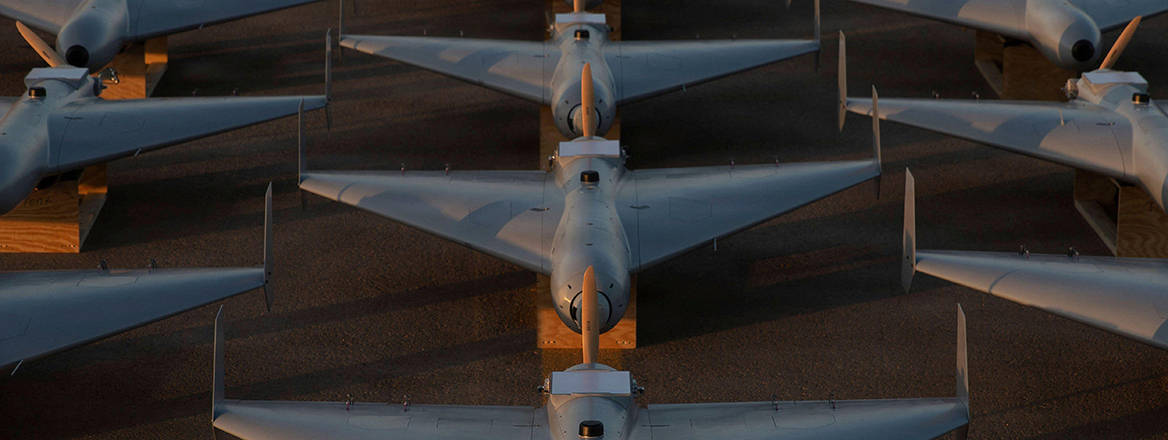
Yet, loitering munitions – not drones – swiftly seized media and analytical attention; both as predator and much sought-after prey. Most vividly, infamous Shahed-136s with their distinctive silhouette, buzzing sound and vast numbers, which, according to leading datasets and analyses, far exceed Iranian missile launches (and other loitering munitions). Starkly set against world-famous skylines, loitering munitions have indelibly been seared into many a mind’s eye.
An Increasingly Important Distinction: Drones and Loitering Munitions
Despite their frequent conflation, drones and loitering munitions are distinct technologies (despite being developmentally related). Often, the term ‘drone’ is used to refer them both, as has frequently (but not always) been the case regarding Shahed-136s and other loitering munitions. More precisely, however, drones and loitering munitions are Unmanned Aerial Vehicles (UAVs), also known as Unmanned Aircraft Systems (UAS). This jargon can become confusing, hence the need for clarification.
Another term used quite widely to refer to loitering munitions is ‘one-way attack [OWA] drone’, despite them typically being able to manoeuvre in all directions. ‘Kamikaze drone’ is another, but because they are not human this is illogical. Notwithstanding, drones and loitering munitions differ and this distinction matters: drones are not munitions (unlike loitering munitions and missiles, despite claims to the contrary). They also see different usage and possess different implications including threats, as illustrated in the Israel-US-Iran war.
A Paradoxical Relationship: Drones and Loitering Munitions in the Iran War
Illustrative of drones’ and loitering munitions’ paradoxical relationship with public perception is that Iran and its proxies have launched large-scale and at times intensive loitering munition barrages for direct strikes, often against highly public – and sometimes civilian – targets. Meanwhile, reports of Iranian or US or Israeli drone use and of their purposes have proven elusive. Emblematic of loitering munitions swiftly seizing attention are reports of a dramatic near-miss (likely by a Shahed-136) with the world’s tallest building, Burj Al-Khalifa in Dubai UAE, on the war’s first day. Also, a strike by a jet-powered Shahed-238 against the luxurious Fairmont Palm Hotel, Jumeirah, Dubai.
Drones, unlike loitering munitions, are designed to be recovered and reused
Further compounding the attention differential are politically and militarily significant loitering munition strikes, including: 1 March (very likely by a Shahed-136) against a tactical operations centre in Kuwait (this directly resulted in the US’s single largest loss of service-personnel, so far, including numerous injuries); the strike on 1/2 March by what has been disclosed as a ‘Shahed-like’ loitering munition against the RAF’s airbase in Cyprus, one that resulted in significant political repercussions; and that of 5 March, by Iranian Arash-2 loitering munitions against Azerbaijan’s Nakchivan airport, in a strike that both geographically and politically widened the war. Moreover, given the increasing importance of the Azerbaijan air corridor for international air travel, this latter strike was strategically more significant for having occurred despite condolences conveyed from Azerbaijan to Iran upon the death of Ayatollah Ali Khamenei. Unsurprisingly, a cause célèbre about loitering munitions has ensued.
Meanwhile, drones, juxtaposed with loitering munitions by the former’s relative discretion, are identifiable only in limited reports of their use and losses; as of 10 April, the US had reportedly lost 24 MQ-9 Reaper drones in its Iran operations, but there has been comparatively limited coverage. On 20 March, IDF officials stated ‘more than a dozen’ IAF drones had been downed over Iran. Yet, this drew scant media attention, as did the loss of a US MQ-4C ‘Triton’ drone and its cutting-edge intelligence, surveillance and reconnaissance (ISR) equipment (costing US$238m) on 9 April (one of only c. 20 Tritons in the US’s inventory).
Drones, unlike loitering munitions, are designed to be recovered and reused. Drones are also frequently vulnerable to air defences because of, for example, their predominant and extensive use in ISR and Target Acquisition (TA), where larger drones are capable and often employed. This also indicates considerable incentive for drone losses not to be reported and/or details withheld. Conversely, Iran has been keen to emphasise and even revel in loitering munition use and their ‘destruction’, which sees discomfiting echoes of the regime’s frequently apocalyptic pronouncements.
In Concert: Drones, Loitering Munitions and Missiles
While reports of Iranian or Iranian-linked drones are few, several have emerged of small drones working in concert to facilitate loitering munition strikes. Prior to the US’ Kuwait operations centre strike on 1 March, small quadcopter drones are suspected of providing prior ISR and TA. Similarly, before the attack of 16/17 March on the US Embassy in Baghdad, Iraq, conducted with loitering munitions and rockets, an Iranian proxy released small drone ISR and TA footage. The embassy’s C-RAM (Counter Rocket, Artillery and Missile) system shot down two attacking loitering munitions. In an example from 24 March an Iranian proxy struck targets inside US Camp Victory, Baghdad, using loitering munitions: a quadcopter drone (possibly fibre optic controlled) that provided the preceding ISR and TA. This division of effort reflects the different threats that drones and loitering munitions frequently and increasingly pose.

Iran has combined drones with loitering munition and missile (and/or rocket) launches, including in efforts to overwhelm or ‘game’ air defences and inflict maximum damage. The strikes against the Kuwait command centre and the US Embassy Baghdad employed this modus operandi. The approach was also evident in the 7 October 2023 Hamas-led attack that overwhelmed Israeli defences. Similarly, the combination of loitering munitions and missiles was used in Iran’s attack against Israel on 13-14 April 2024. And in September 2024, Russia dramatically increased its use of Shahed-family loitering munitions (notably some Shahed UAS are drones) together with missiles to maximise mostly countervalue costs for Ukraine while also employing drones for ISR and TA. Apparently, Iran has learned from them.
Where drones have been unable to provide ISR and TA, satellite imagery has sufficed. Indeed, Russia and China reportedly provided Iran satellite intelligence for the 27 March strike that destroyed a valuable US E-3 Sentry aircraft (used for C4ISR and ‘battlefield’ management, costing c. US$280m). This strike combined at least one missile and several UAVs – almost certainly loitering munitions. The event was doubly significant because the E-3 was providing detection coverage to partly compensate for coverage lost after successful Iranian missile and loitering munition strikes against at least 12 US and allied ground-based radars; E-3s are typically swifter and more adept than ground-based radars at detecting loitering munitions. NATO has since recognised the need for improved detection and protection of this capability, given loitering munition capabilities and threats. Indeed, such has been the volume of Iranian strikes combining missiles and loitering munitions, including against airpower assets, Iran is considered here to have conducted a 'counterair campaign'.
Loitering Munitions: Central to Iran’s Strategy and Key Campaigns
So far, loitering munitions have clearly proven vital to Iran’s strategy to ‘blind’ its adversaries and impose high – mostly countervalue – costs and punishment, with the aim of both deterring further strikes and deflecting attention away from its nuclear and ballistic missile programmes. Iran’s political goal remains to make the continuation of endeavours against it unattractive, including politically. Loitering munitions have been at the fore of this. Although the US-Vietnam war (1954-75) and the Afghanistan war (2001-21) provide important templates for Iran, a critical difference is Iran’s drone, missile and particularly loitering munition capabilities and use.
Indeed, Iran’s move on 2 March to shut the Strait of Hormuz and the subsequent audacious announcement of sovereignty over the Strait in return for ceasing its strikes, is backed substantially by its missile and particularly mobile loitering munition capabilities. They pose a serious threat to vessels attempting to bypass Iran’s control and any potential endeavours to de-mine the Strait. The role of loitering munitions here differs from Iran’s recent conflicts, wherein ballistic missiles were more influential. In consequence, based on this difficult to interdict threat, Iran may now seek concessions for its nuclear programme in return for reopening the Strait.

Compounding the impact and efficacy of Iran’s strategy is the prior widespread underestimation of its loitering munition capability, amplified by Iran’s use of them in combination and en masse. Loitering munitions have clearly severely tested numerous allied air defences and frequently penetrated them. Iran’s approach has also been markedly different to that typically used by the US, Israel and Western militaries, who often employ comparatively expensive ‘exquisite systems' including sophisticated precision-guided munitions. Unlike them, loitering munitions such as the Shahed-136 can be comparatively easily and inexpensively manufactured in either cottage industry or larger-scale production. Their launch mobility means they are particularly difficult to ‘hunt’ let alone eradicate. Accordingly, Iran’s remaining stocks have proven difficult to accurately estimate let alone strike.
Therefore, despite Israel and the US having been strained by loitering munitions and expending great resources to interdict them, loitering munition salvoes persisted to 22 April and at a significantly higher rate than missiles (except 28 February and 8 April). Consequently, concern abounds that their use might increase again, for instance against Arab Gulf states’ desalination and energy infrastructure. On 4 and 10 May Iran struck the UAE using loitering munitions and missiles and continues to threaten the region. Iran is exploiting this with influential deterrent and coercive effects.
The Interception Challenge
Increasingly underpinning Iran’s ability to deter and coerce is the loitering munition interception challenge, which is greater than US officials (and many others) anticipated. Estimates of the cost-differential between Shahed-136s and their interceptors approximate the ratio of 1:28, with the case of UAE providing the key evidence. This is markedly higher than for missiles, where the ratio is 1:10. However, this ratio does not consider impacts to Iran’s production, wider capacities and reputation (that are substantial). Notwithstanding, it compliments Iran’s strategy. It has also rung alarm bells because stockpiles of key interceptors are expensive, time-consuming to produce and are in some cases reportedly running seriously low, including in crucial wider political-military context.

Contributing to costs and stockpile scarcity is limited allied identification and capacity to decide, from a range of options, whether and how to intercept drones, loitering munitions and missiles based on their threat in context. In addition to Iran’s radar strikes, this has also likely contributed to their penetration of air-defences. Loitering munitions and drones can be particularly difficult to intercept because they often possess a small radar cross-section (for example, Shahed 136s), fly at slow speed and a low trajectory and have significant manoeuvrability. Their use of the ‘air littoral’ (or seam between where ground forces and jet bombers operate) means they frequently challenge radars, which are the main means of detecting them, especially at long range and are seldom optimised for loitering munitions. Currently, loitering munitions appear to possess considerable advantages over counter-UAV systems in part but not only because of mass.
So, What Can Be Done?
As the Iran war clearly demonstrates (as has the Russo-Ukrainian war) massed loitering munition use (and in combination with other munitions) can severely overwhelm detection and interception systems. It can also cause extensive and very costly damage. Consequently, to address this threat, and others, a more purposeful design is needed. This should include integrated layering of threat detection, identification, prioritisation, decision-making, cuing and interceptor/countermeasure launch. It also means effectively combining a variety of detection systems – including radar and radio frequency for longer ranges and optical-electric, visual and even acoustic for shorter ranges – with various air-defence weapon systems. Fibre-optic drones and loitering munitions – owing to their lack of radio emissions – can be particularly difficult to detect and so ‘strike’. This underlines the importance of variegated detection systems, including optical electric (thermal) detection.
Weapon-system integration should include inter alia missiles (including models less expensive than those necessary for ballistic missile interception), electronic capture or jamming and often underestimated machineguns/cannons. Although lasers have been asserted, they are currently incapable of providing defence beyond ‘close-in’ areas and their reliability is of concern but may improve in the future. Significantly, Ukraine has pioneered UAV interceptors that are highly flexible to deploy and particularly cost-effective against low-flying UAVs (at c. $1,000 each). Improved designs are inbound.
Before the Iran war the US reportedly did not take up Ukraine’s counter-UAV offer, however, Gulf states have since shown great interest as has the US post-E3 loss. Impressively, Ukraine has obliged despite continuing heavy Russian combined loitering munition and missile strikes. Ukraine’s major UAV-related innovation (despite recent comments by Rheinmetall’s CEO) means it possesses leading UAV expertise including in combining counter-UAV and missile capacities. This can be seen regarding its ‘Delta’ platform and recent ‘Sky Map’ software. Ukraine has also cleverly extended forward Arabian Gulf states’ defence line with UAV interceptors mounted on unmanned surface vehicles (USVs). Israel also possesses leading expertise and has especially skilfully layered its air defences with considerable redundancy that can be learned from.
The Shahed-136 itself is an object-study of innovation and adaptation: from German decoy drone and loitering munition to Israeli loitering munition, to Iranian Shahed-131/136, to the design and conceptual basis of the US’s new (and more refined) loitering munition ‘LUCAS’
What is most vital (and demanding), as stressed by Ukrainian experts, is investing in personnel; not merely possessing technology (contrary to temptations). Israel’s system exemplifies this insight, too; its famous air defences involve real-time decisions by humans for target and weapon prioritisation; it is not fully automated. Therefore, distinction and proportionality can be attained, for which human expertise is invaluable and indispensable. Similarly, it is not difficult to foresee situations whereby incoming loitering munitions require identification, prioritisation and appropriate neutralisation before unarmed drones, because of the greater damage they could inflict. Human decision-making, as Israel practices, is also necessary to prevent costly 'overkill’ as has occurred in the Iran war. While this is not a new problem, it remains a considerable ‘gap’ in most allied air-defences.
Conclusion
It is high time that the distinct threat posed by loitering munitions was taken sufficiently seriously. Ample warnings abound ranging from Nagorno-Karabagh (2020), to the Russo-Ukrainian war (2022-) – including operation ‘spiderweb’ and its serious results for Russia’s strategic bomber fleet, its prestige and even its power. Numerous lethal loitering munition strikes in recent years against US forces in the Middle East also attest to their threat. Neither is it distant; drone and loitering munition intrusions proximate to locations vital to Euro-Atlantic defence have also recently occurred. The loitering munition threat is deceptively extensive because the Iran war closely interlinks with other – including major – conflicts and a growing nexus between leading contemporary developers, suppliers and users of loitering munitions and related technologies: China, Iran, North Korea and Russia.
Their cooperation has been well-documented and labelled the ‘axis of upheaval’ or CRINK because of its implications, of which loitering munitions such as the Shahed-136 are an encapsulation. The Shahed-136 itself is an object-study of innovation and adaptation: from German decoy drone and loitering munition to Israeli loitering munition, to Iranian Shahed-131/136, to the design and conceptual basis of the US’s new (and more refined) loitering munition ‘LUCAS’. Thus, it is almost certain the loitering munition threat will increase before it can be more effectively mitigated.
Prospective examples of conflict in which loitering munitions are likely to be at the fore – and used en masse over a protracted period – loom very large indeed. They include Taiwan, the High North and actions by non-state actors including terrorists in various locations, including potentially within allied states. While the US has been concerned with improving air defence for some time, counter-loitering munition and counter-drone capacities are demonstrably lacking in requisite capability, depth and endurance, as they are among many militaries (with few exceptions).
Ukraine has demonstrated that technological innovation is necessary to counter the threat, together with – as Clausewitz famously identified – political, military, economic and organisational will. Undoubtedly, complacency will prove increasingly fatal. In the contemporary era when needed, will – which can also serve as a deterrent – has all too often appeared lacking. Now is time to rise to the challenge and invest in appropriate technology with and not instead of people.
© James Page, 2026, published by RUSI with permission of the author.
The views expressed in this Commentary are the author's, and do not represent those of RUSI or any other institution.
For terms of use, see Website Terms and Conditions of Use.
Have an idea for a Commentary you'd like to write for us? Send a short pitch to commentaries@rusi.org and we'll get back to you if it fits into our research interests. View full guidelines for contributors.
WRITTEN BY
James M Page
Guest Contributor


- Jim McLeanMedia Relations Manager+44 (0)7917 373 069JimMc@rusi.org