

Checkmate? Russian Orbital Manoeuvring Threatens Ukraine’s Space Capability

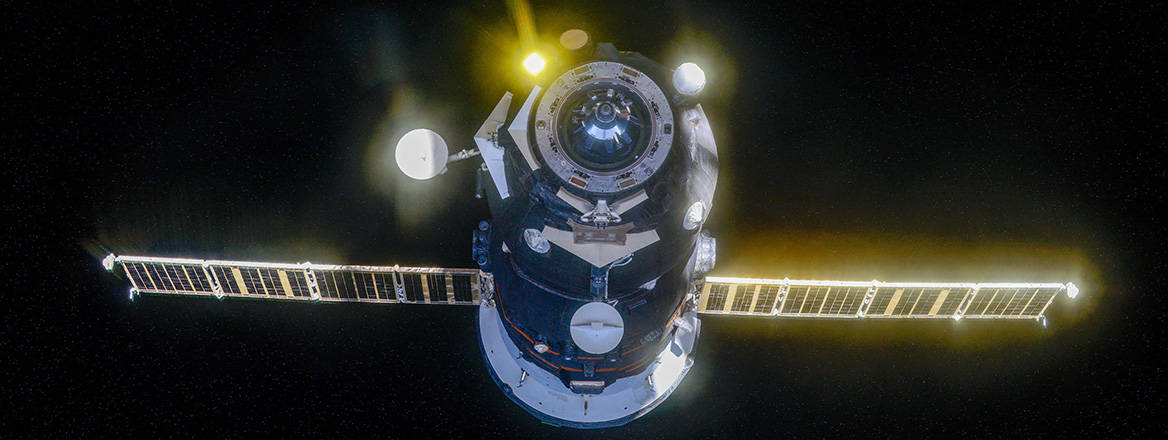
With unclear intention, Russia’s satellites have been placed curiously close to a commercial satellite that provides essential intelligence for the Ukrainian armed forces.
In late May, four Russian military satellites adjusted their position to match the orbital plane of the commercial radar reconnaissance satellite ICEYE-X36. The Russian satellites were declared to be for military purposes and launched in April 2026, with their exact capabilities unknown. The seemingly targeted ICEYE satellite is not just any commercial radar satellite – it is a Synthetic Aperture Radar (SAR) satellite from the Finnish company ICEYE whose data aid Ukraine. An orbital plane matching manoeuvre is costly and the positioning of four satellites at once seems highly intentional. The question is: why would Russia perform such a manoeuvre and what are the possible motives?
Possible Motive One: Intimidation
Russia is no stranger to intimidation tactics, either on the ground or in space. Concealing manoeuvres in space is tricky to do and satellites can usually be identified – all alien puns aside, there is little risk of ‘little green men’ in space. However, very often the on-board capabilities of a satellite cannot be gleaned from the outside – unless external indicators, such as sensors, can be seen.
The type of manoeuvre as conducted by Russia can appear threatening because of what this could be a precursor to: the way in which the Cosmos satellites are currently positioned, a rendezvous and proximity manoeuvre (RPO) could be conducted with relatively little warning. RPOs can be conducted for a number of reasons, such as getting close enough to photograph a satellite to gauge its potential capabilities, or to intercept/listen into signals being sent to and from the satellite. These signals can also be interfered with and disrupted. Further, satellites could be physically harmed.
Part of the intimidation motive could have been to spook the operators sufficiently to move the satellite – a move that would adjust its coverage area (currently set to support Ukrainian Armed Forces as best as possible) and to further expend costly fuel. However, ICEYE-X36 does not appear to have moved.
The physical destruction or even interference of a satellite would cross a red line that Russia (and in fact, no other space actor) has previously crossed
It seems unlikely that Russia would use four brand-new satellites and use vast amounts of their on-board fuel simply for the sake of intimidation. The fuel aboard a satellite dictates its lifetime and is essentially the currency of space operations. ‘Wasting’ it on a political objective thus seems disproportionate. The Cosmos satellites could also be one-way satellites with a singular mission. However, the cost of this again speaks against intimidation alone as a goal. Especially since Russia’s space industry is in dire straits. This points to other potential reasons.
Possible Motive Two: Non-Kinetic Interference
Russia could be positioning its satellites closely for the purpose of intelligence gathering or jamming satellite communications – the data that ICEYE-X36 sends back towards the ground station. It seems unlikely that Russia would position a satellite to photograph and gain further information about X36, as it is a commercial asset whose resolution and capabilities are publicly known. It thus seems more likely that Russia is trying to intercept the ICEYE data, potentially to use it for their own military operations but also to deny Ukraine the advantage of radar data. Satellite data, including radar images, which capture the situation on the ground unhindered by darkness or adverse weather conditions, have enabled the Ukrainian military in their targeting operations. According to the Ukrainian Ministry of Defence, 38% of ICEYE data contributed directly to strikes.
While ICEYE-X36 is not the only ICEYE satellite that the Ukrainian Armed Forces have access to, there is further symbolic value in seemingly threatening part of the constellation that enables Ukrainian targeting. The interference and even temporary loss of data from the satellite would nonetheless have an impact on operations – even if the loss can be supplemented through further ICEYE data or radar and optical images from supporting states.
Possible Motive Three: Kinetic Interference
Lastly, kinetic interference and the physical destruction of X36 cannot be excluded entirely but seems unlikely at this point, although open source data suggests that Russia is capable of firing projectiles in space, and is thus capable of co-orbital physical interference. With the current positioning of the Cosmos satellites, a damaging RPO could also be conducted with little prior warning. However, the physical destruction or even interference of a satellite would cross a red line that Russia (and in fact, no other space actor) has previously crossed. Destructive tests have been conducted several times (including by Russia), however the weapon systems were always tested against the actor’s own systems.

Help your search results show more from RUSI. Adding RUSI as a preferred source on Google means our analysis appears more prominently.

Stay up to date with the latest publications and events from the Military Sciences Research Group

While such an attack would present an escalation, the question arises whether Russia would also consider it as such. Only several months after the large scale invasion in 2022 did a senior Russian official warn that commercial satellites presented ‘a legitimate target for a retaliatory strike.’ Furthermore, Russia may consider the current political dynamics to favour non-escalation by other actors in response to the attack. For one, it may consider the US to be too pre-occupied with Iran to react, especially given that the commercial satellite does not belong to a US entity. Russia may further be calculating that NATO would not react to the destruction or interference of a commercial satellite by invoking Article 5, despite the fact NATO has declared space an operational domain and that Article 5 was adjusted to include space accordingly. In this way, Russia may have selected X36 as a potential target to test the boundaries of space operations.
Potential Responses
The range of options for the protection of the ICEYE satellite are currently limited and the defence and protection of satellites presents a famous dilemma. This is the case especially for satellites that are already in orbit, since adjustments to the hardware are difficult (though not altogether impossible). The key to a safe and protected satellite system generally lies in resilience and the creation of redundancies. Given that it is a commercial asset, it is likely that X36 does not have defence mechanisms on board which it could deploy in case of attempted interference. Given its relatively small size and weight at under 100 kg, it likely also does not have masses of fuel reserves that would allow it to evade its avid observers.
The scenario of non-kinetic interference, with the goal of at least temporary loss of data for Ukraine, seems the likeliest motive for Russia at this point in time. The political goal of intimidation is secondary, but nonetheless important. Regardless of Russia’s true intent for the manoeuvre, this move was also meant to showcase that space assets in the service of Ukraine cannot be considered safe and could come into Russia’s firing line at any moment. The warning is further meant to reach European states and NATO, to say that commercial companies can be targeted at will. This also carries significance for NATO, who have integrated ICEYE data into their reconnaissance infrastructures.
© RUSI, 2026.
The views expressed in this Commentary are the author's, and do not represent those of RUSI or any other institution.
For terms of use, see Website Terms and Conditions of Use.
Have an idea for a Commentary you'd like to write for us? Send a short pitch to commentaries@rusi.org and we'll get back to you if it fits into our research interests. View full guidelines for contributors.
WRITTEN BY
Juliana Suess
RUSI Associate Fellow, Military Sciences


- Jim McLeanMedia Relations Manager+44 (0)7917 373 069JimMc@rusi.org