

Canada Calling: Lessons for Europe on Confronting the Financing of Political Interference

Canada has dedicated considerable time and resource to the challenge. Europe could learn a lot from across the Atlantic.
For most of the past decade, discussion of political interference in Western democracies has focused overwhelmingly on information operations involving bots, trolls, on- and offline disinformation campaigns and cyber-enabled manipulation. Yet much of this activity is underpinned by a less visible and less understood, and thus less addressed issue, namely finance.
The financing of political interference, whether through covert donations, opaque influence networks, pressure on diaspora communities, front organisations, think tanks, media outlets or commercial proxies, is emerging as a fundamental national security challenge facing democracies. While attention in Europe has largely centred on Russian influence operations, Canada has spent recent years developing a broader and more mature understanding of the problem, particularly in relation to China, Iran and India. In doing so, it has begun to confront this less visible threat, boosting understanding and developing defences to confront the financial dimension of the threat political interference poses to the nation’s democracy.
Not All Malign Finance is the Same
At its heart, this understanding recognises that the paraphernalia and structures of financial integrity were not designed to detect or disrupt hostile state interference. Anti-money laundering (AML) regimes were built principally to identify the proceeds of crime and, latterly, terrorist financing and sanctions evasion. Hostile state activity often sits outside these categories. Money used to interfere with democratic systems may be entirely legal in origin, pass through regulated channels and involve actors that appear legitimate. The challenge for those in the public and private sectors that steward the integrity of the financial system is not, in this case, to identify illicit finance, but to detect the malign intent of those that attempt to abuse the financial system in pursuit of democratic interference.
Canada’s experience demonstrates both the scale of the challenge, and the importance of including, a financial dimension to democratic resilience frameworks.
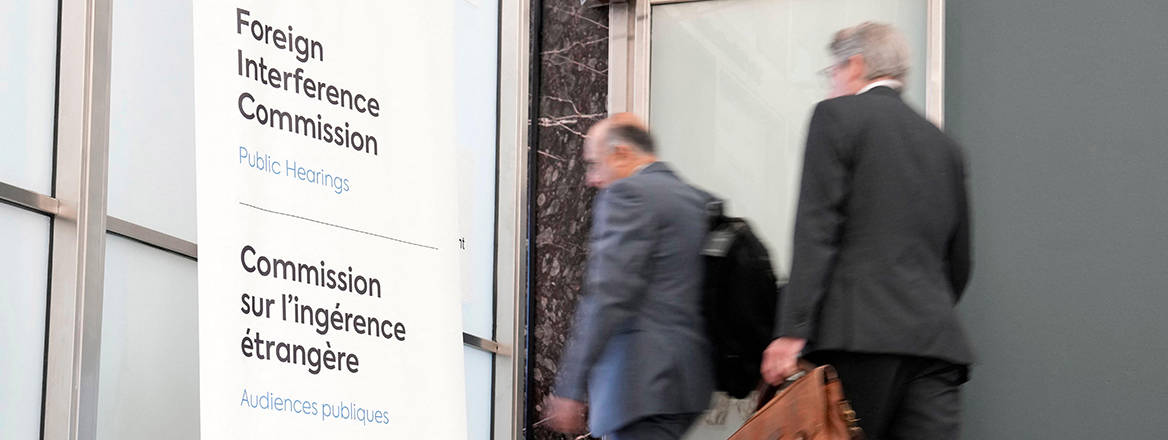
At the centre of Canada’s recent efforts has been the country’s Public Inquiry into Foreign Interference in Federal Electoral Processes and Democratic Institutions. The enquiry emerged following mounting public concern regarding alleged Chinese interference in Canadian politics and elections. Beyond addressing the specifics of electoral malpractice, the enquiry helped catalyse a broader national conversation about the nature of foreign interference itself, exposing the extent to which hostile states operate continuously, not merely during election campaigns, to manipulate democratic outcomes and public debate.
Influence operations through shaping narratives, cultivating relationships, funding intermediaries and influencing communities occur long before votes are cast.
Thus, one of the most important lessons is that political interference is not a periodic electoral threat, but must be viewed as a permanent operating condition, present 365 days a year. The response must be equally intense.
Recognising this, Canada has moved from temporary election-focused coordination mechanisms towards more permanent structures for monitoring and responding to interference threats. This reflects a recognition that influence operations through shaping narratives, cultivating relationships, funding intermediaries and influencing communities occur long before votes are cast.
Furthermore, beyond a focus on a narrow electoral-related definition of interference, considerations and responses need to confront transnational repression, economic coercion, manipulation of diaspora communities, influence of academia and think tanks, local-language media capture, and strategic investments that create political leverage.
This broader framing is important because hostile states rarely compartmentalise their activities. Financial interference, information manipulation, cyber activity and commercial engagement often operate together as part of a wider hybrid strategy.
Conseils Pour l'Europe
For Europe, Canada offers a highly relevant lesson. The awareness of political interference in London, Brussels and member state capitals is rising, and parliamentary enquiries are calling for evidence. Debate itself, especially in the EU, is increasingly weaponised by politicians for domestic narratives and hence action remains slow and hindered. It is also heavily shaped by a single (though still significant) threat – Russian activity covering sabotage operations, disinformation campaigns, cyberattacks and electoral manipulation. These are real and growing challenges, and while the EU is addressing all of them with varying degrees of success, Canada’s experience with Chinese influence operations offers more comprehensive insights into forms of interference that are more subtle and embedded within legitimate economic and social structures.
Indeed, several Canadian officials and researchers these authors met during a recent roundtable discussion in Ottawa argued that the principal challenge lies not in identifying a single ‘smoking gun’, but in understanding the cumulative impact of sustained influence efforts over time. Put differently, democracies are like the proverbial frog in boiling water, unaware of the threats they face until it is – potentially – too late.

This is particularly evident in relation to diaspora communities where researchers have documented how hostile states allegedly pressure communities through intimidation, coercion and threats directed at family members overseas. Financial measures, including the freezing of family assets, have reportedly been used to punish activism, including within Canada. Yet even in Canada where considerable time and effort have been invested by the government in illuminating foreign political interference, participants at the Ottawa roundtable acknowledged that understanding of the financial structures supporting influence operations remains scant, despite being key to detecting and disrupting the threat.
A New Dimension to Illicit Finance
For decades, at the urging of global organisations such as the Financial Action Task Force (FATF), governments have invested heavily in monitoring illicit finance connected to organised crime and terrorism. Until recently, considerably less attention has been paid to the financial mechanisms enabling hostile state interference. This creates vulnerabilities that both sophisticated state and non-state actors can exploit. Canada’s financial authorities are in the vanguard of confronting precisely this challenge.
One of the most notable developments has been the extension of expectations placed upon financial institutions. Canadian authorities have increasingly signalled that the regulated sector should consider foreign interference risks as part of their broader integrity and security obligations.
This represents a significant evolution in thinking. Traditionally, financial institutions have been expected to identify criminal proceeds, sanctions evasion or terrorist financing. Asking them to consider hostile state interference activity requires a fundamentally different approach and creates immediate practical challenges. For example, what does financial activity linked to foreign interference actually look like? How should banks distinguish between legitimate foreign influence (for example trade and investment flows) and malign interference? What indicators should trigger concern? These are challenges that new legislation, government departments and communication are beginning to address in Canada.
By contrast, Europe continues to treat political interference and financial integrity as primarily separate policy domains. Intelligence agencies, electoral regulators, and financial supervisors frequently operate in parallel rather than through genuinely integrated frameworks, while hostile actors do not respect such bureaucratic distinctions.
The reality is that many of the same vulnerabilities exploited for money laundering and sanctions evasion can also facilitate political interference. Anonymous companies, opaque beneficial ownership structures, professional enablers, crypto-assets, informal transfer mechanisms and complex international networks all provide potential vectors for covert influence operations.

As recent discussions on crypto donations in politics in the UK illustrate, political finance legislation was largely designed for an earlier era. Most frameworks assume political influence occurs through direct donations to parties or candidates. Increasingly, however, influence flows through an ecosystem of actors sitting outside traditional political structures, including media platforms, influencers, advocacy groups, think tanks, online communities and commercial networks. Indeed, some of the most politically influential figures in democratic societies may hold no formal political office at all. This creates significant systemic blind spots and vulnerabilities that are open to (often legal) exploitation.
Widening the Lens
As is so often the case when confronting the financial dimension of security threats, the challenge is not addressed via bans, in this case on foreign engagement and investment, but in improving awareness, transparency, oversight and resilience.
Canada’s Foreign Influence Transparency and Accountability Act reflects this balancing act. It seeks to distinguish between legitimate foreign influence and non-transparent influence and covert interference. On the one hand, democratic societies rightly remain wary of introducing measures that could chill legitimate political participation or mirror the restrictive ‘foreign agent’ laws employed and weaponised by authoritarian states; but excessive caution and delay also carry risks. Democracies are already under attack via covert interference and as long as regulatory gaps exist, hostile actors will continue to exploit them.
The most important lesson Europe should therefore draw from Canada is conceptual rather than technical. Most critically, Europe needs to move beyond viewing political interference as a solely electoral issue. As with many contemporary national security threats, focusing on money flows can inform the design of effective responses. For example, the UK’s 2025 National Security Strategy underlines that ‘All elements of our security are supported by our ability to tackle illicit finance…’ including funds that underpin threats from hostile state actors. Foreign interference should be understood as one such threat.
Yet this broader understanding of foreign interference also exposes the limitations of current anti-illicit finance frameworks in addressing evolving national security threats. When it comes to combating illicit finance, most countries are led by the recommendations of the FATF and are striving to satisfy its regular assessments, but this risks overlooking the expanding array of national security risks that are facilitated by illicit finance. Canada has just undergone its most recent FATF evaluation, the result of which will be revealed later this year. Regardless of that outcome, while Canada has not solved this problem nor fully mapped the financial dimensions of foreign interference operating within its borders, it has at least recognised the scale and complexity of the challenge and mobilised across government and the private sector and feels more prepared to face the most serious financial threats to its democracy than its partners across the Atlantic in Europe.
Even if this response remains in its infancy and is only beginning to be operationalised, Canada has at least started building a practical response, while much of Europe remains caught in political and institutional debates over how the issue should be understood and addressed.
© RUSI, 2026.
The views expressed in this Commentary are the authors', and do not represent those of RUSI or any other institution.
For terms of use, see Website Terms and Conditions of Use.
Have an idea for a Commentary you'd like to write for us? Send a short pitch to commentaries@rusi.org and we'll get back to you if it fits into our research interests. View full guidelines for contributors.
WRITTEN BY
Tom Keatinge
Director, CFS
Centre for Finance and Security


Kinga Redlowska
Head of CFS Europe
Centre for Finance and Security

- Jim McLeanMedia Relations Manager+44 (0)7917 373 069JimMc@rusi.org