Trench Gascoigne Essay Prize 2026: Open for Entries
RUSI's annual competition for original writing on contemporary issues of national and international defence and security.


Dating back to 1874, the Trench Gascoigne Essay Prize reflects and reinforces RUSI's status as a leading platform for free-thinking debate on defence and security. Initially endowed by Colonel Frederick Richard Thomas Trench-Gascoinge (1851-1937), a British soldier, landowner and High Sherriff of Yorkshire, to encourage military officers to write, the prize now has wider appeal, and we are particularly pleased that our publisher, Taylor & Francis, has agreed to support the competition.

Essays are judged based on their originality, strength of argument, quality of analysis, style, clarity and conciseness.
This year's competition introduces several changes, so please read the information below carefully before submitting your entry.
Essay Prize Regulations
Eligibility
Essays must be submitted by candidates in one of following categories:
- Non-military students currently in full- or part-time education
- Individuals within the first 10 years of their regular or reserve military career
At the time of submission, candidates must fulfil the eligibility requirement.
We actively encourage applications from individuals of all backgrounds, including people of colour, women, LGBTQIA+ individuals, and people with disabilities. The competition is open to entrants of any nationality, but entrants must present their work in English.
Themes
While essays may cover any topic related to defence and security, entrants are encouraged to engage with one or more of RUSI’s thematic themes:
- Geopolitics and Global Security
- Military Sciences and Nuclear Policy
- Illicit Economies, Finance and Security
- Cyber, Tech and Resilience
- Energy, Climate and Security
Prizes
In each category:
- Winner: £1,000, publication of the winning essay in the RUSI Journal and one year’s RUSI membership
- Runner-up: one year’s RUSI membership
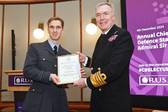
Winners will receive their award from the Chief of Defence Staff, Air Chief Marshal Sir Richard Knighton, at RUSI’s annual Chief of Defence Staff Lecture in December 2026.
All winners and runners-up will be notified by the end of November 2026.
Competition Rules
- Essays must be submitted as a Microsoft Word Document or PDF.
- Essays must come with a title and not exceed 4,000 words, excluding footnotes. Shorter submissions will not be penalised.
- Essays must only have one author. Multiple-author submissions are not allowed.
- Essays must not contain any text identifying the author, as judging will be conducted anonymously.
- Entrants must not have any unspent criminal convictions.
- RUSI permits the use of AI for generating images, sourcing initial background reading, translation from source language into English and rephrasing text to enable flow and basic proofreading. Entrants must disclose any use of AI in their essay.
- All submissions undergo routine plagiarism and AI detection checks. In line with standard plagiarism policies, RUSI does not permit entries which include research outputs produced wholly or in part by another person or generative AI and claimed as an author’s original work.
- Entries must be the entrant's original work and must not have been published elsewhere. Essays produced as part of study at universities or military staff colleges are eligible, provided they have not been previously published.
- Previous winners of the Trench Gascoigne Essay Prize are not eligible to receive a further prize.
Entries that do not comply with these rules will be disqualified.
Submission
Entries can be submitted via the form below or emailed to trenchgascoigne@rusi.org with the subject line ‘Trench Gascoigne Essay Prize’.
Please include:
- Full name
- Full rank (where applicable)
- Postal address
- Which prize category the essay is being entered for
- AI declaration (if applicable)
Judging Panel
This year, our judging panel will consist of Lieutenant General Sir David Capewell KCB OBE, Distinguished Fellow, RUSI, and former Chief of Joint Operations, Ministry of Defence; Air Vice Marshal Peter Dye OBE, former Director General, Royal Air Force Museum; Rosalind Roberts, Director of Research, RUSI; and Georgina Lee, Portfolio Manager for Politics, International Relations, Strategic Studies and Law Journals at Taylor & Francis.
Deadline
The deadline for submissions for the 2026 Essay Prize is Saturday, 31 October 2026, at 23:59 GMT.
For further information, please email trenchgascoigne@rusi.org.


Previous years' prizes
See the winners from previous years.







Read the previous years' winning essays
2025 Winners: Scott Mackie and Yazan Issa

2024 Winners: Daniel Skeffington and Flt Lt Tim Shortland


2023 Winners: Reilly Joseph and Turner Ruggi

2022 Winner: Maurizio Recordati Koen

2021 Winner: William Parker

2020 Winner: William D James