

What are China’s New Wolf Warriors Really Fighting For?

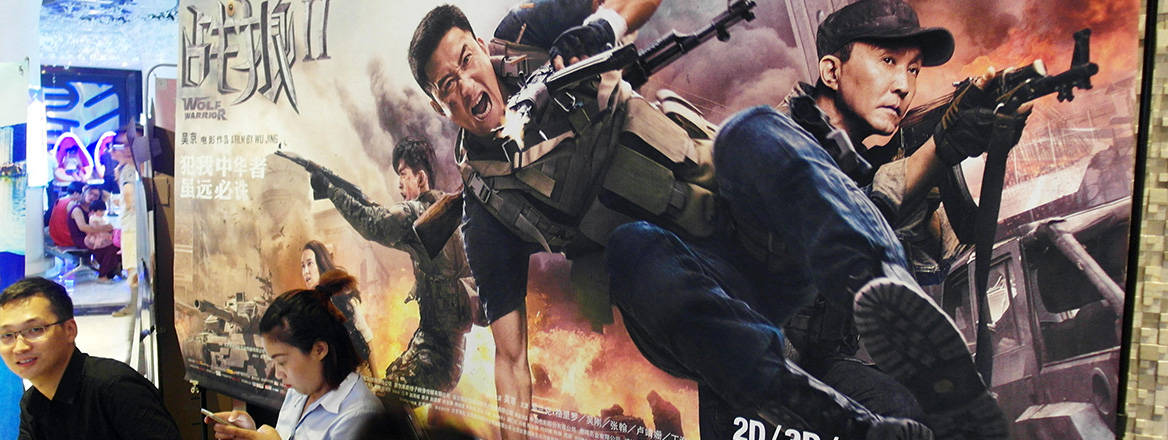
The recent return of China’s ‘wolf warrior’ diplomats has more to say about domestic pressures than about external challenges to China’s rise.
On 24 January, China’s Ministry of Defence announced it was investigating two members of the powerful Central Military Commission, the country’s supreme military leadership body. The removal of Zhang Youxia, China’s highest-ranking general, along with Liu Zhenli, leaves the Commission with merely two members (President Xi Jinping and one uniformed official) to head and manage China’s People’s Liberation Army. This internal fracture in China’s military apparatus contrasts with the recent external assertiveness of its foreign policy community.
Its culmination came last November, with the return of China’s infamous ‘wolf warriors’, confrontational diplomats who had made themselves first known through fiery rhetoric during the Covid pandemic. Consul General in Osaka Xue Jian posted the following tweet in response to Japanese Prime Minister Sanae Takaichi’s position on military support for Taiwan: ‘The only thing to do is cut off a dirty neck without a moment’s hesitation. Are you ready for that?’
Such language, combined with support from China’s Foreign Ministry, whose spokesperson asked, ‘Where does Japan intend to take China-Japan relations?’, successfully framed the debate in terms foreign to China’s domestic politics, shifting attention to the regional balance of power.
Yet this risks obscuring the deeper internal causes for Chinese diplomats’ ;initial reactions to Takaichi’s stance. Turning our attention to China’s politics in analysing this episode instead provides key insights: aggressive rhetoric provided relief for a foreign policy-making system under intense political pressure and thus serves as useful indication of the varying levels of constraint felt inside China.
Living Up to China’s Ambitions
The political institutions of the Chinese party-state have undergone major change under President Xi Jinping, aimed in large part at strengthening the role of the Chinese Communist Party (CCP) in decision-making. The Ministry of Foreign Affairs (MFA) is no exception, with Xi Jinping stating in 2018 that ‘diplomacy of socialism with Chinese characteristics for a new era’ (a phrase that refers to Xi’s political doctrine) must ‘uphold the authority of the [CCP] Central Committee as the overarching principle’. In 2019, the appointment of Qi Yu, an outsider to foreign affairs, as party secretary of the MFA coincided with probes from the Central Commission for Discipline Inspection, which eventually gave a ‘failing grade’ to the ministry, citing a lack of adherence to new directives under Xi’s doctrine. This episode shows the direct pressure applied to diplomats to fulfil Xi’s vision and has been linked to the first emergence of wolf warrior tactics.
The comeback of a policy clearly linked to his diplomatic vision will have sent a clear signal of strength from Xi to the Party’s leadership
Success in foreign policy is indeed critical to Xi Jinping’s relevance and legitimacy as a leader. In Xi’s own framing, China is on a trajectory from ‘standing up’ under Mao Zedong to ‘becoming rich’ under Deng Xiaoping, to ‘becoming strong’ under him. China has abandoned the previous policy of ‘hide your strength, bide your time’ in favour of a more assertive stance, often referred to as ‘major-country diplomacy’. Yet China’s economic, technological or military progress has at times encountered obstacles that threaten to place the country in strategic overreach. Chinese diplomacy must now square the circle of projecting continued strength while managing necessarily limited resources.
Channelling Nationalist Sentiment
To this end, wolf warrior tactics ease urgency and provide room for a calibrated and timed response while contributing to shaping the image of a confident China both abroad and at home. Recent reforms to China’s propaganda system have emphasised synergy between ‘internal’ and ‘external’ propaganda, taking into account the importance of a coherent narrative in the information age. This has been instrumental in managing popular nationalism. China’s communist leaders have benefited from nationalist sentiments, but they have been careful to channel them towards desired objectives and to prevent bottom-up expressions from taking over, instead advocating for a top-down approach where the state is responsible for defending China’s interests. Wolf warrior diplomats play a decisive role in channelling and expressing aggression in the face of perceived challenges to China’s position.
Japanese Prime Minister Takaichi’s recent statements on Taiwan were a challenge in two ways. First, by giving her legal assessment on the right of Japan to intervene in a Taiwan contingency, she has weakened barriers to such an intervention and has provided a timely demonstration of will after a year marked by American efforts to obtain clearer ally commitments. This has directly contradicted the image of an abandoned Taiwan, unable to rely on its partners. Second, by doing so, she has provided further grounding for expansions in Japan’s defence budget. For China’s domestic audiences, this directly contradicts two foundations of the CCP’s legitimacy: on the one hand, the CCP founded the People’s Republic of China a few years after participating in the defeat of the Japanese Empire which restored Chinese sovereignty, on the other hand the ‘reunification’ of Taiwan would constitute the final stage in the reassertion of China’s territorial integrity by the CCP.
Building Institutional Cohesion
Consul General Xue Jian’s rhetorical escalation provided an opportunity to channel national resentment at Japan’s geopolitical influence over Taiwan and the region and to reaffirm China’s status in dealing with its neighbours. This show of strength was also possibly aimed at China’s wider foreign policy community, which has been operating in a climate of renewed political mobilisation, contrasting with a hollowing of the decision-making power of its ministry. Xi Jinping has indeed been calling for civil servants to ‘dare to struggle’, dedicating themselves to the Party’s vision. Yet he has also taken away their capacity for initiative by elevating the role of the CCP’s Central Foreign Affairs Commission. This turn in favour of Party institutions has been highlighted by a crisis in the promotion of civil servants. Following the purging of Minister Qin Gang after a mere eight months in office, suitable candidates for succession have been lacking and former Minister Wang Yi has been forced to return despite his advancing age.

These personnel issues find echoes in the People’s Liberation Army (PLA), where similar issues have impacted combat readiness and reform progress. Three waves of purges in military leadership from 2023-2025 notably left the Central Military Commission (CMC, supreme military leadership body) missing three of its seven members, while the minister of Defence has exceptionally not been promoted to the CMC, breaking with precedent and reducing his authority. Overall, with institutional cohesion at risk within both the MFA and PLA, the return of wolf warrior diplomacy sets an example of dedication to the Party’s goals and of confidence in spite of constraints.
Strengthening the Party’s ‘leadership core’
While not unusual under Xi’s anti-corruption drive, 2025 purges have been linked to wider struggles within the CCP leadership and the return of wolf warrior diplomats may have played a signalling role within Chinese elite politics. Purges in the PLA have affected the balance of power between groups that had been promoted under Xi Jinping. While it is unclear whether Xi is behind the purges or whether they are the result of a pushback from party elders, they have effectively removed actors that had been elevated by Xi in an attempt to gain tighter control of the PLA. Perhaps even more consequential, Xi appeared to take a slight step back from the forefront of politics earlier in 2025. A significant measure of a leader’s prominence, references in official media to Xi Jinping and his signature Xi Jinping Thought were unusually omitted from key articles. Meanwhile, mentions of ‘collective leadership’ started to appear, an allusion to the practice of power sharing that had ended with Xi’s centralisation of authority as ‘leadership core’.
Xi has since returned to prominence, but the lasting impact of a potential challenge to his authority may have been determining in the revival of wolf warrior tactics. The comeback of a policy clearly linked to his diplomatic vision will have sent a clear signal of strength from Xi to the Party’s leadership. Conversely, showing themselves as willing to support such a message may helpfully position high-ranking diplomats amidst the fallout of recent power struggles, advancing their profiles in the event of ongoing promotions and purges.
In January 2026, a mere two months after Xue’s post, General Zhang Youxia was placed under investigation for ‘suspected serious discipline and law violations’. China’s highest-ranking general and variously described as Xi Jinping’s rival or ally, Zhang has been linked to last year’s controversial mentions of ‘collective leadership’ in China’s official press. While China showcased its advantages through retaliatory export controls against Japan, its initial response to Prime Minister Takaichi was likely shaped to a large extent by domestic constraints, after a year of turmoil for its foreign policy communities and power struggles within the Party’s leadership. Wolf warrior diplomats plausibly acted as a pressure safety valve for China’s highly contentious foreign policy-making process, while also sending a strong signal of strength to the country’s leadership. By doing so, they have provided insights into the layered network of demands that constrain China’s strategic calculations. While China’s fiery rhetoric focused concerns towards a possible escalation, wolf warrior diplomats probably revealed more about the state of China’s domestic politics than about its plans for containing Japan.
© Ange Vaucher, 2026, published by RUSI with permission of the author.
The views expressed in this Commentary are the author's, and do not represent those of RUSI or any other institution.
For terms of use, see Website Terms and Conditions of Use.
Have an idea for a Commentary you'd like to write for us? Send a short pitch to commentaries@rusi.org and we'll get back to you if it fits into our research interests. View full guidelines for contributors.
WRITTEN BY
Ange Vaucher
Guest Contributor


- Jim McLeanMedia Relations Manager+44 (0)7917 373 069JimMc@rusi.org