

Understanding the Relaxation of Japan’s Defence Export Rules

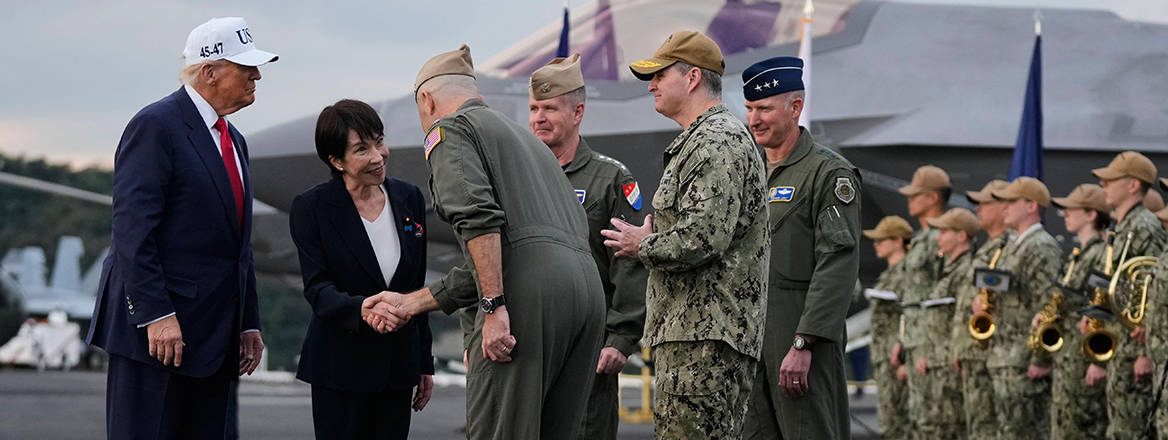
Takaichi is doubling down on the strategic bet made by Abe, that the benefits of a more self-reliant defence posture and engaged international security role outweigh the costs.
The announcement on 21 April that Japan has relaxed self-imposed limits on exporting lethal weapons comes as just one more sign that the country is breaking with foreign and security policy principles it largely followed since the 1950s; rely on the US for military security and maintain minimal armament in order to focus on economic growth, while avoiding involvement in international disputes. Despite the fact this so-called ‘Yoshida Doctrine’ (after post-war PM Yoshida Shigeru) has been dismissed as ‘an analytical concept created by researchers to justify Japanese foreign policy in the 1980s’, this divergence from the ‘Yoshida line’ remains significant and raises three questions: Why has the shift accelerated? Where is Japan headed? What does it mean for Japan’s friends and adversaries?
The details of this policy change have been ably explained elsewhere. In sum, it brings Japan to a position where it is not substantially any more restricted than most other countries on the export and joint development of lethal weapons. Remaining caveats and exceptions are largely at the discretion of the Prime Minister and cabinet, and do not even require prior legislative approval.
Why this Acceleration Away from the ‘Yoshida Doctrine’?
First, through no fault of its own, Japan’s security environment has gone downhill in the two ways the character in Hemingway’s The Sun Also Rises went bankrupt: ‘Gradually and then suddenly.’ It began from 2003 when North Korea left the Non-Proliferation Treaty. Reflecting the good state of relations at the time, China and Russia initially collaborated with Japan and others through the UN to halt Pyongyang’s nuclear and ballistic missile programs. Two decades on, the situation is reversed with Russia and China using their veto in 2022 to protect nuclear-armed North Korea from international sanctions. This leaves Japan, without a nuclear deterrent of its own, facing three nuclear-armed neighbours, each pursuing territorial claims (Takeshima, Northern Islands, Senkaku) at Japan’s expense, operating closer together on defence than at any time since the days of Yoshida’s leadership. There may be no Korean War now, but North Korea and China have launched missiles over Japanese airspace and into Japan’s exclusive economic zone, respectively. Pyongyang’s troops fight alongside Russians against Ukraine, while friends ‘without limits’ China and Russia mount joint patrols around Japan with nuclear-capable bomber aircraft and ships. Understandably, Japan feels more threatened.
Second, China’s military build-up has tilted the regional military balance against Japan’s security guarantor. The commitment in President Trump’s 2026 national defence strategy to deter China on the first island chain might be reassuring had the ‘pivot’ to Asia lived up to the rhetoric. Washington is racing to catch up, but making help to allies conditional on how much they spend on defence or whether they support ‘excursions’ like that against Iran. It is a logical deduction that if American forces were attacked during a Taiwan crisis and Tokyo did nothing the alliance would ‘collapse’. To help deter a war it would be pulled into, Japan needs the capacity to contribute more to collective deterrence, to diversify alliance relations, and be more self-reliant.
The industry’s sluggish response to the stimulus of higher defence spending since 2022 reflects scepticism about longer term spending commitments
Third, the landslide victory Japan’s electorate gave Japanese Prime Minister Sanae Takaichi in February 2026 meant she no longer needs the Komei party, which had opposed many of her Liberal Democratic Party’s (LDP) security policy proposals as coalition partner. This unleashed a torrent of dammed-up reform initiatives not just on the relaxation of arms exports but on rationalisation and enhancement of Japan’s intelligence capability, and constitutional revision, an LDP ambition since the party’s foundation in 1955. Pre-election talk of scrutinising Japan’s three non-nuclear principles has faded away, but Takaichi brought forward the national security strategy update, which will be delivered this Autumn. Takaichi’s success running on this reform program suggests that the Japanese public expects stronger defence and – up to a point – is willing to pay for it. It is more divided on revising the constitution.
If changes over the last quarter century mean the residual elements of the ‘Yoshida doctrine’ – rely on America, economic growth before defence, stay out of international disputes – are no longer tenable, what’s Japan’s alternative?
Where is Japan Headed?
The logic behind this relaxation of arms export and co-development rules is connected to five trends that indicate Japan’s direction of travel.
First is that Japan needs a defence capability that is more autonomous, but still affordable. Its defence industry must therefore be free to capture economies of scale through access to overseas markets. Over recent years, many Japanese firms have withdrawn from defence due to low profit yields because they could only sell to one customer (Japan’s MoD). The industry’s sluggish response to the stimulus of higher defence spending since 2022 reflects scepticism about longer term spending commitments. Tokyo’s plans to publish its first national defence-industrial strategy later this year signals this rule change on arms exports is one element of a more holistic solution.
Second, as set out in a recent RUSI Journal article, the only way for middle powers to affordably acquire top-tier technological advantage is to pool some of the costs of research and development. The revised rules expand Japan’s freedom of action on international defence equipment development through projects like AUKUS pillar II, GCAP and production of Mogami Frigates with Australia. The ability to export finished defence products manufactured under licence in Japan to the licensor country will be expanded from the US to the full range of partners, increasing defence manufacturing opportunities and technology transfer benefits for Japanese firms.

Third, the instrument of defence equipment transfer adds to the tools supporting diversification of Japan’s diplomatic relations and sharpening its influence. Lethal weapons can now be shared with 17 countries with which Japan has Equipment and Technology Transfer Agreements (ETTAs): Australia, Bangladesh, France, Germany, India, Indonesia, Italy, Malaysia, Mongolia, the Philippines, Singapore, Sweden, Thailand, the United Arab Emirates, the UK, the US and Vietnam. There is also an ETTA with Canada, signed in January 2026. Although Ukraine is not yet on this list, Japan can now assist indirectly in the category of lethal weapons by ‘backfilling’ (in other words, re-stocking the inventory of countries sending weapons to Kyiv).
Fourth, and strategically related to the previous two points, Japan is shouldering a regional security role in response to changes in the military balance and the terms of alliance relations. Arms transfers enable countries like the Philippines to enhance military capability while mitigating the risk of over-dependence on the US. Levelling up the fighting power of like-minded countries along the first island chain (essential to Japan’s sea lane security) makes it less likely that a perception of weakness will encourage aggression by an over-confident China.
Fifth, taking the relaxation of these rules in context with concurrent taboo-breaking reform initiatives (constitutional revision, intelligence reforms, the return of pre-1945 military ranks, etc.), the constraining effect of Japan’s Imperial-era legacy on its agency as an international actor appears to have a diminishing half-life. The population shows no sign of aggression, and both anti-nuclear sentiment and aversion to overseas deployments remain robust. However, the Japanese people are reasonably convinced that the deterioration in their security environment means heeding the warnings of history does not mean turning a deaf ear to the warnings of present.
What Does it Mean Beyond Japan?
China, for one, has decided that this means nothing good, judging from a sharp two-pronged response.
One response is an economic coercion campaign to handicap Japan’s defence industry, and to cause investors and large corporate interests a conflict of interest where they have to choose between support to Japanese policy and business with China. On 24 February 2026, China placed 20 Japanese entities on its watch list and an additional 20 companies on its control list, with the latter having extra-territorial application. According to China's Ministry of Commerce (MOFCOM), PRC exporters must submit a risk assessment report and a written commitment that items will not be used for any purpose that could enhance Japan's military capabilities. Japanese companies affected by these sanctions include entities affiliated with major manufacturers involved in defence, such as Mitsubishi Heavy Industries, Kawasaki Heavy Industries and IHI.
Japanese military power is sincere (and it may be), it could be counted as a positive for deterrence at a moment when allies are unsure about US reliability and capability
Second, Beijing has amped up the information campaign launched following Takaichi’s November 2025 comments on Taiwan, casting her defence reforms as indicative of a dangerous trend of ‘re-militarisation’ or ‘neo-militarism’. Chinese diplomats, state media and social media proxies have produced a slew of material that coheres around three narratives. First, Japan has elected a far-right leader who is bringing Japan back onto a ‘fascist and militarist pathway’. Second, this threatens not only regional peace but even the post-war order, because Takaichi’s remarks on Taiwan indicate the intention behind reform is ‘to pave the way for military expansion’. Third, the reforms ‘sabotage’ institutional safeguards designed to prevent the revival of Japan’s militarism and so violate terms of Japan’s 1945 surrender. The implication is that this provides a moral or even legal basis for unilateral action to prevent Japan from fulfilling its dangerous ambitions.
The campaign is not working, judging from the welcome Takaichi just had in Australia and Vietnam, where she presented an updated version of the ‘Free and Open Indo-Pacific’ concept, emphasising cooperation on supply chains, energy and security. Following the largest participation by Japanese forces in a military exercise with the Philippines, Minister of Defence Koizumi just returned from Indonesia with a new bilateral defence cooperation agreement. Koizumi and his counterpart Sjafrie Sjamsoeddin ‘concurred on the direction of cooperation in the field of defence equipment and technology’. The region is buying what Japan is selling more than what Beijing is saying.
Beijing’s global communication plan may be a flop, but venting hate on Takaichi is a safe way for Chinese nationalists to blow off steam without destabilising relations with the Americans. If China’s concern about Japanese military power is sincere (and it may be), it could be counted as a positive for deterrence at a moment when allies are unsure about US reliability and capability. A pessimistic analysis is that China’s Communist Party is constructing a moral justification for ‘teaching a lesson’ to Japan as an example to others and to expose a stretched US as a feckless ally.
From the point of view of Japan’s Enhanced global strategic partner the UK, the full entry into international defence industry competition offers obvious benefits by expanding the scope for projects like GCAP and providing a welcome added-capacity to defence industrial production at a time of scarcity among allied and like-minded states.
The drawbacks are minor, but worth noting. As Japan’s presence on the international defence market grows, commercial competition may bleed over into political rivalry with allies such as South Koreans. Current analysis notes capacity limits and workforce shortages will challenge indigenous delivery. PM Takaichi is not presenting this as a choice of Guns or butter, but industry caution over sustainable funding is understandable. Growing pressure on Japan’s fiscal and monetary position from the compounding effects of the Hormuz crisis will drive Japan to realise affordability and influence through partnership with a widening group of like-minded countries.
© RUSI, 2026.
The views expressed in this Commentary are the author's, and do not represent those of RUSI or any other institution.
For terms of use, see Website Terms and Conditions of Use.
Have an idea for a Commentary you'd like to write for us? Send a short pitch to commentaries@rusi.org and we'll get back to you if it fits into our research interests. View full guidelines for contributors.
WRITTEN BY
Dr Philip Shetler-Jones
Senior Research Fellow, Indo-Pacific Security
International Security


- Jim McLeanMedia Relations Manager+44 (0)7917 373 069JimMc@rusi.org