

The UK's Defence Investment Plan Has a Lethal Drone Swarm Vision

Drone swarming is often referenced as an important future capability, with little understanding of what is possible today, and how the tactic is enabled.
Drone swarms feature strongly in the UK’s Defence Investment Plan, which promises to ‘deliver operational impact through AI-enabled swarms.’ The tactic has captured the imagination of defence planners and Hollywood for decades, but there is far more to swarming than the science fiction trope.
Swarms are better understood as a collection of different software, firmware and hardware which enable a single operator to control multiple platforms on land, sea or in the air. Modern software-defined warfare is critical here, and will shape procurement of components and inputs which is seen as more important than the shape of the platform, be it an uncrewed ground, air or surface vehicle.
Defining the Swarm
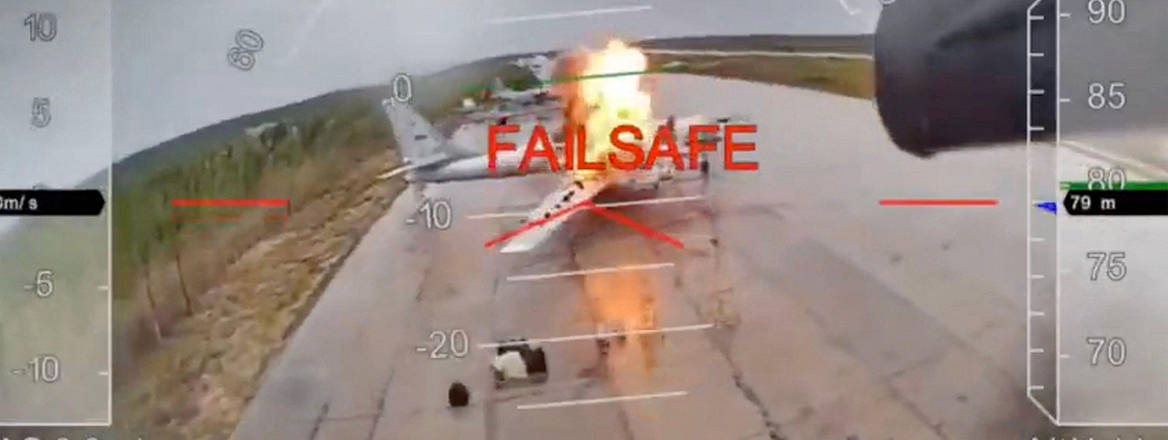
Despite ongoing work on advanced ‘swarm intelligence’ current technology is best described as Single Operator, Multi-Platform (SO-MP) operation. To an extent ‘swarms’ have been demonstrated in live fire trials but have not been used on any meaningful scale on Ukraine’s battlefields. That said, 2025’s Operation Spiderweb strike on Russian strategic bombers – a swarm-like attack involving machine-vision and autopilot software – is one indicator of the technology’s potential.
Some may be tempted to look at Ukraine’s lack of battlefield swarming – groups of collectively intelligent drones that autonomously react to new situations – as a test of whether it carries value. This would be a major oversight for three reasons.
First, it overlooks the leaps in technology that enable SO-MP operations, allowing resilient networking of uncrewed combat, logistics and potentially engineering systems. Groups of unpredictably routed platforms can be sent across the depth of the battlefield or deployed in littoral strike with minimal operator training, relevant in situations beyond Ukraine.
Secondly, focusing on ‘swarms,’ of quadcopter attack drones on land is a narrow approach. One ground control team, or even one operator, directing tens of larger fixed wing drones for deep strike using a mission planning app reduces planning time in large salvo attacks. Lacking this software, there is evidence that Russian salvos of hundreds of drones are less efficient than smaller salvos.
SO-MP approaches promise to act as a force multiplier, but this is only possible if the UK can overcome reluctance to procure drones, something which stems from fears that the platforms will rapidly become obsolete
Thirdly, there has been much work launching multiple drones from uncrewed ground systems and uncrewed surface vehicles. This could complement a high-low munitions mix, presenting serious dilemmas for defending forces in littoral regions. This has been glimpsed in the successful employment of the tactic in Ukraine where small UAS launched from USVs have destroyed costly air defences, the kind of raids once undertaken by commandos in inflatable boats.
These tactics were once dismissed as too difficult due to signal collision in the electromagnetic spectrum. Software development for intra-swarm communication and smart signal management have changed this dynamic.
Focusing on collectively intelligent, fully autonomous swarms misses near term gains. Even without total autonomy, it is not technically challenging to imbue a salvo of drones controlled by one operator with some ability to automatically respond to threats, for example re-routing or returning to the operator when encountering electronic warfare.
Critically, improving software enables uncrewed vehicles to act as a system. The fact that we have seen this to an extent in Ukraine suggests we may be on the way to the combat swarm, recently described by a Ukrainian specialist to this author as ‘the holy grail’.
The Long Road to Swarming
Swarming has long been thought of as a peer conflict phenomenon: visions of clouds of Chinese drones (sometimes based on light shows which are entirely pre-programmed) being weaponised in a Taiwan invasion. However, early discussion of the tactic in the mid-2000s focused on counterinsurgency. Logistics convoys in Iraq and Afghanistan were vulnerable to IEDs, but having accompanying soldiers in gun turrets to look for roadside markers of IEDs exposed them to snipers.
Early experiments at MIT in 2006 described as ‘swarms’, took weeks to plan. Small numbers of drones were fed data from a ground control computer, working in a partially collaborative way to keep scanning for trouble. But they lacked autonomy due to a lack of embedded data processing, which remained the case until around a decade later. From the outset, the idea was met with scepticism, with one 2007 study predicting that even with perfect autonomous systems, no more than five vehicles could reliably be controlled (it is possible to do this with 100 drones today).

Early scepticism did not stop work on control algorithms, for example, for autonomous landing. Open-source software has seen countless iterations since, and was a critical enabler of Operation Spiderweb using 117 partially autonomous drones to strike Russian strategic bombers. In other words, an ecosystem of commercial software, over nearly two decades, paved the way for military-specific applications.
The mid-2000s saw the emergence of compact, commercially available object recognition technology in the form of cameras like the Canon IXUS 75. Niche trends – expensive commercial cameras and hobbyist software were the building blocks of autonomous warfare at scale, following decades of work on deep learning, including DARPA research.
Significant algorithmic breakthroughs occurred in 2015 with the You Only Look Once (YOLO) framework for object detection which more than doubled the speed of object recognition. That year, Naval Postgraduate School researchers were able to control 50 drones from one ground control station, but a lack of onboard computation remained the constraint until 2015, when graphics chip card company Nvidia released the TX1 system on a chip (SoC).
This dramatically accelerated experimentation with robotic manoeuvre. Increasingly sophisticated software such as PX4 fused ground control with autopilot software and machine vision. By late 2016, TX1 chips were used in a demonstration of 100 fixed wing Perdix drones launched from an F-18. Interceptor drones were demonstrated hunting down other drones with this improved machine vision, nearly a decade before their use in Ukraine.
While impressive, the TX1 was built using the 20-nanometre process node. Originally a physical measurement of chip transistors, this is now indicative of a generation of chip manufacturing and in the present day, 20nm is considered ‘mature.’ Today, the latest Nvidia can process almost ten times as much data as the TX1 and are built with the 8nm process.
Where Do We Go From Here?
SO-MP operations appear to be in a transitional phase, and it will take some imagination and experimentation to understand how they can benefit the UK. This means a willingness to procure, whether we see utility in salvos fired from ‘arsenal ships’ or used by light airborne forces, or collectively intelligent swarming in the technical sense of the term.

For example, it may have been difficult to imagine multi-drone convoy protection with quadcopters in 2006 evolving into the ability to destroy entire mechanised units in a European war 20 years later. If small Nato Class 1 drones have progressed this way, how might SO-MP operations evolve?
For one thing, the technology is improving quickly. Mesh networks for deconflicting signals, increased range and improved frequency propagation, are becoming more efficient through improved software. There is growing international cooperation, including companies who have worked with NASA, to improve drone batteries. Hydrogen fuel cells are proven to significantly increase range, potentially increasing drone endurance several times over. Lastly, computer vision is improving due to approaches such as neuromorphic processing, which relies on compression algorithms to minimise data in machine vision libraries.
Range of SO-MP operations could expand further when UAS are paired with UGVs, which already have endurance through hybrid diesel-electric engines measured in scores of hours. The US has demonstrated that 20 drones can be launched by a UGV as part of a project on remote demining. This is particularly important: a limitation of tactical drone operations that require high-definition video transmission (VTX) is that links can suddenly degrade after a few kilometres, therefore rebroadcasting, either on ground or aerial drones, is critical. There will still be a requirement for battle damage assessment, ideally with high-definition video. New drone VTX technology is increasing HD broadcast range to 10 km and beyond, and most drone engagements in Ukraine happen well within this range.
A lethal attack with dozens of drones at once could exhaust a significant depth of hard kill countermeasures. Assuming Russia’s Arena Active Protection System can rapidly acquire new targets after each volley, it would be quickly depleted. Indeed, the magazine depth of some French reconnaissance strike units such as the 13th Demi brigade of the Foreign Legion may see several hundred FPVs per platoon, potentially launched in SO-MP attacks.

This brings us to cost. System on chip processing, high-definition cameras and light detection and ranging (LiDAR) costs for autonomous navigation have fallen to the point where these systems can be considered consumable like ammunition. This can invite comparisons with similar capabilities (tactical strike drones to anti-tank missiles, long range drones to cruise missiles). This debate can be confusing but essentially, the offering of rocket-powered systems and drones is often context dependent. Suffice to say SO-MP operations fall under a high-low mix of weaponry in terms of cost.
Implications
The British Army has several hundred trained tactical drone operators, many of whom work as FPV teams. As a percentage of the force, this is probably less than half a percent. In Ukraine, Unmanned Systems Forces are often described as making up less than 5% of the force. Such figures are misleading, because each operator is supported by drivers, specialists in communications, bomb assembly, electronic warfare and engineering. The training throughput in Ukraine is small, with 5,000 trained last year.
SO-MP approaches promise to act as a force multiplier, but this is only possible if the UK can overcome reluctance to procure drones, something which stems from fears that the platforms will rapidly become obsolete. As noted, software-defined systems increasingly make this less of a concern, and the challenge should be a key focus of the new Task Force RAID, which will examine (among other challenges) autonomous systems.
In many instances, components that enable SO-MP operations, which can be rapidly updated with improved software, have been around for years, and current SoCs will be effective for years to come. The good news is that work is already underway in the British Army, but the time has come to take some bets by identifying platforms that can be ‘spirally updated,’ around an ecosystem of firmware and software.
For our forces to understand different applications of SO-MP operation there can be no iteration without the ability to train with real devices. On this front, the Defence investment Plan has sent a good signal to industry. Now is the time to act.
© RUSI, 2026.
The views expressed in this Commentary are the author's, and do not represent those of RUSI or any other institution.
For terms of use, see Website Terms and Conditions of Use.
Have an idea for a Commentary you'd like to write for us? Send a short pitch to commentaries@rusi.org and we'll get back to you if it fits into our research interests. View full guidelines for contributors.
WRITTEN BY
Robert Tollast
Research Fellow, Land Warfare
Military Sciences


- Jim McLeanMedia Relations Manager+44 (0)7917 373 069JimMc@rusi.org