

From Tehran to Brussels: The Iran Conflict Underscores NATO's Article 3 Imperative

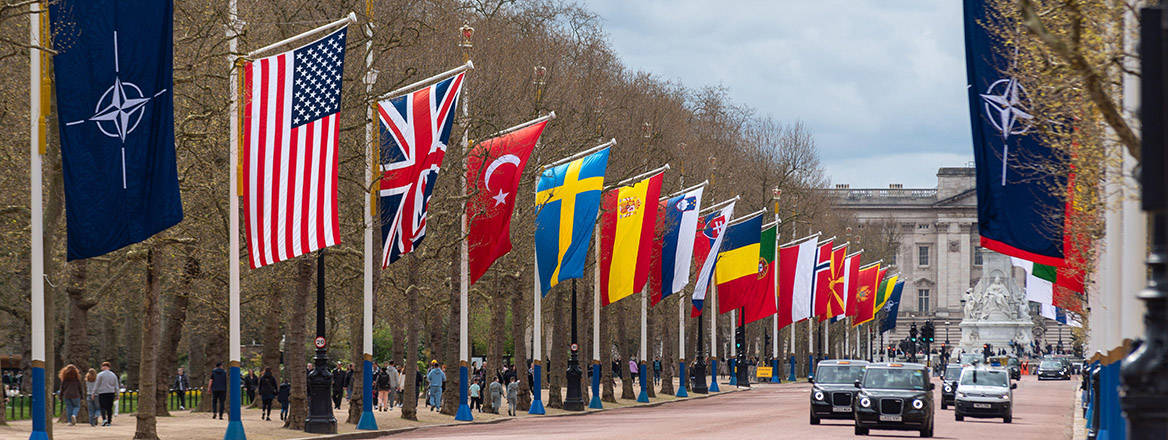
The ambition of NATO’s 5% spending target is softened by the potential to categorise 1.5% of infrastructure spend within the goal, but how will that be interpreted?
The strategic consequences of the Iran conflict have reverberated far beyond the Middle East. Despite a fragile cessation of hostilities, the shockwaves from months of war have driven up fuel prices across Europe, disrupted fertilizer supply chains threatening global food security, and forced school closings across Asia – echoing the disruptions the world experienced during COVID-19. An MOU between the United States and Iran, even if it holds, cannot undo the cascading consequences already in motion.
This conflict was only the latest in a series of compounding shocks – from the European migration crisis and COVID-19 to Russia's war in Ukraine – each arriving before governments fully recovered from the last, eroding institutional capacity, weakening public trust, and making future crises harder to manage. Rapid breakthroughs in AI and other dual-purpose technologies have only compounded the challenge, lowering the barriers for non-state actors to cause catastrophic harm.
Strong, resilient societies are better positioned across the entire risk spectrum to absorb shocks, maintain cohesion, and deny adversaries the vulnerabilities they seek to exploit. Given these cascading crises, it is imperative for Allies to pursue meaningful public and private investments under Article 3 of the NATO Charter, which has been clarified to include critical infrastructure protection, civil defence preparedness, energy security, and the continuity of government and essential services. Without this foundation, the Alliance will remain more vulnerable to future geopolitical shocks and will be ill-prepared to defend its collective territory should deterrence fail.
Shockwaves from Tehran
Allies made a landmark commitment at the 2025 NATO Summit at The Hague to invest up to 1.5% of GDP by 2035 to improve critical infrastructure, network security, civil preparedness, innovation, and the defence industrial base.
The Iran conflict could be viewed as a stress test of the vulnerabilities NATO allies sought to address at The Hague. Military strikes on energy infrastructure and the closing of the Straits of Hormuz are exposing Europe's dependence on fragile supply chains, sending shockwaves through the energy and fertilizer markets. Rising costs are straining household budgets, while boosting Russian oil revenues to fund its brutal war in Ukraine. Meanwhile, NATO has activated its air and missile defence system to intercept Iranian ballistic missiles entering Turkish airspace.
With history as a guide, a wave of irregular migration is a distinct possibility that could strain health and education systems and push social cohesion to the breaking point. Malign actors will follow close behind, exploiting those fractures through disinformation campaigns designed to inflame existing grievances, and undermine the imperative for collective action.
Good Intentions, Unfinished Business
As the world's most mature collective security organization – born from the ashes of the global catastrophe of the Second World War and designed to avert a third – NATO bears a responsibility that extends beyond its own borders. Despite the current strains in transatlantic relations, the Alliance remains a bloc of nations representing approximately half of the global economy. Whatever divides Allies politically, the stakes of collective weakness are clear: a NATO weakened by compounding crises and chronic underinvestment in societal resilience threatens not only its member states but the Alliance itself. Despite recent turmoil in the Alliance, NATO remains one of humanity’s most promising bulwarks against global catastrophe.
NATO admits that its focus on out-of-area operations in recent decades led to under-investment in its civil defence capabilities, and its non-military capabilities were largely outsourced to the private sector. For example, approximately 90% of major military transportation services and 95% of transatlantic undersea fibre-optic networks are owned and operated by the commercial sector. Yet NATO lacks a coherent system to integrate these capabilities into Alliance-wide civil defence and military planning.
As we approach the Ankara NATO Summit in July, Allies should not only reaffirm the Article 3 imperative, but forge a common understanding of what resilience means and which investments should count toward the 1.5% target. The Hague declaration allows allies to count direct contributions to Ukraine's defence toward their spending commitments, raising important questions about how such support should be categorized within the new framework.
Sweden illustrates the dilemma. Stockholm has provided over $10.6 billion (SEK 100 billion) in military assistance to Ukraine, and The Hague declaration's carve-out potentially allows such contributions to be applied toward NATO spending targets – an approach Sweden's Defence Minister has indicated Stockholm is considering under the 1.5% category. Although this support could be justified under the 3.5% category, including it under resilience confronts this question directly. Sweden remains one of the Alliance’s leading examples of civil defence through its Totalförsvar or Total Defence model, and how it defines 1.5% investments will help shape how resilience is understood across the Alliance.
Turning Pledges into Practice
There are a number of avenues the Alliance could pursue to bring greater clarity to the 1.5% commitment and maximize the effectiveness of funds invested.

Help your search results show more from RUSI. Adding RUSI as a preferred source on Google means our analysis appears more prominently.

First, NATO should, at a minimum, establish more refined public guidance on defining exactly what qualifies under the 1.5% pledge. The Atlantic Council highlights that beyond the general categories named in The Hague declaration, NATO offered no further guidance on what actually counts. Under the 2014 Wales Summit’s 2% pledge on defence spending, some Allies folded border security, military pensions and unrelated budget lines into their figures. Without clearer rules, the 1.5% faces the same risk of creative accounting. This guidance must be made public so that the importance of this commitment can be understood across the civil-military ecosystem, including by private actors who will necessarily be partners with NATO governments, such as critical infrastructure owners and operators, as they have a key role to play in advancing true resilience.
Second, Allies should fence-off portions of existing NATO and national-level investment and innovation programs – such as the Defence Innovation Accelerator for the North Atlantic and the NATO Innovation Fund – for projects that directly contribute to the 1.5% target, while creating incentives for private investors to back solutions that serve commercial, resilience, and defence needs. RUSI and Heinrich-Böll-Stiftung have noted that investments in areas like rail mobility, energy grid upgrades, and supply-chain diversification can serve all three purposes at once.
Third, NATO should develop strategic guidance that steers national spending toward the seven baseline requirements that form the foundation of Article 3 resilience, using robust planning to guide cross-sectoral and regional resilience. Modelled after NATO's capability targets, this approach would ensure spending is not only clearly defined but strategically directed toward validated Alliance-wide requirements – and aligned where possible with the EU Preparedness Union Strategy and forthcoming EU minimum preparedness standards to avoid duplication and maximize complementarity. By advancing the seven requirements, NATO will not only improve its deterrence and resilience to possible armed conflict, but also to the many other compounding shocks that have plagued the Alliance in recent years.
The Road to Ankara
Even if the MOU holds and lasting peace takes root, the second and third-order effects of this conflict will reverberate for years to come. The Ankara Summit offers Allies an opportunity to clarify what resilience actually means across the full spectrum of risk – and to drive more meaningful action on Article 3 investments. If implemented properly, the 1.5% target could prove as consequential for societal resilience as the 2% benchmark has been for defence. NATO resilience must not be an afterthought. Our societies depend on it.
© Jobe Solomon, 2026, published by RUSI with permission of the author.
The views expressed in this Commentary are the author's, and do not represent those of RUSI or any other institution.
For terms of use, see Website Terms and Conditions of Use.
Have an idea for a Commentary you'd like to write for us? Send a short pitch to commentaries@rusi.org and we'll get back to you if it fits into our research interests. View full guidelines for contributors.
WRITTEN BY
Jobe Solomon
Guest Contributor
- Jim McLeanMedia Relations Manager+44 (0)7917 373 069JimMc@rusi.org