

From Tailored Air Group to Tailorable Maritime Aviation

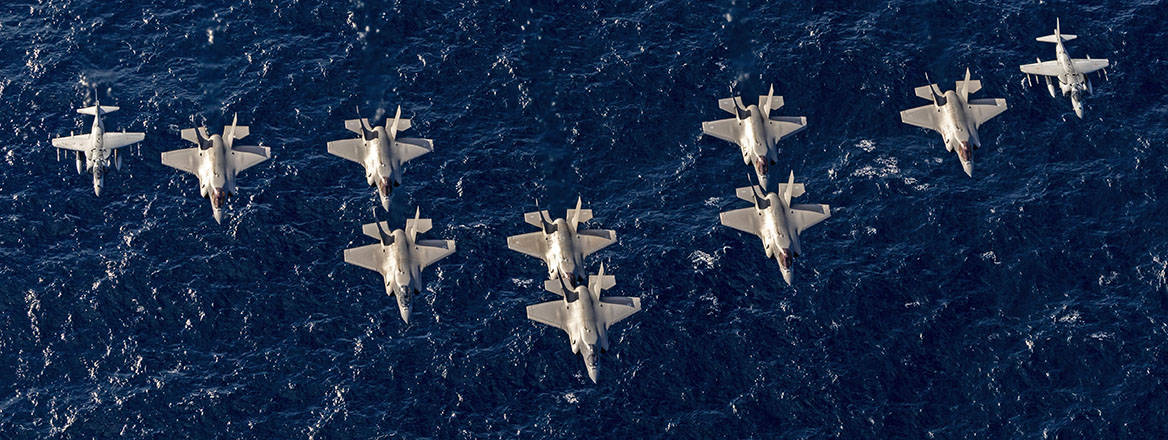
While the Royal Navy's Hybrid Air Wing is often discussed in terms of platforms and technology, its longer-term significance may be to expand the options available to maritime commanders.
The Royal Navy’s Hybrid Air Wing concept is moving from proposition to practice. Proteus has flown, Operation Highmast demonstrated an autonomous logistics sortie between ships, and Exercise Dragon Rider connected crewed and uncrewed aviation systems over extended communications ranges. Alongside projects such as Pantheon and Vanquish, these activities mark progress towards maritime aviation operations in which crewed and uncrewed systems operate as an integrated force.
The significance extends beyond increasing platform numbers or mass. A naval task group can be redirected rapidly, but its embarked aviation is largely selected before sailing, shaped by anticipated tasks and operating environment. Changing its composition at sea is challenging, particularly at range, in contested environments, when assets are committed elsewhere, or when established logistics hubs prove unavailable. As the Royal Navy balances demands across multiple regions, hybridisation may move some decisions about force composition and employment closer to operational need.
This commentary explores which decisions might move downstream and what must still be prepared beforehand. The starting point for this evolution is not a blank sheet, but the Royal Navy’s existing Tailored Air Group (TAG) model.
The TAG Model
The TAG already provides a flexible organisational construct, combining capabilities that can fulfil a range of mission sets. Its composition also crosses Service boundaries, with Apache and Chinook operating alongside Merlin and Wildcat aircraft under the Joint Aviation Command (JAC) deployable Aviation Task Force (ATF) structure, thereby integrating Army and RAF capabilities into maritime-led embarked aviation groups.
Operation Ellamy demonstrated the value of this approach. In 2011, 656 Squadron Army Air Corps was embarked on HMS OCEAN for a planned five-week exercise when it became a five-month operation. Apaches subsequently flew operational attack missions from the sea for the first time. The prior preparation of aircraft, personnel and support arrangements therefore enabled the joint aviation force to respond when the task changed.
A TAG already provides flexibility, but largely through choices made before deployment or by re-tasking assets already embarked. Hybridisation may extend adaptability by building on this during deployment
Carrier Strike Group (CSG) deployments offer a contemporary parallel. RN and RAF personnel generate F-35B capability from carriers, with allied aircraft and ships incorporated into the force as required. As allies develop their own crewed/uncrewed teams, for example the US Marine Corps MUX TACAIR programme, future allied aviation contributions could comprise integrated hybrid packages rather than individual aircraft types. A Joint Expeditionary Force (JEF) deployment offers a comparable model, drawing together capability contributions from participating nations around a shared requirement. An evolved TAG could draw on national, joint and allied hybrid capabilities as required, while remaining maritime in its integration and employment.
These examples show that a TAG already provides flexibility, but largely through choices made before deployment or by re-tasking assets already embarked. Hybridisation may extend adaptability by building on this during deployment:
- Re-tasking: changing what a platform is asked to do (already a feature of maritime aviation).
- Re-configuration: changing what a platform can do by adjusting payloads, software, sensors or mission equipment. Some uncrewed systems may be more readily configured because modular payloads and software-driven functions need not be integrated around cockpit interfaces, crew workloads or life support and survivability requirements as crewed systems are. That advantage is still dependent on architectures, interfaces and assurance regimes that are appropriate to the re-configuration.
- Re-composition: changing how crewed and uncrewed systems are combined and how functions can be distributed between them to generate a particular effect.
These represent adaptation in employment, capability and force composition respectively. None, however, constitutes regeneration, which is restoring capacity after aircraft, weapons or attritable systems have been lost or expended.

Dragon Rider illustrates the operational logic behind re-composition. A Wildcat relayed data between multiple uncrewed systems and their operators, extending their operating range. Capability emerged from the interaction of crewed and uncrewed systems, communications architecture and operators, rather than platform substitution.
Future iterations could therefore see one system detecting, another relaying and a third delivering an effect. A crewed platform might provide judgement, command, or human interaction, while an uncrewed system carries greater physical risk. This reflects the First Sea Lord’s direction: ‘uncrewed wherever possible, crewed only where necessary’. The importance of that flexibility becomes clearer once a maritime force is deployed and circumstances diverge from the assumptions made before sailing.
Adaptation at Sea
The value of adaptability is clearest as the Royal Navy balances finite forces across multiple tasks. A NATO-first posture will not eliminate demands elsewhere, and deployed forces may be re-directed, extended, or re-tasked as circumstances change. A maritime aviation group in the North Atlantic, for example, may have to operate at range, in challenging conditions, whilst shifting across a broad mission set as priorities and potential threats evolve.
Ukraine shows how quickly combinations of systems and methods can change as adversaries adapt to one another. In the Black Sea, uncrewed air and surface systems have performed different functions within a strike (according to a Ministry of Defence of Ukraine report), showing how roles can be distributed across a wider system rather than concentrated in a single platform. Black Sea methods cannot simply be transposed to blue-water operations however, where geography, threat types, endurance and environmental demands will differ. The more relevant lesson is the pace at which combinations of systems and methods are adjusted, countered and adjusted again. Hybridisation could present options as adversary methods also evolve.

Adaptation is not limited to combat. During Operation Gritrock, RFA ARGUS and three Merlin helicopters supported the Ebola response in Sierra Leone. A future hybrid group might add autonomous reconnaissance, communications relay and light logistics capabilities to such a response, whilst crewed aviation retains lift, judgement and human presence. Similar combinations could support distributed Commando Force operations. The question therefore is not only whether maritime aviation can adapt, but where in the deployment cycle that adaptation could occur.
Moving Tailoring Downstream
Traditionally, a TAG is mainly composed before sailing. Hybridisation may introduce later points of adjustment where prepared interfaces, authorities and support arrangements allow. Additional equipment or allied systems might be incorporated during deployment; systems re-configured between sorties; and crewed/uncrewed elements recomposed during a mission. Re-tasking could then alter the allocation of work across the group without changing its physical inventory.
Moving those choices closer to operational need does not make them unconstrained. Ship Air Integration (SAI), C2 arrangements, architectures, suitably qualified and experienced personnel, regulation, assurance and support all influence the options available at sea. Hybridisation may therefore defer some decisions, but not their preparation.
Operation Highmast illustrates how hybridisation can create options, while depending on prior integration and support. Moving stores between ships offered a short-range logistics option and the potential to release crewed helicopters for higher value tasks but depended on 700X Naval Air Squadron (NAS) personnel and supporting activity aboard the participating ships. Human involvement was redistributed rather than removed, which is a pattern likely to persist as hybridisation develops.
These downstream options only matter if the systems involved can operate dependably in the maritime environment.
The Maritime Test
SAI activity is a pre-condition for an aviation asset to operate from a ship, establishing relevant clearances and operating limitations since suitability ashore does not equate to utility at sea. ‘Marinisation’ or ‘ship optimisation’ of assets may be necessary, but dependable maritime capability also requires maintenance, sustainment, airworthiness and effective tactical employment whilst at sea. Those demands intensify on moving decks, at night, in poor visibility, high sea states, extreme cold, or in contested or denied electromagnetic environments.


The maritime test should not create a rigid divide between trials and operations. Ukraine demonstrates the value of modifying systems through operational use. The referenced article here focuses primarily on land force UAV complexes but has relevance to the maritime by analogy. It identifies that as adversaries refine their countermeasures, effectiveness declines, requiring constant changes to software, behavioural logic, sensors and radios. Forces need the ability to update and re-configure their systems whilst recognising the tension between rapid evolution and regulation. Although Ukraine’s circumstances and tolerances cannot simply be transferred, and the maritime environment differs, the challenge remains how to shorten the cycle between experimentation, operational experience and re-configuration without compromising necessary standards. This is consistent with the RN’s drive towards continually upgradeable systems.
Dependable hybrid maritime aviation therefore requires both successful demonstrations and the capacity to learn from them quickly. As RAdm (Rtd) James Parkin has argued, the Hybrid Navy depends upon doctrine, people, regulation, logistics and maritime experience as much as technology. Experienced operators and maintainers will be increasingly important to both integration and feedback.
Limits of Adaptability
Adaptability increases the range of choices available to commanders, but it does not remove the practical limits of capacity, endurance and sustainment. Flight deck and hangar space, personnel, weapons stocks, fuel and spares remain finite - constraints that are already managed in contemporary planning. Nor can re-composition restore lost systems or expended stocks. Therefore, hybridisation may increase the options available, but not necessarily the material constraints on sustaining them.
Conclusion
Viewed this way, the TAG's next evolution may be from a group tailored principally before sailing to one prepared to be re-tasked, re-configured and, within limits, re-composed at sea. Hybridisation could give commanders greater scope to adjust how maritime aviation effects are generated as missions and circumstances change during deployment.
This would extend, rather than replace, the principles underpinning the current TAG. Its adaptability would remain bounded by architectures, capacity, endurance, weapons and support. The significance of the Hybrid Air Wing therefore lies not only in what the Royal Navy can deploy, but in when decisions about force composition and employment can be made: maritime aviation tailored before deployment, but increasingly tailorable as that mission evolves.
© RUSI, 2026.
The views expressed in this Commentary are the author's, and do not represent those of RUSI or any other institution.
For terms of use, see Website Terms and Conditions of Use.
Have an idea for a Commentary you'd like to write for us? Send a short pitch to commentaries@rusi.org and we'll get back to you if it fits into our research interests. View full guidelines for contributors.
WRITTEN BY
Lieutenant Commander John Darcy
First Sea Lord’s Visiting Fellow
Military Sciences
- Jim McLeanMedia Relations Manager+44 (0)7917 373 069JimMc@rusi.org