

Seabed War: Russia’s Secretive Defence Units and Undersea Sabotage Architecture

Classified Russian government document revelations add to concerns that the adversarial nation’s undersea threat is both acute and invested towards a further-reaching campaign.
In recent years, threats to both civilian and military underwater critical infrastructure – such as telecommunications, energy, oceanographic, underwater surveillance and navigation infrastructure – associated with Russia’s aggressive actions have become especially visible and are widely recognised as particularly acute, both in academic circles and by government organisations. This applies both to acts of sabotage that may be carried out during a grey-zone period without Russian attribution being revealed, and to operations that may form part of an ultimate Russian naval campaign in the event of full-scale armed confrontation with NATO or individual NATO countries.
In this context, it is extremely important to understand the development of Russian capabilities that could be used in such operations, because the direction of this development, among other things, indicates Russia’s real intentions and the specific scenarios for which it is preparing. This article attempts such an analysis, based both on publicly available information and on some classified Russian government documents provided for this purpose by several European intelligence agencies, the authenticity of which remains beyond any doubt.
GUGI, the GRU and the Undersea Domain
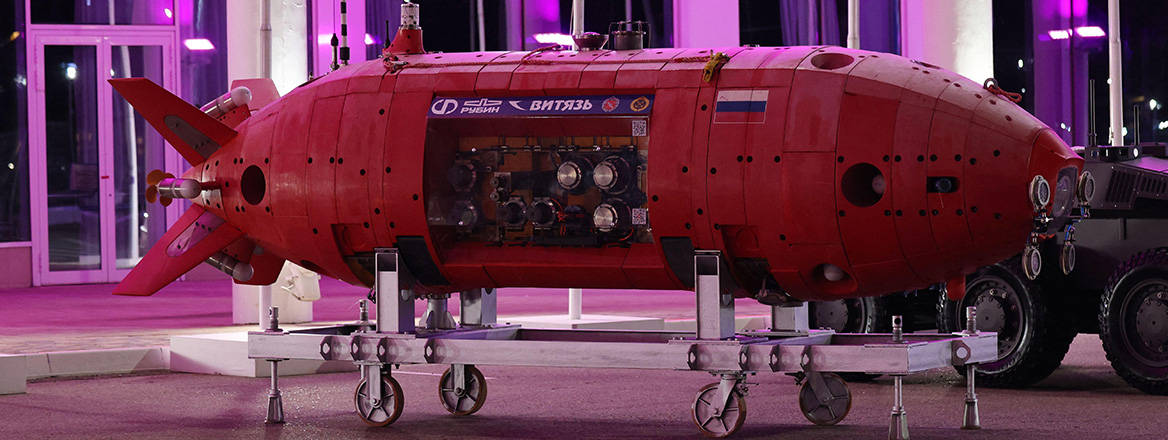
An important element of Russia’s underwater warfare capabilities is the Main Directorate for Deep-Sea Research of the Ministry of Defence of the Russian Federation, known as GUGI and also as military unit 40056. GUGI is one of the most secretive units of the Russian Ministry of Defence. Its main tasks include seabed warfare and deep-sea operations, including the installation of equipment for intercepting underwater telecommunications, damaging and destroying underwater infrastructure, seabed mapping and the deployment of Russia’s own underwater surveillance and navigation systems. It is reliably known that GUGI is capable of conducting operations at depths of up to 6,000 m, using nuclear-powered deep-sea systems of the Losharik type and autonomous deep-sea vehicles of the Rus and Konsul types. The Russian Ministry of Defence, for its part, claims that the new deep-sea vehicle Sergey Bavilin, Project 18200, whose production began in 2024, is capable of operating at depths of around 11,000 m.
It is noteworthy that even while Russia is waging a difficult and exhausting war against Ukraine, it does not stop spending its limited resources on creating expensive infrastructure that has no significance for victory in that war, but is extremely necessary in the event of a prolonged conventional war with the West.
GUGI’s system of capabilities includes military unit 45707 – the 10th Detachment of Hydronauts, specialists capable of working at great depths inaccessible to ordinary submarines, which reports directly to the Minister of Defence of the Russian Federation; the 29th Special-Purpose Submarine Division; special oceanographic vessels, including the Yantar and Almaz of Project 22010, which serve as carriers for Rus- and Konsul-type deep-sea vehicles, oceanographic vessel Vice-Admiral Burilichev of project 22011 (intended to serve as a carrier for the Sergey Bavilin deep-sea vehicle), as well as deep-sea unmanned vehicles and seabed sensor systems, in particular the Russian military ocean surveillance system Harmony, intended to monitor the Russian Arctic from the Murmansk area eastward to Novaya Zemlya and further north to Franz Josef Land.
The 235th Centre
Beginning in 2023, GUGI started close cooperation with another extremely secretive unit of Russian defence intelligence – the Special Activities Service of the GRU (GU) headed by former unit 29155 commander General Andrey Averyanov. The main specialisation of the Special Activities Service is the conduct of strategic covert operations involving kinetic elements – coups, insurgencies, terrorist attacks and strategic sabotage. Its main methods combine illegal human intelligence with elements of unconventional warfare. The result of this cooperation was the creation, in occupied Crimea, of the 235th Specialist Training Centre, military unit 71712, whose specialisation is the conduct of maritime sabotage using unmanned vehicles, including at great depths. In 2024-2025, the 235th Centre actively recruited servicemen from the Naval Centre of Special Operations Forces (military unit 00317), Spetsnaz brigades, the 810th Naval Infantry Brigade and the 29th Special-Purpose Submarine Division.
The unit’s provision with unmanned systems is handled by the Directorate for Advanced Inter-Service Research and Special Projects of the Russian Ministry of Defence (UPMIiSP MO RF) – a low-profile Russian military management body responsible for the most important scientific and technological research. Among its few known projects are its direct involvement in the creation of the Rubikon Testing Centre for Advanced Unmanned Technologies of the Russian Ministry of Defence – which became a real breakthrough in Russian expertise in the development and combat employment of UAVs – as well as Russian-Iranian military-technical cooperation. In addition, UPMIiSP cooperates closely with GUGI through the Russian Ministry of Defence’s Arctic Technologies program.
The head of the 235th Centre is Captain 1st Rank Pavel Chirtsov and his deputy is Colonel Alexander Vasinovich. Both are officers of the GRU Special Activities Service who previously served under diplomatic cover in Russian missions: Chirtsov in the defence attaché office in Finland and Vasinovich in Moldova and Germany. Although Chirtsov began his military service as a submarine officer, he is a specialist in human intelligence and participated in Russia’s seizure of Crimea in that capacity. Vasinovich is a signals intelligence specialist who was responsible for a system of spy antennas deployed on embassy rooftops. The combination of such areas of expertise looks strange for a sabotage unit, but only at first glance.

Most of the servicemen recruited into the 235th Centre are experienced specialists in maritime sabotage. The additional training they receive at the Centre concerns not sabotage as such, but carrying it out at great depths (GUGI’s expertise) using unmanned systems (UPMIiSP’s expertise) without revealing the Russian flag or by using proxies (the expertise of illegal human intelligence of the GRU Special Activities Service) as well as installing espionage equipment on underwater communications (technical intelligence expertise of GUGI and the GRU Special Activities Service). The presence of the HUMINT component in the training of specialists of the 235th Centre, as well as the specialisation of the GRU Special Activities Service, indicates that, with high probability, these individuals will use unofficial cover for their operations, including non-Russian citizens, and will also actively involve HUMINT assets from organisations that, because of their ideological positions, may be interested in conducting underwater sabotage. Such organisations may include separatists, political and religious extremists, as well as radicalised members of environmental organisations – for example, for attacks on offshore oil and gas infrastructure.
Targets of an Undersea Crisis
The use of proxies would help significantly scale attacks against underwater infrastructure in relatively shallow waters, as well as prepare cover positions for strategic sabotage at great depths while denying Russian sponsorship. Modern technologies allow Russia to create a relatively small and not overly expensive unmanned vehicle capable of delivering an explosive charge to underwater infrastructure at moderate or great – though not extreme, depths – approximately down to 1,000-2,500 m. Such a vehicle could be delivered to the operational area even by a small civilian vessel. Given that cables at such depths have almost no protection, this approach creates the threat of almost impunity in disabling, for example, civilian and government transatlantic communications. Repairs of such damage can be carried out by a very small number of specialised vessels, which in turn may become targets of attacks by surface drones, both in the repair area and en route to it. Such surface drones may also be delivered to the operational area by civilian vessels.


A simultaneous attack on several such cables could create a serious crisis – degradation of the civilian internet, financial transactions, cloud services, government communications and military coordination. The greatest threat lies precisely in the mass and synchronised nature of such attacks, especially against the background of a shortage or even absence of repair capacity. Despite the obvious enormous negative consequences of such an attack in peacetime, its greatest importance lies in disrupting command-and-control channels and backup communications precisely in the event of the beginning of a full-scale military conflict. Such an operation could also be accompanied by the disabling of satellite telecommunications, as happened during Russia’s invasion of Ukraine in February 2022, when the Russians carried out a successful cyberattack on the Viasat KA-SAT network.
Another important target for such underwater sabotage in preparation for military confrontation is deep-sea submarine surveillance systems, in particular the GIUK Gap – NATO’s main North Atlantic anti-submarine barrier. Located between Britain, Greenland, Iceland and Norway, the GIUK Gap controls the only route into the Atlantic for Russian submarines. Notably, Russian submarine-launched nuclear missiles do not require such access; they can be launched from the Barents Sea. Therefore, Russian efforts to break through this barrier indicate preparation for a prolonged conventional conflict with NATO, in which, as in the Second World War, the ability to attack transatlantic convoys and threaten other maritime routes would play an important role.
Russian operations to establish control over countries on the west coast of Africa, where, among other things, there is port infrastructure needed by submarines, fit entirely within this logic. A vivid example is Equatorial Guinea, where in 2024 more than 200 Russian military personnel from the Africa Corps, controlled directly by the GRU Special Activities Service, were deployed in the port cities of Malabo and Bata. In 2025, Equatorial Guinea concluded an agreement with Russia allowing Russian warships to use these ports for resupply, crew rest and repairs. The location of the ports makes them extremely convenient for Russian diesel-electric submarines, which from there could threaten eastern Atlantic and West African shipping lines.
The development of the above-mentioned Russian capabilities fits entirely within the logic of late Soviet naval anti-communications warfare doctrine, in which the main objective is to disrupt the entire system of maritime transportation and communications, rather than simply to accumulate sunk tonnage. It is noteworthy that even while Russia is waging a difficult and exhausting war against Ukraine, it does not stop spending its limited resources on creating expensive infrastructure that has no significance for victory in that war, but is extremely necessary in the event of a prolonged conventional war with the West.
© RUSI, 2026.
The views expressed in this Commentary are the author's, and do not represent those of RUSI or any other institution.
For terms of use, see Website Terms and Conditions of Use.
Have an idea for a Commentary you'd like to write for us? Send a short pitch to commentaries@rusi.org and we'll get back to you if it fits into our research interests. View full guidelines for contributors.
WRITTEN BY
Oleksandr V Danylyuk
RUSI Associate Fellow, Military Sciences


- Jim McLeanMedia Relations Manager+44 (0)7917 373 069JimMc@rusi.org