

The Price of Cost-Cutting: What Next for UK Aid and Development Assistance?

Deep UK and Western aid cuts are fuelling insecurity across sub-Saharan Africa. Protecting British interests requires money paired with genuine strategic reform.
Coinciding with Chancellor John Healey’s inaugural budget in the Commons, experts have warned of a ‘material shortfall in the spending power of UK aid’, with outlays falling £410–580 million shy of Labour’s 0.3% target. Conservative estimates suggest a £250-million gap at the very least, driven partially by inflationary pressure, while monitors continue to criticise the Foreign, Commonwealth & Development Office’s (FCDO’s) lack of ‘comprehensive … budgets, strategies and project objectives’. Under the best circumstances, Keir Starmer’s original official development assistance (ODA) reductions announced back in 2025 – amounting to a 42% cut over four years, the steepest of any G7 country – raised concerns around UK partnerships, visibility and clout. The government’s diminishing appetite to hit even these leaner thresholds, and Andy Burnham’s decision to omit the Minister of Development from Cabinet, has dampened hopes of a reprieve.
Crucially, the UK is not alone in this slump. Development Assistance Committee contributions fell 23% in 2025, the largest drop on record: US assistance contracted by 56.9%, EU spending by 13.8%, many European budgets by 10%. Humanitarian coverage has withered as ‘staff [are] laid off and infrastructure sold; residual programmes appear more politicised, transactional and temperamental. The outcome is a system reaching ‘fewer people with less’. Although reports describe efforts to rebrand this shrinkage as ‘efficiency’ – and a belated push to deliver localisation – these narratives misdiagnose, or misconstrue, the reality that Western cuts are the latest in a long-running pattern, one exporting much of the cost to the social margins.
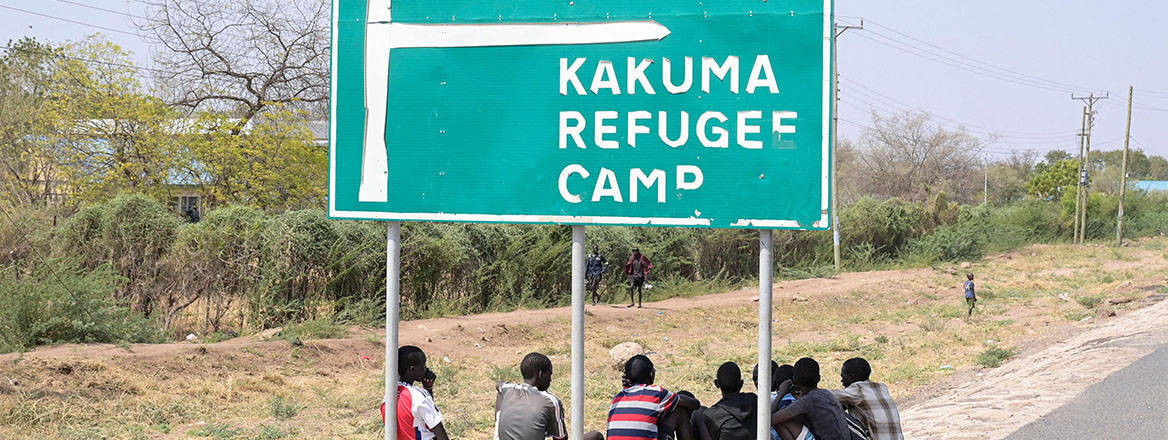
Mary Ana McGlasson and Manny Maung cite the World Food Programme as a useful vignette, with 90% of in-kind rations in 2023 – a peak year for ODA funding – failing to satisfy nutritional needs. 80% were inadequate in 2024. By 2025, disbursements fell from $17 to $5 per month per refugee in camps like Kakuma, while supplies of cereals, stipends and hot meals are drying up for those whom aid flows can actually reach. Elsewhere, an unsavoury mix of apathy, bureaucracy, profligacy and politics hinders any access at all, leaving immiserated populations a bleak choice: ‘rebel, migrate or starve’.
This has serious consequences, with the convergence of ecological shocks, price hikes, epidemics and famine – a so-called ‘polycrisis’ in human security – stoking fears of mass mortality and displacement. Studies are already linking the abrupt suspension of ODA to spikes in violence, a collapse in local healthcare, setbacks in disease prevention and widespread food shortages. Understanding the impact and implications of these cascading – and compounding – risks is therefore paramount, not just for aid-dependent states but for donors themselves.
(Messy) Causal Chains
The incipient nature of recent cuts, lags in budgetary cycles and the resonance of existing coverage pose difficulties in assessing the full consequences of Western retrenchment. Cost-saving – often at the expense of research, monitoring and evaluation – routinely hampers data collection, leaving analysis reliant on conjecture and, occasionally, sensationalism. To help alleviate this information deficit, RUSI research has supplied new insights from government officials, academics, UN workers, NGOs and humanitarian practitioners, offering greater texture, clarity and context around how ODA reductions are influencing fragile and conflict-affected states (FCAS) in sub-Saharan Africa, and what the fallout means for UK strategic and security interests.
Understanding the impact and implications of these cascading – and compounding – risks is therefore paramount, not just for aid-dependent states but for donors themselves
While the study can only provide a snapshot of perceptions across a specific region, several points and patterns are immediately evident. The first is a massive contraction in humanitarian conditions, coverage and capabilities, amplifying insecurity along numerous fronts. Two prominent regressions – in nutrition and health – have a well-established propensity to become threat multipliers in FCAS settings and already appear to be feeding a series of overlapping crises that span the Horn and Sahel. This is not a linear process – these dynamics predate the cuts and do not necessarily prove ODA’s efficacy, which is tempered by numerous variables including regime type, institutional capacity, governance quality and project modalities – but the effects are undoubtedly exacerbated. The corollary is a vicious cycle of violence, dislocation, polarisation and competition; outcomes liable to spill over national borders.
The direct effects for the UK are less clear. On one level, British security – in a narrow sense – seems fairly insulated, at least for now. Militant recruitment, arms proliferation, conflict and displacement are all geographically confined, threatening UK allies and partners rather than the homeland itself. There are exceptions – Islamic State affiliates continue to disperse cash and content abroad, while pressure on littoral bottlenecks and trade corridors may infringe on commercial shipping – but many interviewees considered the consequences containable (in the short term).
However, if security is understood more holistically, the cascading impacts of sub-Saharan instability could have serious material, strategic and financial implications for British interests and influence over time. The ‘combination of climatic, conflict, market and epidemic shocks are not simply additive but multiplicative’, weakening regional resilience and intensifying future threats. Upheaval along NATO’s ‘southern flank’ is conducive to a raft of hostile actors; diminishing trust in Western credibility erodes economic, diplomatic and military ties; and the decay of international norms, laws and progressive values refracts far and wide. Crucially, such processes not only feed into an increasingly volatile geopolitical environment, but inflate the costs of subsequent interventions, as one stakeholder summarised: ‘we are … mortgaging the risk for years to come, assuming we will eventually pay it off’. This is not to imply that ODA cuts are (solely) responsible for these issues, or that aid programming alone offers a solution, but the sudden contraction of funding has sapped any ability or appetite to curb their excesses and externalities.
Rhetoric and Reality
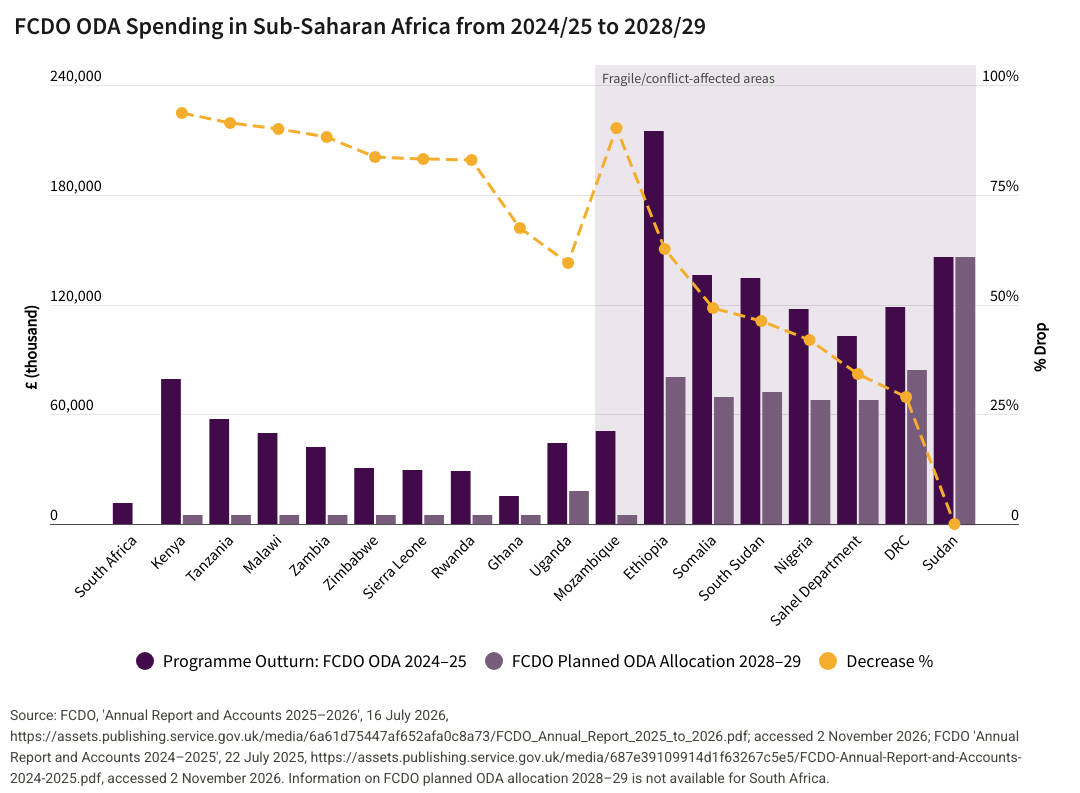
Importantly, the research also exposes inherent contradictions between Whitehall’s actions and aspirations. The ‘modern development approach’ published in July made considerable hay about the importance of fiscal responsibility, local agency and consistency, while linking domestic security to global tranquillity. But the reality appears very different. Every sub-Saharan FCAS, aside from Sudan, faces drastic reductions in bilateral support by 2028–29. Prevention work has been pared back in favour of crisis response; a false economy that could potentially cost billions in ‘managing the downstream consequences of … instability and disease’. Ministers couch the UK as a ‘reliable partner, a dependable ally and a good neighbour’, despite evidence that poorly communicated aid cuts are damaging its credibility among states and civic circles. Previous foreign secretaries such as Yvette Cooper have maintained that ‘instability abroad affects us back at home’, yet there is little link between the UK’s development portfolio and National Security Strategy. Stakeholders likewise recycle the usual narratives of ‘localisation’, ‘co-creativity’ and ‘partnership’ while centralising rump resourcing in larger programmes – a model that effectively resembles Ryszard Kapuściński’s description of ‘enclave development’, funnelling money to the same cluster of urban-based anglophone elites. Without the brokerage afforded by grassroots activists, civil society organisations and community groups – those on the fringes of conventional aid networks – the UK has no way to reach the very populations it is ostensibly prioritising.
What Next?
UK aid undoubtedly requires a rethink, and many of the remedies outlined in Cooper’s ‘modern approach’ are laudable in their ethic and ambition. Similarly, tough decisions may incentivise creativity, reduce bloat and shift the FCDO away from perceptions of a ‘results-machine’ fixated on superficial metrics and risk avoidance. The question is how to deliver this change in a way that is equitable, effective and economical, within the current political climate.

Part of the answer is (unavoidably) financial: resource attrition cannot be offset by technical innovation or operational streamlining alone. Protecting multiyear allocations for FCAS settings beyond Sudan could help improve consistency and confidence – key ingredients for programming – even if they cannot fully satisfy demand.
But prescriptions must also address the UK’s wider planning, assumptions and capabilities – structural problems that eclipse ‘artificial’ spending targets. Strategic incongruity, ministerial turnover, staff reductions and Brexit legacies have all fed into a lack of direction, with International Development Committee reports calling for a clear theory of change in UK foreign policy. As Fleur Anderson writes, the issue is not just budgetary, but the need for a ‘credible long-term trajectory that partner governments, multilateral institutions, NGOs and local organisations can plan around’. Against this backdrop, there are several measures stakeholders should consider.
Practical Priorities for the UK
The first is explicitly tying the UK’s development frameworks, ‘Africa Approach’ and National Security Strategy together, ensuring complementary and clear policy direction. This is not to co-opt or confine aid within a securitised logic, but to acknowledge the overlap and interdependency that invariably conditions different UK interests across the continent. While much of the content may be readily available, it appears too abstract, dispersed or siloed to have operational utility. As one interviewee conceded, it remains ‘difficult to find an internal document articulating [UK priorities and pathways]’; where top-level planning does exist, it rarely ‘trickles down’.
The second, somewhat intuitively, is to build on ‘what works’ while remaining realistic in scope and expectations. For instance, the Integrated Security Fund (ISF) and other cross-governmental mechanisms suffer from numerous imperfections, but studies show the value of integrated programming in violence prevention, security provision and wider development efforts. Preserving this ethic is essential, even if the modalities change over time. Elsewhere, the UK has proved effective as a facilitator/enabler in places like Somalia, where small, well-networked teams have mediated political disputes, linked up rival governance systems and strengthened fiscal federalism. Drawing on the FCDO’s relationships at a local level, British experts can supply real-time data to help steer multilateral interventions and have found success delivering technical advice to informal advisory committees led by Somalis themselves. These are cheap activities that not only play to UK specialisms but elicit valuable multiplier effects, even if they cannot offer a panacea to longstanding structural problems.
Given ODA is unlikely to resolve the root causes of insecurity in isolation, it could be more practical (and palatable) to prioritise specific outcomes within manageable timeframes. This may include addressing particular sources of recurrent violence – such as elections – that are easier to predict, bound and mitigate, although interviewees acknowledged the need for both flexibility and robust triage, allowing stakeholders to exploit windows of opportunity while linking back to high-level strategic objectives. Crucially, the UK should also consider ramping up support for early warning systems – (comparatively) low-cost inputs imperative for assessing/targeting interventions in spaces that the US has largely vacated.

Additionally, several participants stressed the benefits of diplomatic acuity. Over time, Whitehall’s role in the aid space has shifted from ‘retailer’ to ‘wholesaler’, with the FCDO citing financial (and labour) impediments to direct implementation, co-design and monitoring, even when spending was still at 0.7%. Skills, relationships and expertise risk depreciating as administrators become dependent on third parties or blind to the local realities of programmes they fund. A cadre of civil servants able to blend diplomacy with development capability could yield considerable dividends, especially in conflict-affected contexts where missions need political proficiency and partnerships as much as project management.
At the same time, UK investment must encompass ‘institution-building, networks and wider civic ecosystems’ (rather than a ‘succession of short-term projects’) to better cultivate domestic agency and accountability. This includes extending support to a variety of actors (for example, business groups), providing dynamic, small-scale grants and rapid-response funds and experimenting with different forms of (light-touch) regulation. Experts likewise cited the advantages of financing locally owned grant-making bodies that have ‘operational autonomy to make funding decisions as they see fit’, and extending credit beyond the usual urban-centric ‘NGO class’.
More broadly, it is incumbent on ministers to reflect on how far a transactional posture in bilateral engagement really furthers British objectives. UK institutions cannot necessarily compete with the expediency of ‘bailout diplomacy’, the breadth of regional patronage or the scale of Chinese infrastructure. Attempting to do so also risks contradicting the norms, values and perceptions integral to long-term development efforts and UK security interests. French experiences across the Sahel offer a worrying parable. By adopting an increasingly mercurial tack in its brokerage, Paris has been blamed for neglecting democratic principles and the rule of law; an approach precipitating (or prefacing) widespread populist backlash and empowering a string of Russophile juntas.

Finally, RUSI’s research corroborates previous studies in calling for greater collaboration to maximise UK agency and impact. In the absence of USAID, and a lack of confidence in the State Department’s reliability, this should cohere where possible with like-minded partners across Europe, with ongoing debate over the EU’s Multiannual Financial Framework providing immediate opportunities to align priorities, programmes and strategy. Interviewees called for coordinated conditionality packages in Somalia, for example, to push politicians into finally agreeing a workable federal formula. The UK can likewise use access to international financial institutions as a means of amplifying influence, while improving the performance of multilateral organisations, whether by helping preserve progressive norms, seconding advisers to strengthen interventions or advocating for debt relief. While there remains (understandable) scepticism over the bargaining power UK stakeholders could (and should) exercise in regions like the Horn, experts described residual leverage among local elites, particularly in terms of reputation and personal interest. Relationships may briefly rupture, but powerbrokers ‘don’t want to lose the West’. This provides an important opening – one that can only be exploited through concerted, consistent and organised collaboration.
The ‘reset’ in international aid may offer space for improving UK engagement, and for wider discussions around the power, equity and interests framing how development is defined and delivered. There is clear self-interest in doing so, but to make progress the UK needs both resourcing and real reform.
© RUSI, 2026.
The views expressed in this Commentary are the author's, and do not represent those of RUSI or any other institution.
For terms of use, see Website Terms and Conditions of Use.
Have an idea for a Commentary you'd like to write for us? Send a short pitch to commentaries@rusi.org and we'll get back to you if it fits into our research interests. View full guidelines for contributors.
WRITTEN BY
Michael Jones
Senior Research Fellow
Conflict, Security and Resilience


- Jim McLeanMedia Relations Manager+44 (0)7917 373 069JimMc@rusi.org