

The Overstretch Facing the US Navy

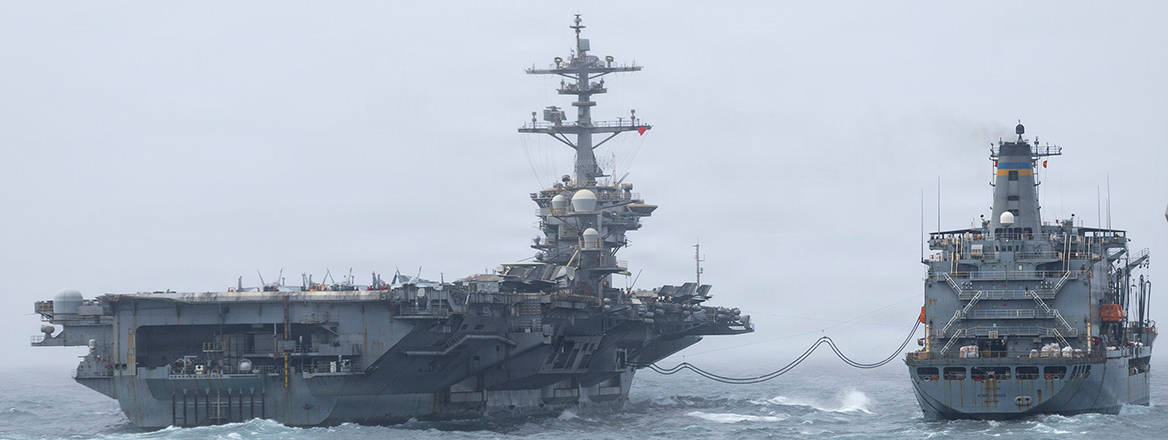
The US is exceeding its own plans for deployment of aircraft carriers, and the knock-on effects, and the strain, should be a cause for concern.
In the late 1990s the political scientist Samuel Huntington described the emergence of a ‘uni-multipolar’ world in which the US would be stronger than any major regional power yet might sometimes have less available regional capacity than many of them. Though some way off at the time of Huntington’s writing, this reality may now be upon us. Nowhere is this more apparent than in the maritime domain where the US Navy remains globally dominant and yet seems to have less capacity in most key regions than it would like.
USS Abraham Lincoln has hit the headlines because it was deployed for over 270 days – almost nine months, most of them in the Middle East. The US Navy’s standard deployment length is around seven months, or 210 days. More worryingly, the length of the Lincoln deployment is neither a one-off, nor is it a record. That dubious honour goes to USS Gerald R Ford which completed a 326-day deployment earlier this year. This has now become a trend, rather than an exception. Based on US Navy press releases over the last decade, it can be established that of the 11 carrier deployments since 2023, eight have lasted for eight months or more, and five have been at least nine months.
On paper the US Navy has 11 aircraft carriers, and will soon have only ten, as USS Nimitz is retired. It might sound like a lot, and it is in comparison to the rest of the world, but it takes considerable effort to keep just one on station. In principle, deployment schedules should be determined by the US Navy's Optimized Fleet Response Plan, its force generation planning model for deployments and rotations. The plan assumes a three-year cycle for each carrier based on a seven-month deployment, with the remainder made up of maintenance, training, leave, and a period at high readiness. That means that at any given time, the US Navy should expect to have two or three carriers deployed and the rest at some other point on the generation cycle. If a deployment then stretches to nine months, or ten or eleven, the maintenance requirements will usually be longer. This, in turn, has an impact on the rest of the cycle and a knock-on effect on the availability of maintenance facilities for other vessels.
While it might be intuitive to think of the problem in terms of force structure and posture, it is also arguably reflective of a deeper issue of strategic discipline
When considering the impact of longer-than-planned deployments, one might use an analogy with a car owner who skips regular servicing. The car will be fine for a while, but, at some point, things will start to go wrong. When the owner does eventually get the car to the garage for a service, it is going to take longer and be more expensive. If the car is old, then there could be a lot more pain to come. Lincoln, for reference, was commissioned 44 years ago. The oldest two US carriers, Nimitz and Eisenhower, are 51 and 48 years old respectively.
Several factors have combined to bring the US Navy to this point. Among them is maintenance being deferred in order to keep deployment cycles on track – something which has been a challenge for decades. Over time as vessels have aged, the costs of maintenance deferred during earlier periods have accumulated. Several crises in both Europe and the Middle East have compounded the problem, since a requirement to retain an aircraft carrier on station, to signal deterrence and reassurance, means longer deployments. In effect the Iran war has not caused the present crisis, but it has shone another light on it.
The issue extends to escort vessels. The US Navy has started to rotate destroyers into and out of strike groups mid-deployment. This eases the morale and maintenance burdens for individual escorts, but there is a price to pay in integration and tactical effectiveness at the formation level. In effect, interchangeability is a sensible adaptation to scarcity but it also illustrates that the impact of overstretch is fleet wide. It is also worth mentioning here the problems that one escort has had in recent weeks. USS Benfold spent four days adrift without power – more concerning is the fact that the ship is part of the Washington carrier strike group coming onto task, not the worn-out Lincoln group about to leave.

The US amphibious fleet is probably a few years further down the same road. The US Navy and Marine Corps have a presence target, and aim to have three Amphibious Ready Groups with embarked Marine Expeditionary Units deployed at all times – one in the Atlantic, one in the Pacific and one forward deployed to Japan. The actual readiness state has been barely half of what is required. The same 36-month readiness cycle that is supposed to generate amphibious ships as well as carriers, is openly acknowledged to be broken, and is probably closer to 44 months in practice. The US Navy and Marine Corps have effectively opted to normalize this longer cycle as a response to limited hull availability.
While it might be intuitive to think of the problem in terms of force structure and posture, it is also arguably reflective of a deeper issue of strategic discipline. The risk posed to readiness by the strategy of persistent presence has been understood for at least a decade. Dynamic Force Employment, introduced in the 2018 US National Defense Strategy, sought to mitigate this tension by replacing predictable rotations with the more flexible employment of ready forces. It meant that the US would remain strategically predictable while becoming operationally unpredictable, reducing the expectation that particular forces would provide continuous presence in particular theatres.

Dynamic Force Employment was explicitly intended to preserve readiness while allowing forces to respond to emerging requirements. However, more recent carrier deployments have become longer rather than shorter. While this may have been unavoidable in the context of the war with Iran, earlier deployments were also prolonged in periods during which the US was not directly a belligerent party in a regional crisis. This raises an important question. Was dynamic force employment inherently flawed because crisis signalling often creates demands for persistent presence, or has its logic simply been subordinated to political expediency? In the latter case, the problem lies less with the concept itself than with the willingness of the US Navy and US Department of Defense to meet crises head-on by extending the deployments of forces already in theatre. It is recreating precisely the persistent presence burden that dynamic force employment was intended, in part, to alleviate.
Consequences and Lessons
There are several consequences of the US Navy’s current predicament, as well as lessons that allies and adversaries alike can draw.
In strategic terms, there are several major considerations. First, successive US presidents and national security strategies have declared the Indo-Pacific as the primary theatre, and the order of battle in the Middle East, particularly in the US 5th Fleet, was progressively reduced. This included a decision to end the standing carrier presence in CENTCOMs AOR which was a legacy of the War on Terror era. But every time a crisis flares up, even ones of the US’ own making, the magnet of the Gulf proves too strong, and there is precious little left for naval deterrence near Taiwan or in the South China Sea.
Second, despite its enormous capacity, war with a medium sized regional opponent has brought the US global posture to a crisis point. This is true across multiple areas not just naval platform readiness. The US has, for example, burned through a decade’s worth of THAAD interceptor production and will likely take years to replace stockpiles of key complex weapons. Any regional opponent will know that the US will, moving forward, have to confront it with one eye on the expenditure of resources needed in the Indo-Pacific. Equally, China may very well calculate that the expenditure of US resources in regional wars outside Asia is improving its own strategic position. The question is not whether any specific crisis creates an opportunity for an adversary in another theatre, but rather how each sides’ wider view of the strategic situation is shifting.

Militarily, a key lesson appears to be that despite efforts to become operationally unpredictable, the US is anything but. In Asia, this means that a low-intensity crisis which plays out over months will lead the US to reflexively deploy carriers to a region. For an opponent such as China, this represents an operationally interesting lesson. Beijing could, in principle, initiate a blockade or quarantine of Taiwan with its coastguard and paramilitary forces and compel the re-allocation of disproportionately valuable US capabilities, and sit back and watch the subsequent erosion of their readiness over a period of months. The PLA Navy could be held in reserve and be committed, if China had already planned to escalate, at a later point when the US Navy is suffering from exhaustion.
At the human level, complaints about morale can be easily dismissed as part of any conflict and as inherent to long uncomfortable deployments. However, the potential impact on retention bears considering. The Pentagon is not blind to the problem and US Defense Secretary Pete Hegseth has ordered a retention review and bonuses for aviators. The US has, in past years, been rather effective at meeting its retention targets and achieved most of them in 2025. However, the more routine long deployments become, the more expensive it will become to retain sailors and aviators with key skills through financial incentives. There is also a risk that the progress of recent years is reversed.
Resolving the current readiness issues will not be easy. Moreover, fixing the issue will require more than technocratic solutions to issues such as maintenance backlogs. At a fundamental level, the US will require greater strategic discipline in how it uses capabilities, which it has become accustomed to use reflexively, across a range of contingencies. The right question in every scenario is not always, to quote former President Bill Clinton ‘where is the nearest aircraft carrier’.
© RUSI, 2026.
The views expressed in this Commentary are the authors', and do not represent those of RUSI or any other institution.
For terms of use, see Website Terms and Conditions of Use.
Have an idea for a Commentary you'd like to write for us? Send a short pitch to commentaries@rusi.org and we'll get back to you if it fits into our research interests. View full guidelines for contributors.
WRITTEN BY
Dr Sidharth Kaushal
Senior Research Fellow, Sea Power
Military Sciences


Professor Kevin Rowlands
RUSI Journal Editor
Publications

- Jim McLeanMedia Relations Manager+44 (0)7917 373 069JimMc@rusi.org