

Order Missiles and Bombs to Increase European Combat Air Mass, Not Drones

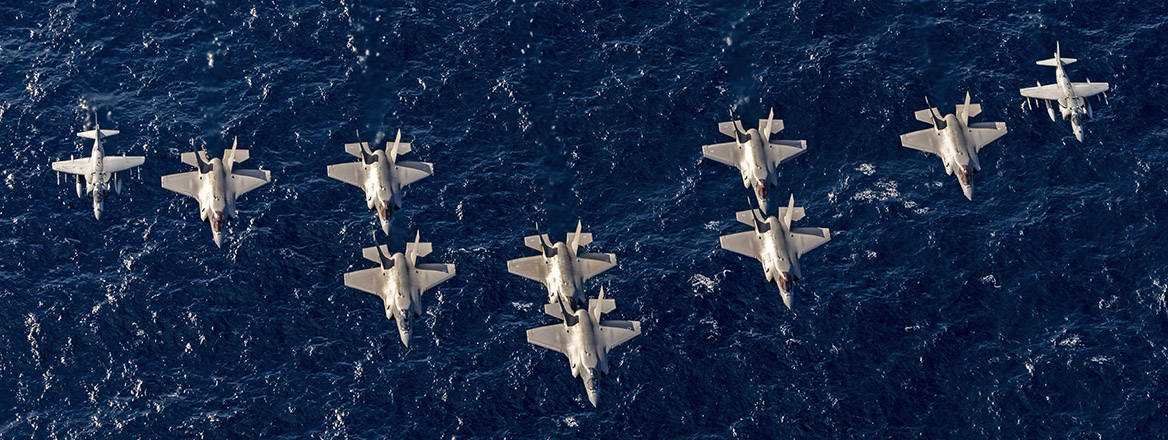
The acquisition of glide bombs for the F-35B is a welcome and overdue way to efficiently increase practical UK combat air mass in a NATO context.
The recent confirmation that the UK Ministry of Defence has approved a Foreign Military Sales purchase of the GBU-53/B Small Diameter Bomb II for the RAF/RN F-35B Lightning Force is excellent (and long overdue) news. To date the Lightning Force has operated the most sophisticated strike fighter in the world, designed for operations against the most potent adversary air defence systems, without a suitable strike weapon. At present, UK F-35Bs can only use the Paveway IV – a free-fall laser and GPS guided precision bomb – which lacks the range to be useful against any serious air defence threat, even when used from a stealthy F-35. The MBDA SPEAR stand-off miniature cruise missile, designed for the MoD’s SPEAR 3 programme to equip the F-35B with a capable strike weapon against heavily defended targets, is years behind schedule and will now not enter service until at least the early 2030s. The first SPEAR test carriage flight in the bay of an F-35B was announced in May 2026.
In this context, the acquisition of an off-the-shelf glide bomb capability from the US, that is already cleared for use on the F-35B and that can hit moving targets from significant distances in defended airspace, is a very sensible stopgap solution. The GBU-53/B is far easier for Russian air defences to shoot down, and takes longer to travel to targets from standoff ranges compared to a powered missile like SPEAR or the US made AGM-88G AARGM-ER which is purpose-designed destruction of enemy air defences (DEAD). However, it is still a major boost to the potential lethality, tactical flexibility and survivability of UK F-35Bs against any significant threat, compared to the current Paveway IV. Perhaps the most interesting thing about the acquisition, however, is its out-sized impact on UK combat power in any serious conflict scenario.
Deploying practical firepower at useful speeds, over long ranges and against sophisticated Russian air defence systems is a major challenge for UAS and CCA developers
In effect, the acquisition of a stockpile of GBU-53/B glide bombs will take the number of useful weapons that each British F-35B can deliver in a sortie against any serious ground-based air defence threat from zero to eight. It will take the number of strike weapon options for heavily defended targets for the F-35B fleet as a whole from zero to one. Yet this decision has taken the better part of a decade since the first F-35Bs arrived at RAF Marham in 2018. There is no public information on the size or value of the UK FMS order for GBU-53/B, but a Norwegian order for 580 of the bombs, plus training, support and logistics materials to enable their use on F-35A was valued at up to $293 million in 2023 (around £220 million). In the context of the tens of billions of pounds spent every year on Defence in the UK, the level of expense required to transform the effective combat mass that the F-35B Force could contribute to any serious NATO conflict is tiny.
The need to rapidly increase UK and wider NATO combat mass is a common refrain at Defence conferences, in policy speeches by senior military and political leaders, and in Defence strategy documents such as the 2025 Strategic Defence Review. Where they reference the Air Domain, such statements are usually made specifically in reference to ambitious but loosely defined uncrewed air systems (UAS) or collaborative combat aircraft (CCA) development programmes. However, deploying practical firepower at useful speeds, over long ranges and against sophisticated Russian air defence systems is a major challenge for UAS and CCA developers. It is also one that is getting harder as Russian air defences adapt over time in their daily contest against the rapidly iterating Ukrainian long range drone strike campaign.

Ukraine and Russia both rely on launching waves of between 250 and 500 one-way attack drones per night for their respective long range strike campaigns. The vast majority of these are shot down by a mix of affordable short-range anti-aircraft guns, drone interceptors, helicopter and fixed wing interceptors, and a few by surface-to-air missile systems. Only a small fraction make it through to their targets, and of those a far smaller proportion cause critical damage to military or industrial targets. Only oil and gas infrastructure is flammable and fragile enough to regularly cause spectacular results with light warheads, and widespread enough to be difficult to protect with layered defences.
Despite this, the bill for such ‘cheap mass’ is huge; with one-way attack drones starting at around $25,000 for the most simple propeller powered explosive carriers to well over $150,000 for each one with electronic warfare or communications payload modules or jet propulsion units. A single wave of 500 of such weapons against one target facility can easily cost over $35 million in drones alone – as much as a salvo of high-end cruise missiles like JASSM or DEAD munitions like AGM-88G or RAMPAGE, with far more capable warheads and survivability against defences. Furthermore, launching such waves requires thousands of personnel to transport hundreds of drones to launch points each night, prepare them for launch; plan and programme mission data; protect launch areas with air defences and electronic warfare equipment, and work in logistics support well behind the lines. Western industry, pay and benefits standards and procurement processes would ensure NATO equivalents would cost significantly more to field, especially given that the force elements, doctrine, logistics and mission support equipment to do so will have to be developed, procured and fielded from scratch.


On the upper end of the scale, the RAF, Luftwaffe, Armee de l’Air et de l’Espace and most other medium-sized air forces in Europe are examining increasing combat air mass through developing and procuring CCAs or uncrewed combat aerial vehicles (UCAVs) that will be significantly cheaper to purchase and operate than traditional fast jets. However, as with the UK’s F-35B fleet, the biggest constraint on the practical combat mass of European air power (and thus, the most theoretically lethal and responsive element of European military power as a whole) is not the number of jets. It is inadequate quantities and types of air-launched weapons. Typhoon, for instance, can launch long range Storm Shadow cruise missiles from outside the range of threat systems, but these are scarce weapons only suitable for hitting fixed targets like bunkers and command centres. Just like the F-35B force, the RAF Typhoon force has no air to ground strike options that would be suitable for striking battlefield or Russian air defence targets from viable stand-off ranges. It is limited to the short range Paveway IV and Brimstone, and has limited available stocks of the long range Meteor air-to-air missile. Put simply, if the RAF and other European air forces find themselves at war with Russia over aggression against a NATO member state in the coming years then they will run out of weapons suitable for use against Russian ground based air defences, and glide bomb launching Su-34s bombarding forward ground troops, long before they run short of aircraft or pilots. Efforts to increase combat mass, therefore, should start by trying to address weapon shortfalls rather than platform ones.
What Europe lacks in terms of combat power is not numbers of aircraft (or even tanks or ships). What it lacks are munitions stocks of sufficient depth and types for combating Russia’s most significant capabilities for a NATO self-defence scenario
Fielding UCAVs and CCAs will not help solve this combat mass problem – and in fact may make it worse if they take funding away from potential purchases of air launched weapons for existing fast jets. UCAVs and CCAs fundamentally offer a way to put either more launch rails with weapons or sensors to guide weapons closer to adversary systems for a given level of risk, compared to crewed combat aircraft. In time, they also may be able to do this at scale in a theoretically cheaper fleet than crewed combat aircraft.
However, Europe already fields well over a thousand modern advanced fourth and fifth generation combat aircraft. Broadly speaking, their capabilities as aircraft and as sensors are sufficient to effectively combat Russia’s ground-based air defences and air power. NATO doctrine and pilot training is also still excellent compared to Russian equivalents. What Europe lacks in terms of combat power is not numbers of aircraft (or even tanks or ships). What it lacks are munitions stocks of sufficient depth and types for combating Russia’s most significant capabilities for a NATO self-defence scenario. Fixing this is expensive, but it is far cheaper than trying to build a range of uncrewed CCA and UCAV types, which will themselves also need stockpiles of air-launched weapons to be effective. Instead, European air forces should focus first on properly arming (and passive protection measures for) the jets that we already have. Doing this is fastest way to increase practical combat mass in a NATO self-defence context.
© RUSI, 2026.
The views expressed in this Commentary are the author's, and do not represent those of RUSI or any other institution.
For terms of use, see Website Terms and Conditions of Use.
Have an idea for a Commentary you'd like to write for us? Send a short pitch to commentaries@rusi.org and we'll get back to you if it fits into our research interests. View full guidelines for contributors.
WRITTEN BY
Justin Bronk
Senior Research Fellow, Airpower & Technology
Military Sciences


- Jim McLeanMedia Relations Manager+44 (0)7917 373 069JimMc@rusi.org