

Operation Rummy: Franco-British Nuclear Cooperation Strengthens European Deterrence

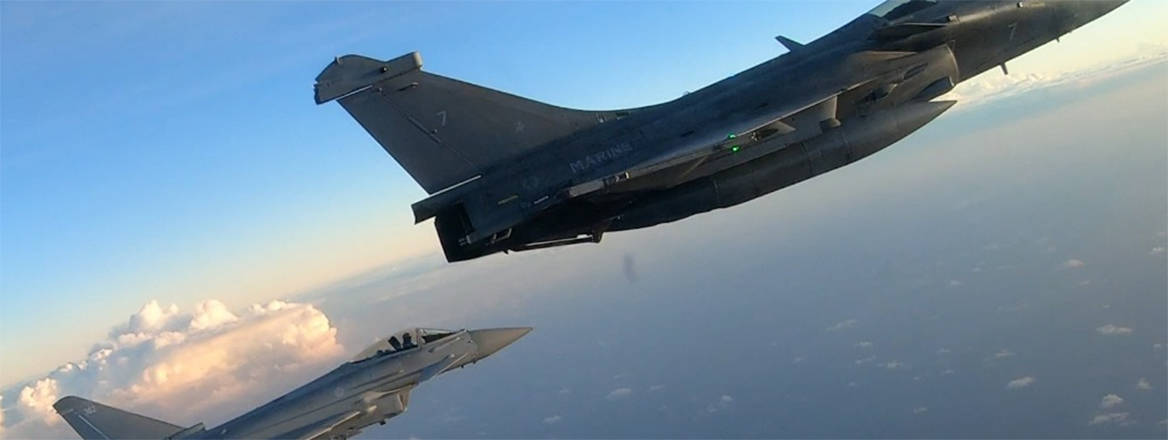
Operation Rummy, the first joint Franco-British nuclear air exercise, deepens bilateral deterrence and offers a template for wider European nuclear cooperation.
On 20–21 October, the Royal Air Force and France’s Strategic Air Forces (Forces aériennes stratégiques, or FAS) conducted a joint nuclear exercise, marking a noteworthy advance in Franco-British cooperation on nuclear deterrence. The mission – dubbed Operation Rummy – saw British Eurofighter Typhoons escort French Rafales from the Saint-Dizier airbase in northeastern France to the Mediterranean Sea for a simulated long-range nuclear strike mission. The exercise was a step forward in the operationalisation of the 2025 Northwood Declaration, under which France and the UK committed to closer nuclear cooperation and coordination. It has also had the benefit of allowing the UK and France to signal their respective and joint commitments to European nuclear deterrence more broadly – which has thus far posed some challenges. The next step will be figuring out how to bring the various nuclear cooperation efforts underway in Europe together, so as to maximise their effectiveness and clarity.
Benefits to Bilateral Nuclear Cooperation
Operation Rummy follows earlier attendance by British officials at France’s Operation Poker nuclear exercise in December 2025. The active participation of British aircraft this time around is a valuable – and much awaited among the expert community – demonstration of the French and British intent to use the Northwood Declaration for meaningful engagement, not just political signalling.
The joint exercise reinforces a sense of shared British and French threat perception and signals – to adversaries as well as allies – a progressively advanced level of strategic and operational coordination on nuclear matters between the two countries. In a real-world scenario, escorting a French nuclear strike would implicate the UK as a key enabler for the attack, thereby making it a target for retaliation. By playing out such a contribution in training, London has therefore demonstrated an ability – as well as a potential willingness – to serve in such an enabler role and to bear the associated risks. In fact, British Typhoons could make an important contribution to a French nuclear operation in what the French call an épaulement (conventional support) role, given their particular suitability to Defensive Counter Air operations.
Considering that France holds sacred the independence and self-sufficiency of its nuclear deterrent, it remains unclear to what extent the FAS would be willing to rely on foreign enablers for a real-world nuclear mission, or just how far Paris would be willing to take cooperation in practice. However, Operation Rummy is an encouraging indicator of a broader willingness in both Paris and London to think ambitiously about possible avenues for a further expansion of Franco-British nuclear collaboration and cooperation. This could – in theory – take a variety of forms, including more complex joint exercises or even eventual joint nuclear planning and targeting (though the latter remains a remote prospect for the time being).
A desire to avoid the perception that forward deterrence might compete with US extended deterrence by replicating NATO-style nuclear coordination outside of NATO structures will also limit France’s ability to bring the various bilateral conversations together, limiting the effectiveness and ambitions of the initiative
For the UK, closer engagement between the RAF and the FAS also presents valuable learning opportunities as the RAF gets ready to return to a nuclear role with NATO’s DCA (dual-capable aircraft) mission. Unlike the FAS – which carry sovereign French nuclear weapons – the RAF would be delivering American B61 bombs as part of a wider NATO mission, commanded by SACEUR (Supreme Allied Commander Europe). As such, the two air forces’ nuclear roles will be very different. Nevertheless, there is room for meaningful exchange on a range of matters, including effective force management to account for both conventional and nuclear mission requirements, as well as considerations relating to personnel training and broader cultural aspects necessary for effective nuclear mission delivery. Should the UK decide to eventually consider a return to a sovereign air-launched capability (for now, still an academic discussion), experience gained through engagement with the FAS will become even more relevant.
The Bigger European Picture
More broadly, Operation Rummy – and any future joint Franco-British nuclear exercises – point to new opportunities for both France and the UK to strengthen their contributions to European nuclear deterrence.
In the last several months, France has held a number of bilateral nuclear steering groups with partners who have joined its ‘forward deterrence’ initiative. The initiative – announced by President Macron in March – is aimed at making more tangible the ‘European dimension’ of France’s ‘vital interests’, which guide the Élysée’s nuclear decision-making. However, thus far, French engagement with allies has largely been limited to bilateral meetings – with the exception of a joint drill flown by the FAS and the German Luftwaffe over Germany in July. Germany was also due to take part in Operation Poker in the autumn, though there has been no public reporting of German involvement in the latest iteration of the exercise in September.
Certain aspects of French nuclear posture – including the sanctity of the independence of the French nuclear deterrent and France’s absence from NATO’s Nuclear Planning Group (NPG) – complicate efforts at closer practical collaboration with partners. A desire to avoid the perception that forward deterrence might compete with US extended deterrence by replicating NATO-style nuclear coordination outside of NATO structures will also limit France’s ability to bring the various bilateral conversations together, limiting the effectiveness and ambitions of the initiative. These and other challenges risk leaving French forward deterrence partners increasingly frustrated over the lack of meaningful engagement and risk creating a disjointed and confused approach to nuclear deterrence in Europe.
Critically, it also demonstrates the UK’s capacity to engage in meaningful nuclear cooperation – at both a strategic and operational level – with NATO Allies, independent of its relationship with the US
The UK faces a different set of challenges when it comes to clearly and credibly signposting the role of its nuclear deterrent in the security of European allies. First, the UK’s nuclear deterrent is closely linked to that of the US, as the Trident D5 missiles that carry the UK’s nuclear warheads are leased from a shared UK–US pool. This has led to concerns by some over potential vulnerabilities that could arise in the credibility of the UK deterrent should the US’ relationship with the UK or NATO sour further. Furthermore, the UK’s nuclear forces – unlike those of France – are assigned to the defence of NATO, which remains the primary venue for UK engagement with allies on nuclear issues. In a shifting European security environment, that may no longer be sufficient. However, bilateral engagements on nuclear matters outside of the NATO architecture could introduce confusion into alliance signalling or planning, if not managed carefully. Finally, SSBNs (nuclear-powered ballistic missile submarines) are simply not as well suited as a fleet of Rafales – or any other aircraft, for that matter – for clear alliance signalling. While the latter can be forward-deployed or engage in highly visible joint exercises, the effectiveness of SSBNs is predicated first and foremost on their stealth, making it somewhat more challenging (though certainly not impossible) to use them for nuclear signalling to allies or adversaries.
Franco-British nuclear cooperation – particularly through joint exercises – presents opportunities for both France and the UK to overcome some of these challenges. For France, Operation Rummy – alongside earlier British attendance at Operation Poker and the joint FAS–Luftwaffe sortie – serves as an example of what is possible with other partners under forward deterrence, and helps demonstrate France’s commitment to meaningfully operationalising the initiative with partners. For the UK, participation in joint nuclear air exercises with France allows it to signal British commitment to European nuclear deterrence more easily than would otherwise be possible with SSBNs. Critically, it also demonstrates the UK’s capacity to engage in meaningful nuclear cooperation – at both a strategic and operational level – with NATO Allies, independent of its relationship with the US. At the same time, the UK is currently uniquely positioned – as a nuclear peer and having flown in a simulated nuclear strike mission with the FAS – to serve as a conduit between French and NATO nuclear planning. France is highly unlikely to join the NPG or to take part in Steadfast Noon (NATO’s nuclear training exercise) anytime soon; however, the UK – and hopefully other allies in the future – can use their experience of flying in French nuclear exercises to inform NATO’s nuclear planning and training, and vice versa.

Next Play
The challenge now will be to maintain momentum when it comes to meaningful nuclear cooperation under the Northwood Declaration and, for France, its forward deterrence initiative. As perhaps the most obvious next step, France could consider involving the RAF in Operation Poker, which would facilitate a more expansive exchange on strategic and operational matters. At the same time, looking for opportunities to get more forward deterrence partners flying with the FAS – initially in conventional, and hopefully eventually in nuclear, training missions – should also be (and likely already is) a priority.
One way to maximise the effectiveness of any future joint training missions would be to conduct these operations on a trilateral, rather than a bilateral, basis – with France, the UK and non-nuclear allies taking part together. This could include, for example, simultaneously involving Germany and the UK in a future iteration of Operation Poker. Such an approach would have the benefit of ensuring greater coherence in efforts to strengthen European nuclear deterrence and in British, French and broader European nuclear signalling, while still remaining conscious of concerns over duplication with NATO nuclear deterrence arrangements. Combining allies’ participation in joint training missions would also allow the leveraging of a more diverse set of capabilities in a single exercise. It would likely also be less resource intensive than a series of bilateral engagements. Aligning the timings of Steadfast Noon with one of these bilateral/trilateral exercises (where allies’ resources allow) with Operation Poker – as has been suggested elsewhere – could further reinforce the ability to coordinate NATO and French nuclear operations, while maintaining the clear independence and self-sufficiency of multiple decision-making centres.
Operation Rummy was a welcome public display of the progress being made behind closed doors on strengthened Franco-British nuclear cooperation. It is also a clear demonstration of how bilateral cooperation between Europe’s two nuclear powers strengthens the credibility of their respective deterrents, as well as of European nuclear deterrence in the round. Finding ways of maintaining momentum on these efforts – and bringing them together, where possible – will be key to making clear both to allies and to adversaries that French and British nuclear commitments to Europe are anything but a bluff.
© RUSI, 2026.
The views expressed in this Commentary are the author's, and do not represent those of RUSI or any other institution.
For terms of use, see Website Terms and Conditions of Use.
Have an idea for a Commentary you'd like to write for us? Send a short pitch to commentaries@rusi.org and we'll get back to you if it fits into our research interests. View full guidelines for contributors.
WRITTEN BY
Darya Dolzikova
Senior Research Fellow
Proliferation and Nuclear Policy


- Jim McLeanMedia Relations Manager+44 (0)7917 373 069JimMc@rusi.org