

‘No Good Answer’: Who Would Defend a United Ireland?

Northern Ireland is NATO territory. Irish unification would remove it from the Alliance – and neither London nor Dublin has planned for the defence consequences.
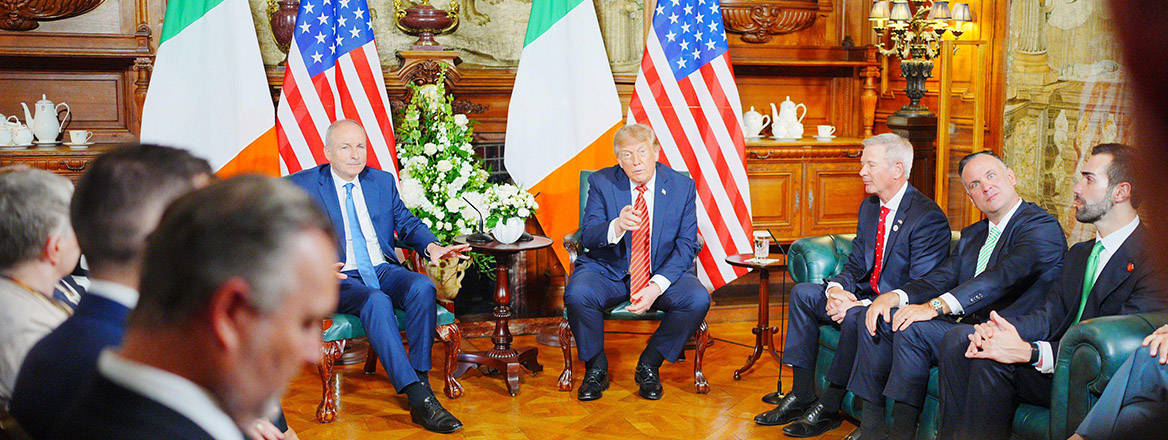
Asked in Dublin on 12 September whether he favoured Irish unification, the US President Donald Trump replied that it would be ‘a very cool thing, to be honest with you’, and that ‘no matter what you say, no matter how well you say it, there's no good answer’. He was more right than he can have intended. On the constitutional question there are several answers, all of them contested. On the defence question there is no answer at all, because nobody has done the work.
Formally, nothing has changed. Washington's position remains anchored in the Good Friday Agreement, and the statutory test in Schedule 1 of the Northern Ireland Act 1998 – that it appear likely to the secretary of state that a majority would vote to leave – is not met and not close: the most recent Northern Irish polling shows 35.8% for leaving the Union against 49.7% for remaining. The prime minister will say no to any poll, and for the moment he has the better of it.
Trump had earlier met President Connolly, whom he pronounced ‘terrific’. The presidency is ceremonial and Connolly sets no defence policy; but she was elected in October on 63.4% of first preferences, the largest mandate the office has recorded, having campaigned for unification while calling NATO's role ‘warmongering’ and opposing European militarisation. On Irish unity the two presidents are agreed. It is very nearly the only thing they agree about, and it is the one that would remove territory from the Alliance's treaty area.
None of which is an argument for the absence of British staff work on what a transfer of sovereignty would involve. Planning assumptions are made years before the events they anticipate, and on the Irish question there appear to be none.
What NATO Would Lose
This matters because Northern Ireland is currently NATO territory, falling within the Article 6 Treaty area for the sole reason that it remains within the Union. Were that to change, the Alliance’s treaty area would contract for only the second time in 77 years. The first occasion was Algerian independence in 1962, an Alliance dilemma which was handled largely by being ignored. The Treaty was never amended; the ‘Algerian Departments of France’ remain in Article 6 to this day; the North Atlantic Council simply declared, in January 1963, that the provision had become inapplicable from the date of independence. That is thin precedent, and it was available only because nothing of consequence depended on it.
Much would depend on the Irish case. The UK continues to underwrite its western approaches through Ireland. RAF quick reaction alert covers Irish airspace under an arrangement struck in 1952, updated after 9/11 to cover renegade civilian aircraft, and not publicly acknowledged until a parliamentary answer in 2022. There is no published legal basis for the arrangement, and it has been challenged in the Irish High Court on constitutional grounds. National security in Northern Ireland, meanwhile, is reserved to Westminster and discharged by the Security Service – functions which cannot be transferred by simple declaration or renaming.
The state which would inherit the defence responsibilities of the island of Ireland, its waters and skies, cannot presently discharge the limited responsibilities it already has.
The figures deserve setting out plainly, because they are habitually softened. The Defence Forces stood at 7,756 at the end of 2025 against an establishment of 9,739. The Naval Service has eight hulls, can crew only four, and by September of this year had two vessels deployable – none of them fitted with air search radar. The Air Corps has no combat aircraft, and no interceptors. The state has no primary radar, which is to say no independent means of knowing what is in Irish airspace: a pilot landing in Dublin reported a large drone around 10 miles off Howth on 8 September, and air traffic control had no radar return on the object at all. Ground-based air defence consists of six systems with a maximum engagement range of 9 km. Defence spending runs at some €1.2 billion per year, the smallest share of GNI* (modified gross national income) in the entire EU.
None of this is to reflect on the Defence Forces themselves, whose record in UN and European operations – UNIFIL (UN Interim Force in Lebanon) above all, and continuously since 1978 – is out of all proportion to their size. Rather, the present issues are the accumulation of 70 years of political choices about what to ask of those fine men and women.
The consequences stopped being hypothetical some time ago – in December 2025, four ‘military-style’ drones breached the no-fly zone during President Zelenskyy’s visit to Dublin. In February, the Defence Forces informed An Garda Síochána, the Irish police, that they could not provide counter-drone security for various meetings of Ireland’s forthcoming Presidency of the Council of the EU. The attempt was then made to train Irish soldiers how to bring down drones with shotguns.
What followed ought to command the attention of British and European defence analysts. On 28 June, three days before Ireland assumed the EU Presidency, a French multipurpose frigate with transponders switched off manoeuvred in the Irish Sea 22 km off Howth, carrying air defence radar and up to 32 anti-aircraft missiles. It remained outside of Irish territorial waters, with two Irish vessels operating nearby. The French crews had to be issued with Irish tactical radios, as the Defence Forces do not hold NATO-standard communications equipment. In early September a Royal Navy Type 23 and a Merlin provided air defence for a meeting of EU foreign and defence ministers in Wicklow, remaining 14 miles offshore for the same reason. Quite what the legal issues are remains unsettled: the attorney general was asked to advise on the constitutionality of foreign militaries operating in Irish waters and on Irish territory, which is a question most states settle before the ships arrive, rather than after.

Foreign Policy called Ireland ‘literally defenceless’ in June, and ‘becoming a French military protectorate’. The characterisation is unfair to an army and unanswerable about a state: it is not that the Defence Forces will not defend, but that they have never been equipped to.
Dublin is moving, slowly. A €60 million Thales contract for towed sonar arrays, a €1.7 billion five-year investment plan, an establishment target of 11,500 personnel by 2028, primary radar and combat aircraft acquisitions in the pipeline. Set against procurement lead times of a decade, however, the honest reading of that programme is that Ireland is now buying, at considerable expense, the ability to do for itself what the UK has been doing for it since 1952. This project will not be completed within the decade.
What Cannot be Bought
There is a trickier problem beneath the hardware which is persistently avoided. Capability can be purchased; intelligence networks and institutions cannot. Northern Ireland-related counterterrorism accounted for around 16% of the Security Service’s resources in 2024, and there is no Irish body waiting to inherit that burden. An Garda Síochána’s Crime and Security Branch is not a security service, and has never been asked to become one. A new Irish service would be establishing itself at precisely the moment that its caseload would be heaviest and most politically charged, since the organisations of most immediate concern would be those whose entire express purpose was the Union which had just been dissolved. Human sources, moreover, are recruited by particular services and run by particular handlers. They do not easily transfer with sovereignty, and a change of flag is more likely to collapse Northern Ireland-related networks than to bequeath them. The Patten transition offers a sobering precedent: a far smaller reform of a single police service took years to settle, and the PSNI (Police Service of Northern Ireland) has never since reached the strengths which the reform recommended. It stood at only 6,190 officers last October, against Patten’s 7,500.

Place the two halves side by side and the severity of the problem is plain. Unification would extend an Irish air policing obligation over the airspace of the North, while leaving the Republic reliant on the air force of the state it had just supplanted there. It would require an Irish successor to an intelligence function which has no Irish counterpart and cannot be reasonably established inside a transition period. It would remove from the Alliance’s treaty area a territory whose security NATO has never had to seriously contemplate losing, on the strength of a single 64-year-old precedent which worked because little depended on it.
None of this is an argument about whether the border poll should happen, or how anybody should vote in it. The questions are identical whichever way one would vote, and they are questions a serious unification project should want answered rather than fear being asked. On the present evidence, neither government is doing much of anything at all – and the whole cost of that unpreparedness will fall on whichever of them is surprised in the event.
© Philip Hamilton, 2026, published by RUSI with permission of the author.
The views expressed in this Commentary are the author's, and do not represent those of RUSI or any other institution.
For terms of use, see Website Terms and Conditions of Use.
Have an idea for a Commentary you'd like to write for us? Send a short pitch to commentaries@rusi.org and we'll get back to you if it fits into our research interests. View full guidelines for contributors.
WRITTEN BY
Philip Hamilton
Guest Contributor


- Jim McLeanMedia Relations Manager+44 (0)7917 373 069JimMc@rusi.org